Newsletters
November 2014 - Profile Rock, Beaked Hazelnut, Monarchs
WELCOME TO GREEN FUTURES !
NOVEMBER, 2014
“Climb up some hill at sunrise. Everybody needs perspective once in awhile, and you'll find it there.
-Robb Sagendorph
“We do not understand that it is also vandalism wantonly to destroy or permit destruction of what is beautiful in nature, whether it be a cliff, a forest, or a species of mammal or bird.”
-Theodore Roosevelt
TRASHING JOSHUA'S MOUNTAIN – DCR protecting, promoting and enhancing our commonwealth of natural, cultural and recreational resources.Not quite!
Joshua's Mountain is a small hill on the relatively flat coastal plain in southeastern Massachusetts. It was created by glaciers depositing large granite boulders carried from the northwest and left behind as the glaciers melted away.
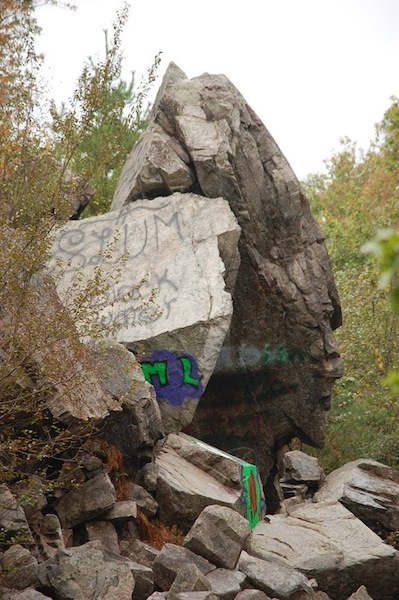
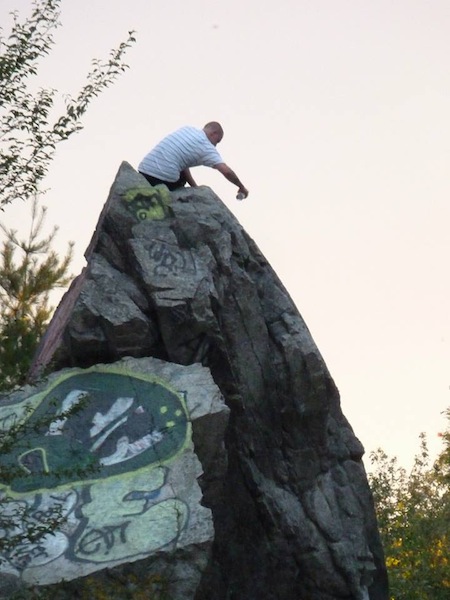
On the northeast side of Joshua's Mountain is a rock which when viewed from a distance resembles a profile of an old man's face. When viewed from its opposite side, the view changes the profile to that of a colonial farmer.
Joshua's Mountain and its rock with a profile, Profile Rock, were created thousands of years ago, but today, fully formed, they reside within the Freetown State Forest, a part of the greater Southeastern Massachusetts Bioreserve.
The state forest portion of the Southeastern Massachusetts Bioreserve, rich in natural and cultural diversity is unfortunately under the jurisdiction and management of the Massachusetts Department of Conservation and Recreation (DCR).
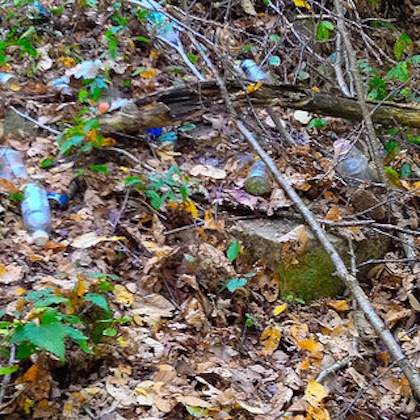
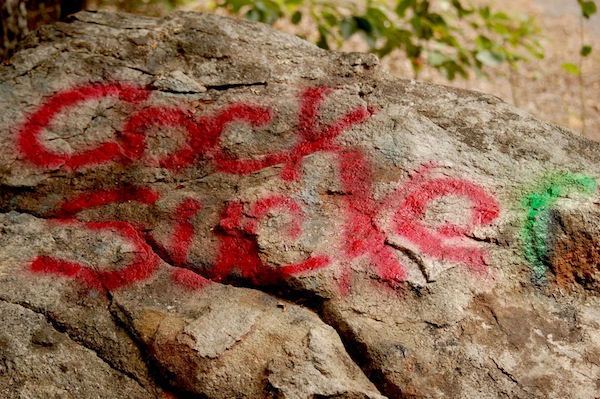
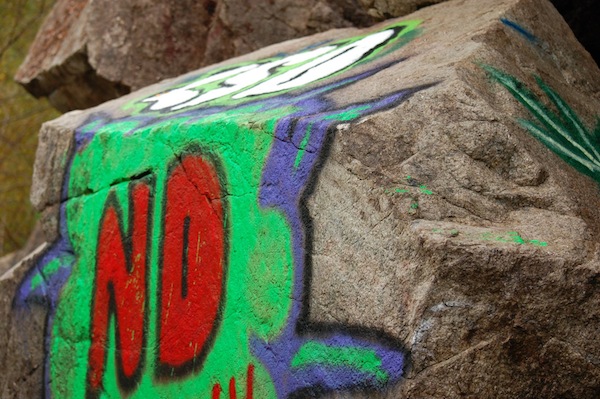
Like much of the rest of the forest, Joshua's Mountain receives little attention although some efforts have been made, recently, in cleaning up the area and improving the general appearance of the parking and viewing area. Unfortunately, the efforts are too little and not sustained. Paint vandalism, trash, cigarette butts, beer and “nip” bottles litter the summit as well as the woods at the base of the hill.
DCR Regulation 304-12.05 prohibits alcoholic beverages on DCR property. Other regulations forbid dumping trash on the property, lighting fires, spray painting the rocks and trees, damaging state property, etc. Are any of these laws, rules and regulations enforced? Check out the photos, below, for the answer.
We don't see problems of this magnitude on adjacent Bioreserve parcels managed by the City of Fall River's Water Department or on The Trustees of Reservations' property at the southern edge of the Bioreserve.
There are over a million people within 50 miles of the Bioreserve. There will always be some degree of vandalism, littering/trash dumping, trespass on ecologically sensitive areas and other inappropriate activity. It has to be dealt with promptly and those destroying and/or vandalizing our land have to be apprehended, charged and prosecuted. What DCR has allowed to happen on and to our land, under their care, is a tragedy.
LEAVING WILDERNESS ALONE – More on the 50th Anniversary of the Wilderness Act
In last month's newsletter we wished the Wilderness Act a “Happy 50th Birthday!” The Wilderness Act was signed into law by President Lyndon Johnson in 1964.
One of the individuals actively advocating for passage was David Brower, at the time the chief executive director of the Sierra Club. Brower was one of the most inspiring environmental advocates of the mid to late twentieth century.
Author Kenneth Brower, one of David's sons, has written an excellent article on present threats to the Wilderness Act. You can read it here: http://www.outsideonline.com/outdoor-adventure/nature/Leave-Wilderness-Alone.html
For more on David Brower: http://en.wikipedia.org/wiki/David_Brower
BIORESERVE FLORA OF THE MONTH – Beaked Hazelnut (Corylus cornuta)
In our September, 2014, Newsletter our “Bioreserve Flora of the Month” was the American hazelnut. Since that article appeared we've received a few queries from woodland hikers on the difference between the American hazelnut and the beaked hazelnut. Some were familiar with one, but not with the other.
For the September American hazelnut article, go here: http://gf.gareworks.com/?content=bevoad8gcgcCVG8a
The beaked hazelnut like the American hazelnut is a shrub, not a tree. It has a more restricted range than the latter growing in open woodlands and forest edges from Georgia up the Appalachians to Canada's Maritime Provinces. From the Maritimes west in the states and provinces along the United States/Canadian border, then northwest through the middle of Manitoba, Saskatchewan and Alberta. The beaked hazelnut is also found along the west coast from southern British Columbia, south through western Washington, Oregon and northern California and the northern section of the Sierras.
In our area the beaked hazelnuts are rarer than the American hazelnut and prefer growing in drier upland soils than the American.
Beaked hazelnut shrubs grow to a height of eight to twelve feet. They sprout readily from rhizomes (root-like underground stems that have buds and roots). Under ideal growing conditions dense thickets of multiple stems grow from these rhizomes.
The round to oval toothed leaves of beaked hazelnuts are shiny green and very similar, although usually more oval, than American hazelnut leaves.
Hazelnut flowers are catkins (hanging, scaly flower spikes, without petals). Hazelnut catkins appear and grow in the fall, remain dormant over winter, expand in spring and are pollinated by the wind and small flying insects.
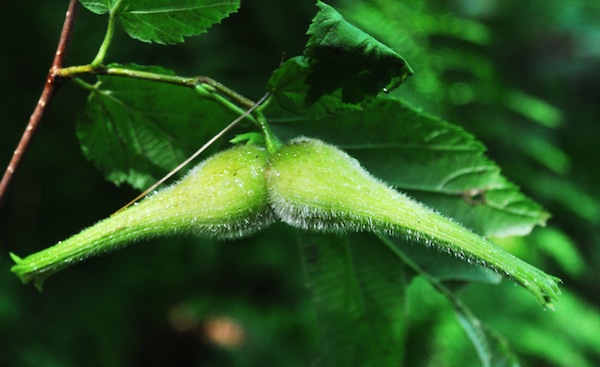
The beaked hazelnut gets its name from the shape of the husk that encloses the nut. The husk is rounded at the base and tapers to a green sheath that resembles a bird's beak. The husks are 2 to 2 ½ inches long and covered with sharp, irritating hairs which can cause discomfort to sensitive hands if the husks are handled.
The nuts are tan to brown, with a tan scar where they were attached to the husk. They are eaten by most nut and seed eating forest birds and by rodents, such as red squirrels, gray squirrels, flying squirrels, striped chipmunks and various species of forest and meadow voles and mice.
We also like to eat beaked hazelnuts. They taste similar to the commercially grown European hazelnut sold in most grocery stores and supermarkets.
BIORESERVE FAUNA OF THE MONTH – Monarch Butterfly (Danaus plexippus)
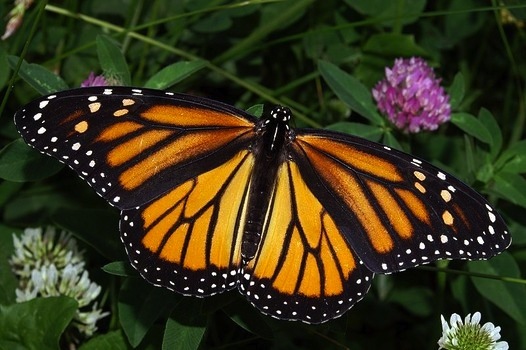
(Photo - Wikipedia Commons)
Everyone loves the black and orange monarch butterfly. Unfortunately, the monarch's reign may be ending.
How many monarchs did you see this past summer? We only saw three or four.
Monarch butterflies are unique among butterflies in undergoing massive migrations. Some North American monarchs fly over 3,000 miles each fall to reach their wintering area in the mountains of Mexico.
In past years we've watched them gather in late September and early October down at Gooseberry Island and in the dunes at Horseneck Beach. They would spend the night immobile on bayberry and other shoreline shrubs until the sun would come up over the horizon and warm and animate them. As they warmed they would exercise their wings and flock to the seaside goldenrod to fuel up. After breakfast, if the winds were favorable, they would begin to spiral up into the sky heading south-southwest over the ocean.
Unfortunately these mass monarch migrations are becoming a thing of the past. Monarchs are in trouble and their troubles have been caused by us.
Returning monarchs in the spring lay their jade green eggs, one at a time, on the underside of a milkweed leaf. Milkweed is the monarch caterpillar's sole food plant. The caterpillars are attractive, covered in a pattern of yellow, black and white stripes.
The bright and colorful patterns of both the adult butterfly and juvenile caterpillar advertise the fact that both are very bitter tasting and poisonous and so should not to be eaten. Most butterfly predators take heed and leave them alone.
After feeding for a couple of weeks, the caterpillars hang head downwards and shed their skin becoming a pupa. The hardened, protective outer layer of the pupa is called the chrysalis. It is green with a pattern of small gold dots. The adult monarch will emerge from its chrysalis in ten to fifteen days.
Many naturalists and nature enthusiasts are deeply concerned about the monarch. Every spring fewer come north and every autumn fewer head south.
Here's what we had to say about them back in April, 2014:
We are losing our monarch butterflies. Both children and adults thrill at the sight of so colorful a creature when one is encountered flitting about the garden flowers on a sunny summer day. And, we marvel that such a fragile and tiny bit of life can fly all the way to Mexico to escape our cold and snowy northern winters.
Sadly, it appears, monarchs may be going the way of the passenger pigeon, heath hen and dodo bird. How many did you see last summer? We saw very few. http://www.nytimes.com/2014/01/30/us/monarch-butterflies-falter-under-extreme-weather.html?_r=0
If you own or have access and permission to a vacant field or patch of land you might want to try scattering some milkweed seeds. Milkweed is the sole food of the monarch caterpillar. For a possible milkweed seed source, go here:http://monarchwatch.org/bring-back-the-monarchs/resources/plant-seed-suppliers
Here's the some of the latest news on our vanishing monarchs: http://news.nationalgeographic.com/news/2014/10/141010-monarch-butterfly-migration-threatened-plan/
LAST FULL MONTH OF AUTUMN - November
"The year has turned its circle,
The seasons come and go.
The harvest all is gathered in
And chilly north winds blow.
Orchards have shared their treasures,
The fields, their yellow grain,
So open wide the doorway-
Thanksgiving comes again!"
-Author unknown
Happy Thanksgiving to all!
Count your blessings and click on our Calendar to see some of what's happening outdoors in November.
<Back
Social