Newsletters
September 2014 - Fracked Gas Pipeline, Giant Leopard Moth
WELCOME TO GREEN FUTURES !
SEPTEMBER, 2014
"Sure there are dishonest men in local government. But there are dishonest men in national government too."
- Richard M. Nixon
“Politics is the art of looking for trouble, finding it everywhere, diagnosing it incorrectly and applying the wrong remedies”.
- Groucho Marx
STOP KINDER-MORGAN – Stop FERC too!
Way down here in the southeastern corner of Massachusetts many are not aware of the proposal to run a high-pressure “fracked” gas pipeline from New York through Richmond, Massachusetts, and then across the northern section of the state to a point north of Boston.
As presently proposed the pipeline path will not only run through thousands of acres of private property, but will also destroy vast swaths of public forest and park land and we will all be paying for this destruction because costs will be passed along through new charges on our utility bills.
They’re talking gas for domestic use, but some feel the reason for this push by BIG ENERGY and the Feds, to transport huge quantities of gas across Massachusetts, is mainly for big profits that can be realized by gas exporters shipping liquefied natural gas (LNG) to overseas markets.
The federal government, specifically the in-bed-with-BIG-ENERGY Federal Energy Regulatory Commission (FERC) has, no doubt, already given the green light to the Kinder-Morgan Pipeline and okayed the route it is to follow, although they are playing coy and won’t yet tell us the exact route chosen.
FERC may believe they are omnipotent, but with massive citizen outrage and key political backing FERC’s nefarious plans can be thwarted. Advocacy for our remnant public forests means we oppose any and all destructive activity on those lands.
Back in 2003 upon hearing a massive LNG import, regasification and storage facility was proposed by Hess LNG for a heavily populated, low income, economically desperate Fall River neighborhood …and said project had been okayed by FERC and …as a few nitwit local politicians brayed …“there was nothing anyone could do about it,” we formed the Coalition for Responsible Siting of LNG Facilities.
It was an eleven year battle, but we won! Yes, little “we” couldn’t actually defeat mighty FERC and a major energy company too, but we stonewalled them long enough that the economics of their project went south and their ill-conceived plan was shelved. If unfamiliar with this grass-roots battle to save our community google “Coalition for Responsible Siting of LNG Facilities” or go to gf.gareworks.com and type LNG into the “site search” box.
For up-to-date info on the ill-conceived Kinder Morgan project go here: http://www.nofrackedgasinmass.org/
Interestingly, the above site mentions our LNG fight. Here’s the mention:
INEVITABILITY & SELF-FULFILLING PROPHECY VS. COLLECTIVE ACTION & RESISTANCE
FEBRUARY 20, 2014 KATY LEAVE A COMMENT
All this talk of FERC (the Federal Energy Regulatory Commission), eminent domain, and collusion between government and industry can be a bit discouraging. My major takeaway from Peter Vickery’s interview on WRSI, however, is that what we are facing is a “collective action problem”.
As far as I know, the last time an energy company tried to put a new natural gas terminal in Massachusetts, the effort was defeated. The time was 2011, the place was Fall River (and then Mt. Hope Bay), and the company was Weaver’s Cove Energy. FERC actually issued rulings against the company.
This was a long battle, involving many parties and intervenors. Please read this Conservation Law Foundation article for inspiration. According to Weaver’s Cove’s website, they haven’t given up entirely — but remember, their website and their bluster is for their investors. (If you look closely, they haven’t updated the project’s status since 2009). Kinder Morgan may act as if the TGP Northeast Expansion is a done deal, but we are at the very beginning of this fight.
A collective action problem requires a collective action solution. That’s why we’re here.
Some background, http://www.huffingtonpost.com/lucia-greenweiskel/kinder-morgan-gas-pipeline-fracking_b_5592574.html
From CLF: http://www.clf.org/blog/clean-energy-climate-change/governors-infrastructure-plan/
STAY THE COURSE - Taking back the forest …one square foot at a time
As summer winds down the Freetown State Forest portion of the Southeastern Massachusetts Bioreserve will be losing the additional staff provided this summer by the Massachusetts Department of Conservation and Recreation (DCR) to try to get a handle on decades of poor management and neglect.
In next month’s e-newsletter we will list some of the good, bad and ugly actions that occurred in the forest this summer in the effort to take back the forest from dumpers, vandals, illegal off-road vehicle operators, obtuse bureaucrats and commercial exploiters.
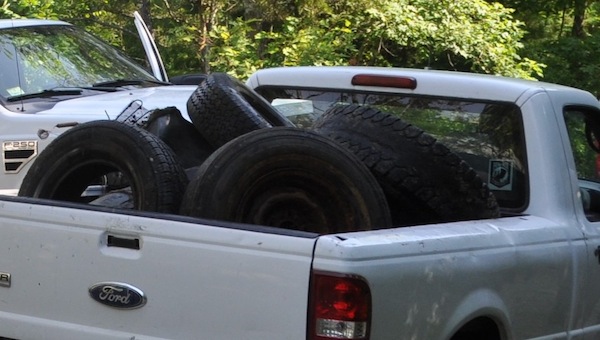
Here are some images from our latest trash cleanup at Freetown. Can you believe that this was allowed to occur? A huge “Thank You” to the volunteers, who despite delays and other inconveniences, used one of their precious Saturday mornings to help in the cleanup. Mother Nature loves ya!!!


BIORESERVE FLORA OF THE MONTH – American Hazelnut (Corylus americana)
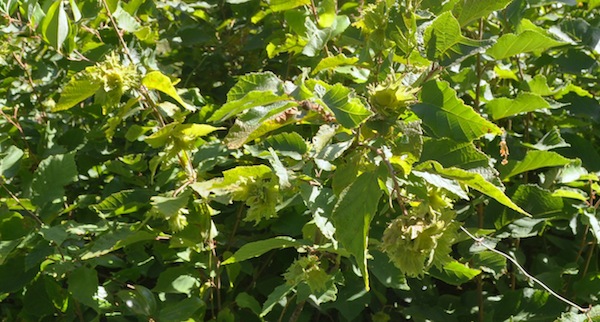
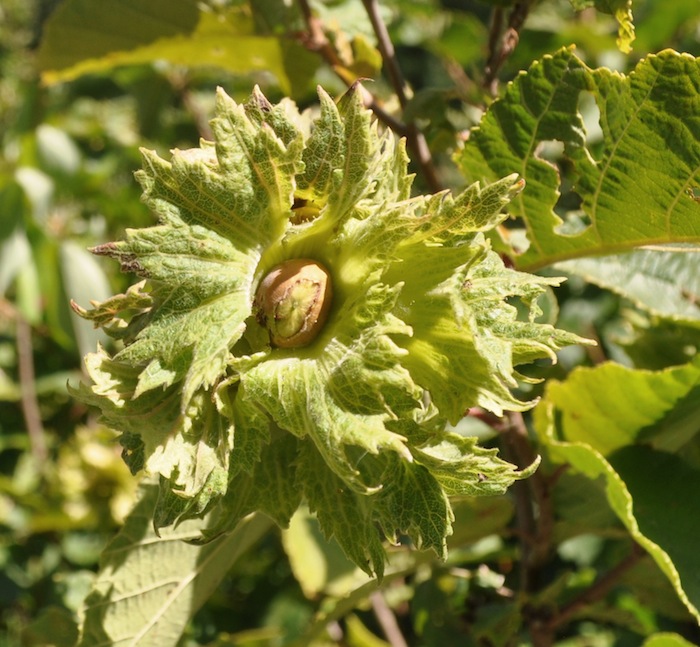
The American hazelnut is one of two hazelnut species found in the Southeastern Massachusetts Bioreserve (SMB). The other one is the beaked hazelnut.
American hazelnut is a multi-stemmed shrub that forms thickets along forest edges and in forest openings after logging or after a natural disturbance has removed the forest canopy. Hazelnut shrubs grow to a height of 15 feet and will die out if overtopped by adjacent vegetation.
Hazelnut leaves are dark green, oval, 3 to 5 inches long with doubly serrated edges. They are deciduous.
Hazelnuts are monoecious (male and female flowers on the same shrub). Early in spring male flowers appear. They are yellowish-brown catkins and up to 3 inches in length. Female flowers are inconspicuous reddish-brown catkins with bright red stigmas (the receptacle part of the flower where germination occurs). Catkins are long, cylindrical flower clusters that dangle from branches allowing wind dispersal of their pollen. Various species of willow are our most common catkin bearing shrubs locally. The catkin bearing pussy willow was “Flora of the Month” in our February 2012 Newsletter, http://gf.gareworks.com/?content=oc2d912BCj0AFQnf.
Once pollinated by the male catkins, the female flowers develop into half-inch diameter nuts which are contained in a leaf-like, tight fitting, green husk with ruffled edges. Nuts start to mature by mid-August in the SMB and are eagerly gathered by squirrels and other forest rodents. Birds that enjoy hazelnuts include wild turkeys, ruffed grouse, blue jays and many other woodland bird species. Ruffed grouse are also fond of the catkins. Hazelnut twigs, leaves and catkins are browsed by deer, moose, hare and rabbit.
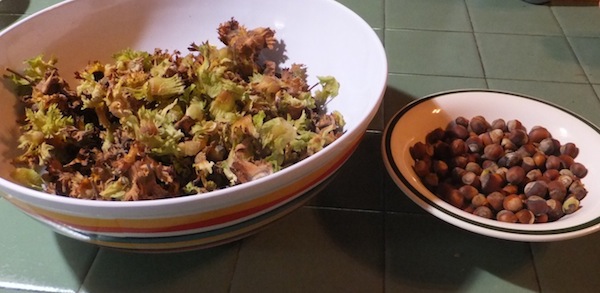
Both local hazelnut species are similar in flavor to the European hazelnut, also known as filberts, available in local supermarkets. Out in the forest, local wildlife usually devours the wild hazelnut crop immediately upon ripening making it almost impossible for humans to gather any quantity of these tasty nuts.
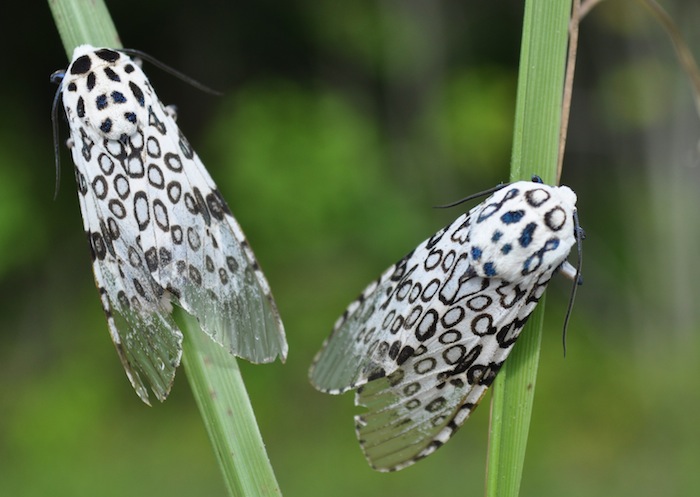
BIORESERVE FAUNA OF THE MONTH – Giant Leopard Moth (Hypercompe scribonia)
Giant leopards in the Bioreserve? You bet there are. Tigers too!
Giant leopard moths that is …and they are members of tiger moth family, the Arctiidae.
With a wingspan approaching 3 inches these large, showy moths are found along meadow/woodland edges from eastern Texas and the Mississippi Valley north to the Great Lakes and east to southern New England and down the Atlantic coast to Florida.
The giant leopard moth flies strictly at night and they, along with many other tiger moth species, have an internal sound producing organ that they use to jam the echolocation signals of foraging bats. Another defense is that if threatened or alarmed these moths give off a vile smelling liquid from thoracic glands that ward off most enemies
Adult males are on the wing throughout the summer searching for mates and females search for broad-leaf plants upon which to lay their eggs.
To attract a mate female giant leopard moths emit pheromones downwind of their location. Males pick up these airborne pheromones with their sensitive antennae and follow the pheromone trail to the receptive female. Competition is keen. First male to reach the pheromone producing female mates, later arrivals are out of luck. Shortly after mating the female lays her eggs.
The wings of this moth are white with a pattern of small black circles, spots, blotches and scribbling, hence their “leopard” name. Wings in older moths become translucent along their lower margins from a wearing away of the colored wing scales.
Their stout abdomen is black with orange markings and metallic blue spots. Their legs are banded black and white and their antennae are black.
Giant leopard moth caterpillars look very similar to the popular woolly bear caterpillar and that is because both the giant leopard moth and the adult form of the woolly bear, the Isabella moth, are both in the same tiger moth family. Giant leopard moth caterpillars are black in color with bright reddish-orange bands between body segments.
Both furry caterpillars are very “woolly,” the “wool” being sharp bristles called setae.
The Isabella Moth was our September 2013 Bio. Fauna of the Month. You can check it out here: http://gf.gareworks.com/?content=xdkruE878hjQfFR9.
After munching on violets, plantains, dandelions and other broad-leaved plants for a few weeks during the summer, the now 2 to 3 inch long caterpillars bury themselves in leaf litter in a sheltered spot on the forest floor, curl up and hibernate until spring.
In spring, with the return of warm weather, the caterpillar will form its cocoon and slowly transform into its adult form. Within a month a new generation of giant leopard moths appear. Watch for them.
AUTUMN – Knocking on the door
Wow, where did summer 2014 go?
Although summer in New England is precious, fall is a very valuable season too. Where else can one find such fantastically colored foliage bordered by roadside edges of blue asters, pink Joe-Pye weed, white Queen Anne’s lace and yellow goldenrod?
Don’t forget to stop by farm stands or farmers markets that will be full of orange pumpkins, yellow and green squash and gourds, multi-colored Indian corn, crisp and juicy apples and sparkling cider.
Ride a bike along a woodland or country road on a clear, cool and crisp autumn morning …or on a dusky, soft as velvet fall evening …with fallen leaves all about and the scent of wild grapes heavy in the air.
Make a special effort to enjoy an outdoor autumn this year because, like a precious New England summer, it won’t last long. Click on ourCalendar for some autumn things to do.
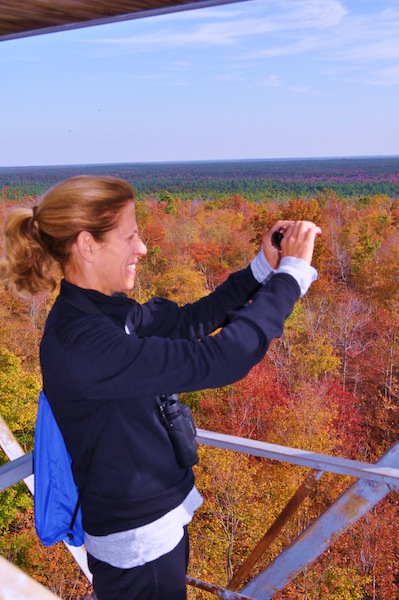
– State Representative Carole Fiola autumn leaf peeping from the Southeastern Massachusetts Bioreseve Fire Tower atop Copicut Hill.
“I cannot endure to waste anything so precious as autumnal sunshine by staying in the house."
- Nathaniel Hawthorne
<Back
Social