Newsletters
September 2013 - Swamp Azalea, Isabella Tiger Moth
WELCOME TO GREEN FUTURES !
SEPTEMBER, 2013
"In a time of universal deceit, telling the truth is a revolutionary act."
- George Orwell
God has cared for these trees, saved them from drought, disease, avalanches, and a thousand tempests and floods. But he cannot save them from fools.
-John Muir
JOHN IS RIGHT, NO LACK OF FOOLS IN HIS CALIFORNIA AND NO LACK OF THEM HERE IN MASSACHUSETTS, EITHER! –
Send a message to those mismanaging our public forest lands. If you’ve already sent one, we and the trees thank you. Get your friends and family members to send some outrage too.
Yes, this land is your land - http://gf.gareworks.com/objects/File/thisland.pdf
DISMANTLING OUR PLANET BIT BY BIT -
In light of the recent direct action against the burning of coal at local Energy Capital Partner’s Brayton Point Station (see our August 2013 newsletter - http://gf.gareworks.com/?content=1djuMK7Q7gaw8W84) check out this dramatic YouTube video on recent direct action to shut down the first U.S. tar sands open-pit mine in Utah.
https://www.youtube.com/watch?v=Yr3lwylwMn0.
On average it takes four tons of sand and soil to get one 42 gallon barrel of oil from tar sands. As with “mountain top removal” to extract coal, what is left after the oil is extracted from the earth? Answer: Destroyed land, dead wildlife, toxic sludge and polluted water.
BIORESERVE FLORA OF THE MONTH – Swamp Azalea (Rhododendron viscosum)
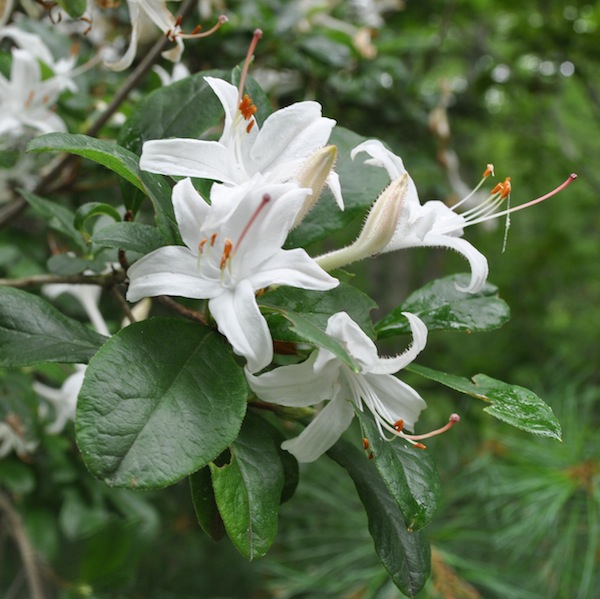
Swamp Azalea is a deciduous shrub that grows in humus-rich wooded wetlands from Maine south down the coast and west to the Appalachians to Tennessee and west to Arkansas, Oklahoma and Texas.
An alternate name for this shrub is clammy azalea because of its very sticky flowers that feel damp and clammy to the touch. These flowers are large, up to 2 inches long, with 5 spreading petals and 5 extended stamens (male fertilizing organ) ending in a long tube with a bulbous base. The flowers are bisexual. Their scent is very sweet with “tropical” spicy overtones and they are usually white, occasionally whitish-pink and rarely lavender in color. Swamp azalea blooms from early July into August.
Swamp azalea fruits are long, dry capsules filled with flat membranous seeds.
The swamp azalea is a member of the acidic soil loving heath family. Other well known heath family members in local woodlands are blueberry, cranberry, mountain laurel and rhododendron.
This azalea reaches 6 to 8 feet in height and 12 feet in width. Leaves are sparse, alternate and simple in shape a little over an inch long and dark green on both surfaces.
Some weevils and other insect species nibble on the seeds and foliage, but most forest critters leave this shrub alone. Swamp azalea leaves and flowers contain andromedotoxin in the grayanotoxin group. This toxin can cause a very rare poisonous reaction called grayanotoxin poisoning if ingested. Sniff, but don’t eat.
BIORESERVE FAUNA OF THE MOTH – Isabella Tiger Moth (Pyrrharctica Isabella)
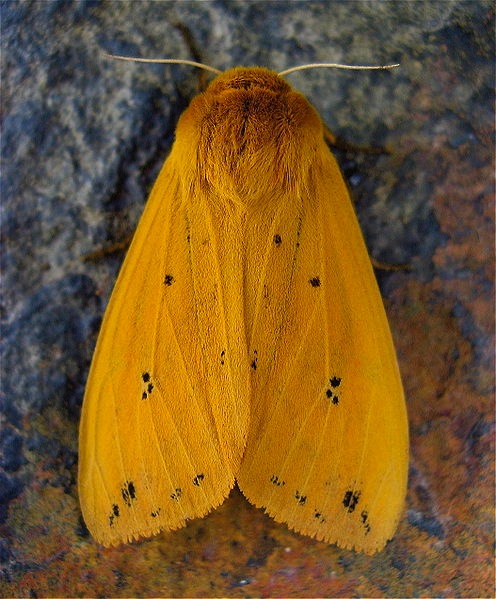
Photo – Jurvetson CC-by-2.0
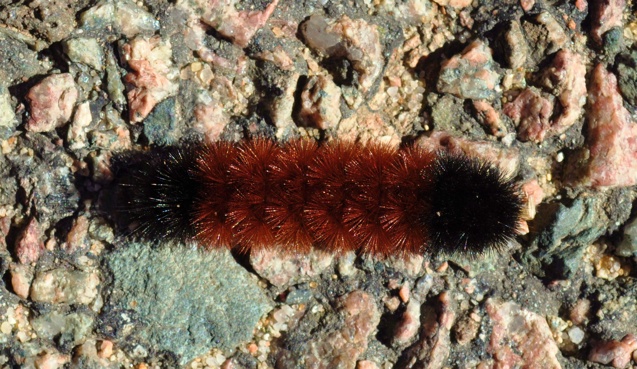
The bears are coming! As summer winds down we eagerly await the appearance of the winter weather prognosticating wooly bear.
The lovely wooly bear is the caterpillar stage of the equally lovely Isabella tiger moth. Isabella tiger moths are medium-sized, heavy bodied summer moths that fly about from June through August laying their eggs on birch, elm, maple and plants in the aster family.
Isabella moths are a pale yellow to yellow-orange in color with a very furry thorax. They have a wing span of up to two and a half inches. The wings have small black spots scattered here and there. These moths have their forewings covering their hindwings when at rest.
Isabella moth caterpillars are black at both ends and reddish-brown in the middle. The wooly bear’s thick “fur” coat is actually composed not of fur, but of setae (stiff hair like structures found on many different caterpillar species). These stiff and sharp setae protect the caterpillar from birds and other caterpillar eating critters.
For more on the wooly bear stage of the Isabella moth and their winter predicting talents, go to our October, 2009, Newsletter, here: http://gf.gareworks.com/?content=T0QnX20QCjVVuS82
STATEWIDE REQUEST – It can’t only be happening here!
We recently issued an “Info Alert” on a new website, http://massdestruction.info/. We want to document examples of gross negligence and mismanagement of our public forests, parks and reservations, anywhere in Massachusetts, that are under the care and protection of the Massachusetts Department of Conservation and Recreation (DCR).
We will be issuing periodic updates on this issue in the months ahead and sharing the results with the news media.
Please help in spreading this site, http://massdestruction.info/, across the state. Our public forests thank you!
BEST TWO MONTHS OF THE YEAR TO BE IN NEW ENGLAND – September and October!
September and October are magical times to be out roaming about area woodlands and forests and our vanishing farmland countryside. Autumn temperatures are cooler and humidity lower than during the high months of summer.
Apples, pumpkins, cranberries, Indian corn and colored leaves all surrounded by clean, crisp air are some of the things you’ll find.
This is the perfect time of the year to walk the many trails and wood roads in the Southeastern Massachusetts Bioreserve. Peak foliage season in our neck of the New England woods is usually October 15 through October 22.
For more structured fall activities, click on our Calendar.
Gathering Leaves by Robert Frost
Spades take up leaves
No better than spoons,
And bags full of leaves
Are light as balloons.
I make a great noise
Of rustling all day
Like rabbit and deer
Running away.
But the mountains I raise
Elude my embrace,
Flowing over my arms
And into my face.
I may load and unload
Again and again
Till I fill the whole shed,
And what have I then?
Next to nothing for weight,
And since they grew duller
From contact with earth,
Next to nothing for color.
Next to nothing for use.
But a crop is a crop,
And who's to say where
The harvest shall stop?
<Back
Social