Newsletters
November 2011 - Peace Haven, Cottontail, Fern, Lee Berard
WELCOME TO GREEN FUTURES !
NOVEMBER, 2011
“The public will believe anything, so long as it is not founded on truth.”
-Edith Sitwell
“It is proof of a base and low mind for one to wish to think with the masses or majority, merely because the majority is the majority. Truth does not change because it is, or is not, believed by a majority of the people.”
-Giordano Bruno
STATEWIDE TRAGIC IMPLICATIONS -
As you well know if you’ve read any of the “Action Alerts” you’ve received over the last few months …and a big “THANK YOU” to all that have read and have responded …the attack on the Massachusetts Historical Commission (MHC) began over Meditech’s refusal to safeguard the archaeological integrity of the area they wish to build on.
Unfortunately that refusal morphed into a punitive bill, Senate 2053, to strip MHC of most of its regulatory powers. If successful it will have tragic implications not only for Peace Haven, but for the entire Commonwealth.
We’ve long advocated for our shared environment and been involved in a lot of environmental campaigns over the years and cannot remember any where the project’s proponents were as mean and mendacious as they are in this one.
Meditech rancor at the MHC is uncalled for. They knew they were building on an archaeologically significant site. The propaganda from the Fall River Office of Economic Development head-cum-spokesperson for Meditech …is appalling. The one-sided reporting, by the local news media, is pathetic.
The one radio personality that dared invite an archeologist on his show, to explain the historical and archaeological significance of Peace Haven …was fired! Thankfully, station management rethought that hasty decision and he has been reinstated.
Senate Bill 2053, if passed into law, will not only sacrifice the Peace Haven site, but will apply across the state …and retroactively too! All state regulatory decisions will be in jeopardy if decisions can be challenged and then changed so easily via punitive legislation.
Any developer or business that doesn’t want to comply with a particular decision from the Massachusetts Department of Environmental Protection, Massachusetts Department of Transportation, Massachusetts Natural Heritage and Endangered Species Program, etc., etc., can just run to their senator and/or representative and demand they file a bill to “rein in” the agency whose decision they find onerous or …as in Meditech’s case …simply don’t want to follow.
Here’s an “Action Alert” the Massachusetts Archeological Society recently issued:
IMMEDIATE ACTION ALERT
ATTEMPTS TO GUT THE MASSACHUSETTS HISTORICAL COMMISSION AND YOUR CHILDREN'S HERITAGE
Senate 2053, see http://www.malegislature.gov/Bills/187/Senate/S02053, is a bill that would reduce the Massachusetts Historical Commission's (MHC) review of state projects that have an adverse effect on historic properties (buildings, districts and sites) that are in MHC's Inventory but not yet listed in the State Register of Historic Places, by permitting the project proponent to ignore MHC's recommendations for preservation or mitigation. The bill would also be retroactive to any previous project reviews that MHC has done in the past.
We need an immediate response from everyone on this issue as the bill may be heard next week. This is your children's heritage which the MHC has worked to protect since its inception. Do not let the politicians determine your heritage - let the science of anthropology and archaeology do its job!!
The bill is presently in the Joint Committee on State Administration and Regulatory Oversight. Opposition (letters, email, and phone calls) should be directed to the two chairmen and your local state senator and representative. See http://www.malegislature.gov/Committees/Joint/J25 for committee contact information. The two chairmen are Senate Chair Kenneth J. Donnelly and House Chair Peter V. Kocot. The two Vice Chairmen are Senate Vice Chair James T. Welch and House Vice Chair James M. Murphy. Senate Committee Members include: Susan C. Fargo, John F. Keenan, Michael J. Rodrigues, and Bruce E. Tarr. House Committee Members include David M. Nangle, Michael D. Brady, Jason M. Lewis, James J. Lyons Jr., Kevin Agular, Kate Hogan, Edward F. Coppinger, and Steven L. Levy
See http://www.malegislature.gov/People/Search for your local state senator and representative.
BIORESERVE FAUNA OF THE MONTH –NEW ENGLAND COTTONTAIL RABBIT (Sylvilagus transitionalis) AND EASTERN COTTONTAIL RABBIT (Sylvilagus floridanus)
The Southeastern Massachusetts Bioreserve has cottontail rabbits, but are those bunnies the native New England cottontail or are they the alien eastern cottontail …or are they both?
The New England cottontail is the rabbit that was hopping about locally when the Pilgrims landed at Plymouth Rock in 1620.
Originally ranging from eastern New York to the Atlantic coast and from southern Maine, New Hampshire and Vermont to the south shore of Rhode Island and Connecticut the New England cottontail is, today, absent from major portions of its original range.
Our New England cottontail rabbit is currently a candidate for protection under the Endangered Species Act.
The eastern cottontail is the New England cottontail’s mid-western cousin. Warier and quicker to flee at the first sign of danger the eastern cottontail is the cottontail species we are most likely to encounter darting across a road or munching on our lawn in the evening, but what is it doing here?
In the 1800s it became apparent that the New England cottontail population could not keep up with the demands placed on it from market hunters, recreational sportsmen and beagle/basset rabbit hound enthusiasts. The solution was to import more rabbits from the mid-west and all through the 1900s thousands of eastern cottontails were purchased from rural trappers in the mid-west and released throughout the New England states.
Although both the New England and eastern cottontails appear to get along, it was soon discovered that the eastern was thriving, in its new New England home …and the New England cottontail’s numbers were dwindling.
What gives the eastern cottontail a survival advantage?
Studies have shown that the eastern cottontail is quicker to detect danger than the New England species and quicker to flee.
The ability to more quickly detect danger means that the eastern can live in a more open environment and still have time to run from predators
Dependent on dense thicket habitat New England cottontails did not evolve the strategies used by the more open habitat loving eastern cottontail. Dense thickets, early successional forest, shelter New England cottontails from their enemies.
Less habitat specific eastern cottontails soon out-compete their very habitat specific New England cousins.
How can one tell which species of rabbit one is seeing? Not very easily.
It is nearly impossible to distinguish a New England cottontail from an eastern cottontail in the field. The eastern often has a white blaze on its forehead and a reddish fur patch on the nape of its neck, which the New England does not have. The New England often has a black spot between its ears and and a black edge on the front of each ear, but not always.
The eastern and New England cottontail species can more easily be identified by skull features, but that information isn’t of any value in identifying live rabbits.
The latest and best way to identify different cottontail species is by DNA analysis. Wildlife biologists extract DNA from rabbit fecal droppings to conclusively identify species.
Federal and state wildlife agencies are now working on identifying the few remaining areas that contain New England cottontails. To save the New England cottontail their habitat must be intensively managed to remain as scrub thicket and not allowed to develop into forested land where the rabbits won’t be able to survive.
Dense thickets, devoid of competing eastern cottontails, are paramount to the survival of the New England species.
Wildlife biologists working on recovery of the New England species are now eyeing small New England islands, where vegetative succession can more easily be controlled and where the eastern species is not found or can be easily eliminated, as the last best hope for survival of New England’s only native rabbit.
In our area both species of cottontail rabbit breed from mid-March to early September. The bucks, male rabbits, defend a core territory of a few acres to as many as forty acres and expend considerable time and energy in chasing rival males away.
Breeding is promiscuous. Bucks follow the does, females, closely until they find one receptive and willing to mate. On finding a willing partner the bucks and does engage in a wild zig-zagging chase with frequent quick stops. The pursued often stops and the pursuer leaps high into the air turning and landing face to face. One of the pair will then leap straight up into the air and the other will run underneath. Mating follows.
The pregnant does create a maternity nest by digging a shallow hole in a grassy area and lining it with grass, leaves and soft fur she plucks from her body. Gestation averages 28 days. Litters average six and in our area a doe may have three litters during the breeding season.
Baby cottontails, kits, are born with a very fine coat of fuzz and their eyes are closed. Eyes open one week later.
The kits stay snuggled together in the nest and the doe only visits twice a day, usually early morning and evening, to nurse her young. Kits are weaned at one month old.
Cottontail rabbits eat a wide variety of vegetation. Preferences include grasses, clovers, alfalfa, dandelions and whatever you’ve planted in your vegetable garden! During winter they feed on tender twigs, bark, buds, seeds and fallen fruit.
Many critters consider cottontails a gourmet treat. In our area this includes humans, our domestic cats and dogs, red foxes, grey foxes, coyotes, opossums, raccoons, long tailed weasels, fishers, mink, skunks, Norway rats, red tailed hawks, goshawks, red shouldered hawks, rough legged hawks, broad winged hawks, marsh hawks, barred owls, great horned owls, short eared owls, common crows, fish crows, ravens, northern king snakes and black racers.
It’s a tough life when you’re close to the bottom of the food chain.
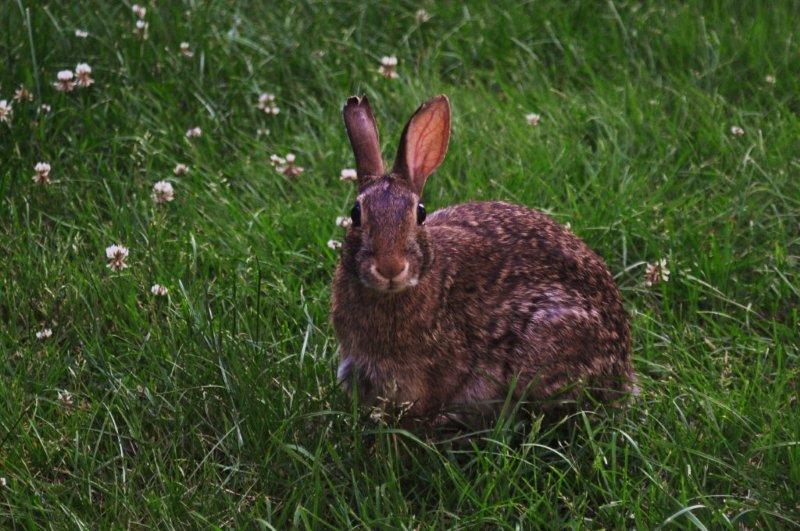
Cottontail Rabbit snacking on clover at sunset.
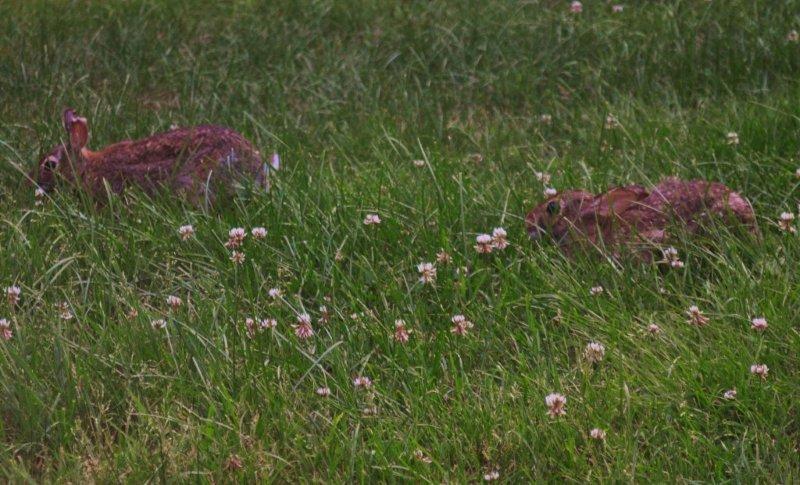
Buck cottontail sneaking up on doe.
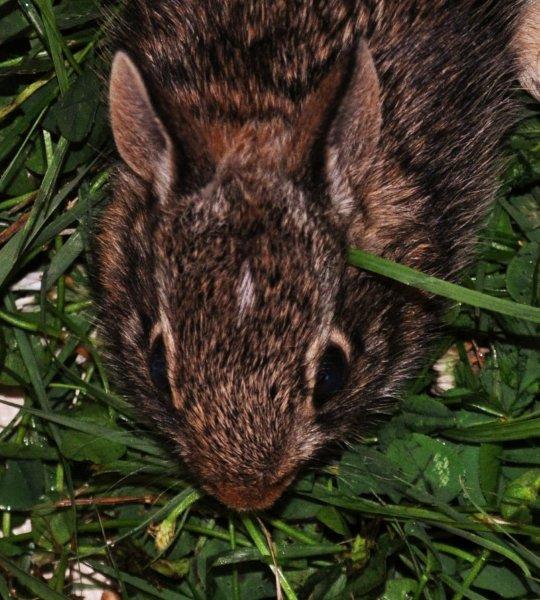
Eastern cottontail kit. Indentified by white blaze on head and russet fur between ears.
BIORESERVE FLORA OF THE MONTH – HARTFORD FERN (Lygodium palmatum)
The Hartford fern, also known as the climbing fern, looks like no fern you’ve ever seen.
The Hartford fern is our only native fern species that grows as a vine. Often mistaken for a species of ivy, a close look shows that those are fronds growing from the vines …not leaves.
Hand-shaped pairs of fronds grow along the vine. The terminal end of each vine bears the more delicately-divided fertile leaflets that bear the fern’s spores.
The Hartford fern is an endangered or threatened species in most of its historical range. In Massachusetts it is listed by the Massachusetts Natural Heritage and Endangered Species Program (NHESP) as a “Species of Special Concern.” The logo of the NHESP is this fern.
Hartford fern populations are rare and localized. To thrive, the Hartford fern requires an extremely moist, very acidic, sandy soil with a sparse pine-oak forest and an understory that allows plenty of sunlight to reach the forest floor. There are only 34 sites where this fern can be found in Massachusetts.
Colonies of Hartford ferns can be found from New England down the Appalachian Mountain range and east to the Atlantic coastal plain.
Along with prince’s pine, ground pine and Polypody fern the Hartford fern is evergreen and was gathered commercially for Christmas wreaths and decorations during the nineteenth and early twentieth centuries. The first American plant protection laws were passed in Connecticut to save this species from commercial exploitation back in 1869.
There is one small colony of this fern in The Southeastern Massachusetts Bioreserve. It is losing ground due to maturing forest canopy and dirt bike abuse. Active management should be implemented to save this unique species.
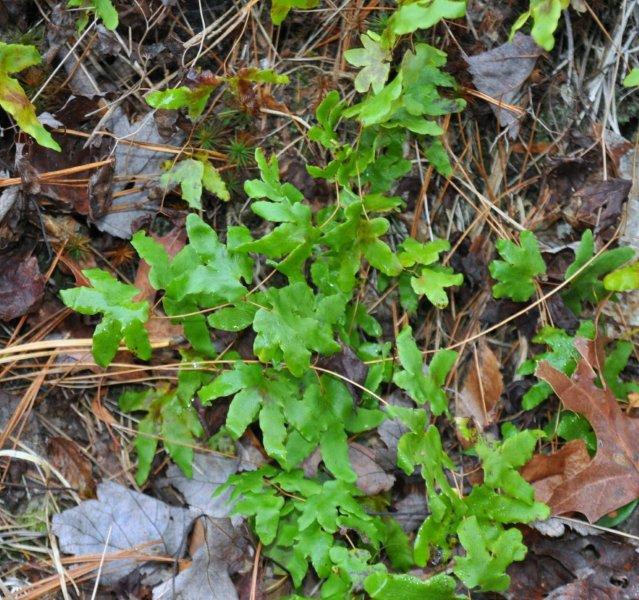
Hartford fern vines trailing along ground.
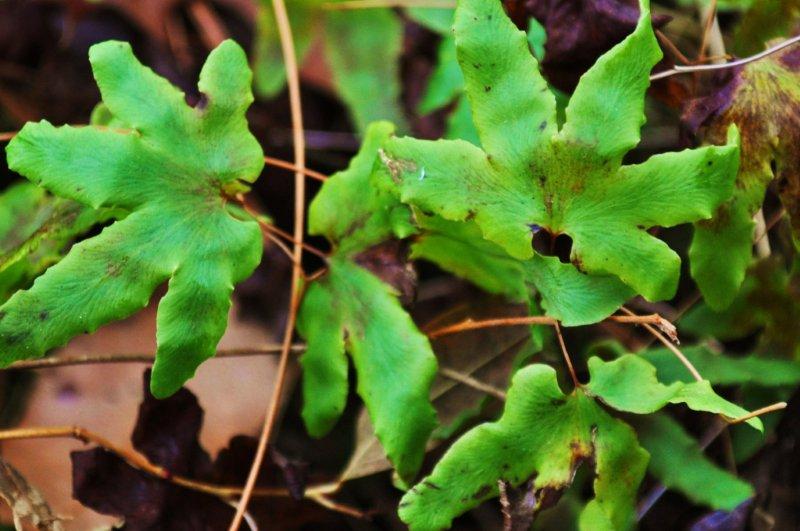
Hartford fern’s palmate fronds.
LEE REMEMBERED -
On November 20th at 12 noon, there was a dedication of a park bench at Pierce Beach Park in Somerset, Massachusetts, in honor of Lee Berard.
As many of you know, Lee was a long time member of Green Futures and never hesitated to volunteer his time ...and trusty canoe ...to help in our many endeavors. Lee was an avid hiker, amateur naturalist, open space advocate, indefatigable Green Futures promoter ...and heck of a great guy.
There was a very nice article on the dedication in the “Somerset Spectator.” You can read more about Lee, here - http://www.southcoasttoday.com/apps/pbcs.dll/article?AID=/20111123/PUB05/111230350/-1/pub05
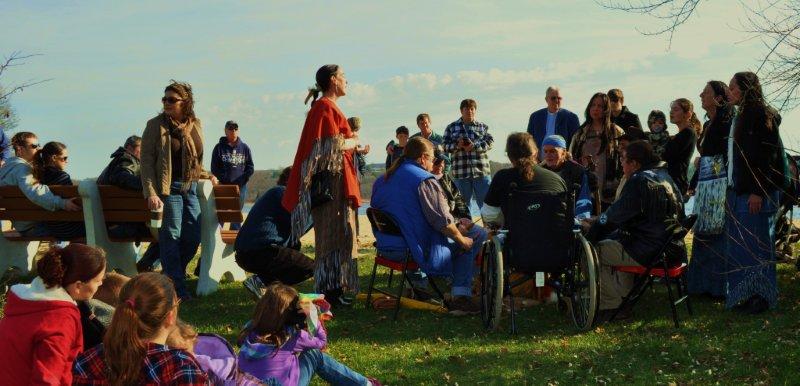
Folks at Pierce Beach Park remembering Lee Berard.

The plaque on Lee’s bench
SEASONS ABOUT TO CHANGE ONCE AGAIN -
Winter is almost here …and in New England it lasts a long time.
Embrace the season and spend some time outdoors in your natural environment this winter. Hiking, cross-country skiing, ice skating, tracking, snowshoeing, ice fishing, winter birding, or just a simple walk around a park or open space area near where you live are great ways to enjoy this unique season.
Click on our rather quiet “Calendar” for other unique winter things to do.
<Back
Social