Newsletters
June 2011 - LNG, Tritium, Lady's Slipper, Fisher
WELCOME TO GREEN FUTURES !
JUNE, 2011
“The drops of rain make a hole in the stone not by violence but by oft falling.”
-Lucretius
“Look at a stone cutter hammering away at his rock, perhaps a hundred times without as much as a crack showing in it. Yet at the hundred-and-first blow it will split in two, and I know it was not the last blow that did it, but all that had gone before.”
-Jacob A. Riis
LNG – Not to be!
“We finally put a stake through the vampire’s heart. I believed that we had driven a stake through this vampire’s heart several years ago, and I’m very pleased that is has finally laid down and died.” – Barney Frank
Love him or hate him you have to admit US Representative Barney Frank speaks his mind and has a way with words. And, in this instance, we agree with him …100%!
Here’s our Joe Carvalho with a wonderful “Guest Opinion” in the June 16th The Herald News.
GUEST OPINION: After long fight is won, anti-LNG group hopeful, vigilant
By Joe Carvalho
Coalition for Responsible Siting of LNG Facilities
“Those who say that something cannot be done should not interrupt those who are doing it.” — Chinese Proverb
I returned to the city of my birth some 11 years ago, content with engaging myself with my work and my love of music, nature and books, until I read of a proposal to build a monstrous liquefied natural gas terminal in the North End of the city. The more I learned of the project, the more concerned I became. The letters “LNG” initially meant little to me but I soon became only too familiar with all of its potentially devastating possibilities.
I attended a presentation by the company, Weaver’s Cove Energy, LLC, to the local environmental group Green Futures, and was struck not only by the magnitude and scale of the project and its potential negative impacts on the neighborhood and the city as a whole, but also by the arrogance of the company’s presenters.
During the lengthy question and answer session, one of the Weaver’s Cove presenters dismissed many of our group’s legitimate concerns, remarking that, “I could be home relaxing instead of being here (in Fall River) answering these ridiculous questions.”
Shortly after that meeting, a small group of concerned citizens met at the
Newport Creamery on President Avenue and discussed the need for a coalition to oppose the LNG project.
A chairperson was needed to head the coalition and, in the absence of anyone stepping up, I agreed to be the acting chairperson for a “few months” until a permanent chairperson could be found. Little did I know that it would take nine years to kill the ill-conceived Weaver’s Cove/Hess-LNG project.
At the outset, the coalition stated that we were not opposed to LNG as a part of the country’s energy needs. Our sole and overriding concern was where this project looked to be located, in a densely populated neighborhood in the city’s North End. As a result of our concern, we named our group the Coalition for Responsible Siting of LNG Facilities, accentuating the term RESPONSIBLE to indicate our intention.
Initially, some local elected officials were cajoled into thinking the project might benefit the city, hearing the company’s exaggerated and unrealistic claims of jobs, gas-powered vehicles for city use, etc.
These officials, once educated as to the overwhelming negative aspects of the project on public safety, economic development of the waterfront and irreversible environmental impacts soon changed their opinion and strongly opposed the project.
Our opposition faced several obstacles, not the least being the rather evident collusion between the Federal Energy Regulatory Commission, or FERC, and the company, Weaver’s Cove/Hess-LNG. Noting that the company had some 33 meetings with the FERC board over the course of the initial years of the project, while then Fall River Mayor Edward Lambert had to wait several months for a single meeting with that same FERC board.
Compounding the collusion was the fact that FERC Commission Chairman, Patrick H. Wood III, formerly worked for Baker Botts, the law firm representing Weaver’s Cove/Hess-LNG. Chairman Wood, ignoring any democratic concepts of a conflict of interest, refused to recues himself from FERC’s vote on siting the project. The U.S. Navy, stationed in Newport, R.I., had initially cited many concerns regarding the giant LNG supertankers transiting Narragansett Bay, but, mysteriously, these concerns were quickly dismissed and the Navy did a flip-flop on the issue.
The defeat of this proposal was the work of many groups and elected officials. Certainly, the Coalition that I was fortunate to lead was the foremost grassroots, all volunteer entity to engage in the fight, but the efforts of Green Futures, Save the Bay, Save Bristol Harbor, and the Kickemuit River Council were all critical to the effort. Governors and other state, federal and municipal elected officials also played key roles in their opposition, especially U.S. Reps. Barney Frank and James McGovern, who worked tirelessly on their districts’ behalf. Individuals who made up the Coalition were the driving force and inspiration behind our success.
Two of those members stand out for their contributions and courage: Lee Weiner, of Somerset, who, though needing the support of a walker, traveled to Boston on several occasions and marched outside of events where the
Hess hierarchy were in attendance, or picketed Hess gas stations in Somerset and Fall River. Mrs. Lillian Goldsmith, who passed away last year and was an early and ardent Coalition member and who hardly ever missed a monthly meeting, even while battling the cancer that would eventually take her life and requiring the presence of a portable oxygen tank, served as an inspiration to us all.
The efforts of Coalition members John Keppel, Michael Miozza and David Fredericks, through their research on thermal exclusion zones, wedge lot ownership, cryogenic pipelines and a host of other pertinent concerns served to place insurmountable obstacles in the way of this profit driven project.
The efforts, commitment and resolve of so many regular, ordinary citizens, acting in extraordinary ways, together, are what ultimately led to the victory we all now share. The future of the region and the greater community is more promising now than at any time in the past nine years.
While we remain vigilant for as yet unforeseen threats to our public safety, waterfront economic development, and environment, we are hopeful in the future.
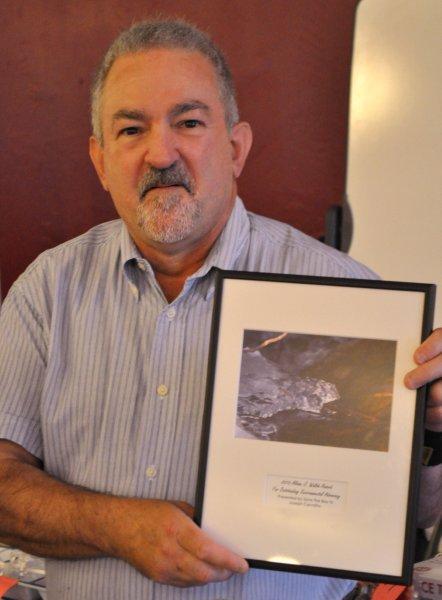
Coalition for Responsible Siting of LNG Facilities’ President Joe Carvalho with a recent award he received from Rhode Island’s Save the Bay for his work in helping stop Hess LNG’s foolish and environmentally damaging project.

Tritium – It’s everywhere!
Just recently, April, in our e-newsletter:
A release in this country of a similar level of radioactivity, as occurred at Fukushima, would trigger an evacuation and exclusion zone of nearly 50 miles.
In our own backyard we have Entergy’s Pilgrim Nuclear Power Station in Plymouth. It is of the same class as Fukushima Daiichi right down to its General Electric Mark 1 reactor.
Pilgrim is an old facility and its license to operate expires in 2012. It is seeking an extension of its operating license to 2032.
Should Pilgrim ever “melt-down” it would necessitate the evacuation of over 5 million people. A 50 mile exclusion zone would include Boston, Plymouth County and most of Bristol County.
Few want a radioactive waste dump in their neighborhood so Pilgrim’s spent fuel rods are stored on site. Spent fuel is even more dangerous than the reactor’s core material. Some forms of radioactive waste have a half-life of millions of years.
Check this out - http://www.msnbc.msn.com/id/43475479/ns/us_news-environment/
RADIOACTIVE – Told you so!
Mayor Vaughn: [to reporter] I'm pleased and happy to repeat the news that we have, fact, caught and killed a large predator that supposedly injured some bathers. But, as you see, it's a beautiful day, the beaches are open and people are having a wonderful time. Amity, as you know, means "friendship". (Jaws)
Also from our April e-newsletter:
Remember, just a few short weeks ago, when folks living in the vicinity of the Fukushima radioactive releases were being assured by government officials that the nuclear power company would soon bring the damaged facility under control?
Governments and corporations can’t handle crises. Unless closely monitored by the people, they always lie!
Check this out:
http://english.aljazeera.net/indepth/features/2011/06/201161664828302638.html
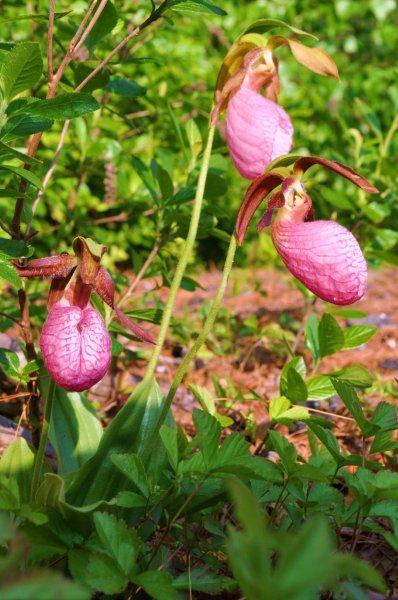
Bioreserve Flora of the Month – Pink Lady’s Slipper (Cypripedium acaule)
Pink lady’s slipper, also known as pink moccasin flower, is one of New England’s showiest spring flowers. Lady’s slippers are members of the orchid family and very common in acidic oak/pine woodlands throughout our area. Each flower rises twelve to sixteen inches above two oval leaves at the base of the plant.
Many gardeners, beguiled by the lady’s slipper’s beauty, have attempted to transplant them into home wildflower gardens. These attempts usually fail because the lady’s slipper needs nutrients it must receive from a specific woodland fungus and the fungus needs nutrients that only the lady’s slipper can provide. This symbiotic relationship is necessary for both species to thrive and to reproduce.
Pink lady's slippers, with their fungus friends, growing in shady forest uplands, are very hardy plants with few insect enemies. Deer will occasionally eat them, but they are not a preferred deer food item. Like all orchids, lady’s slippers are perennial and are long lived.
For pollination the lady’s slipper is dependent on various species of forest bees. Lady’s slipper flowers do not produce nectar, but they give off a sweet smell that fools bees into thinking they do.
The tightly closed flower pouch can only be entered through a tight, narrow slit that a bee must push its way through. Once inside, the hopeful insect finds no nectar, but does find itself trapped. In its frantic attempts to escape, the bee gets covered in pollen. Eventually it succeeds in forcing its way back out of the flower.
In its continuing search for nectar the bee will, sooner or later, makes the same mistake again. The pollen the bee has been carrying since the first encounter now fertilizes this next lady’s slipper. The bee also gets a new pollen coating in attempting to escape from its second mistake and this bee induced cross-fertilization occurs numerous times until the flowers wither.
Do you think the forest bees are relieved once the flowering season is over?
Bioreserve Fauna of the Month – Fisher (Martes pennanti)
In southeastern New England fishers are just about as ubiquitous as pink lady’s slippers. That wasn’t always the case.
Fishers were typically thought of as highly secretive critters requiring huge expanses of dense, high canopy forests composed of large trees, snags, and logs …where squirrels, voles, mice and other rodents abound.
When the first Europeans entered the New England forests, fishers were abundant and a valued fur resource. With agricultural land clearing and the subsequent deforestation of New England, except for the remote far northern forests of Maine and New Hampshire, the fisher was soon extirpated from most areas.
It is estimated that we, here in southern New England, lose about fifty acres of land to development each day. Despite this loss, the cut-over forests that remain have grown back over the past fifty to one hundred years. The return of the forest has brought with it the fisher and other forest dependent wildlife such as black bear, raven, wild turkey, moose, and various other species long absent from southern New England. With an exponentially expanding human population, how long these forest critters and their required forest habitat can endure remains to be seen.
Male fishers are larger than females and can weigh as much as fifteen pounds. Not nearly as heavy as most people incorrectly estimate when viewing a bushy furred fisher in their backyard woods.
Fishers are usually silent. When nervous they make a chuckling sound and a squall somewhat similar to the sound an agitated raccoon makes. If cornered by a dog or large predator they will growl, snarl, hiss, and spit. Most other members of the weasel family make similar sounds.
Fishers are solitary animals except during the mating season. They have a number of dens, usually in hollow trees, throughout their home range and females generally select the most secure when about to give birth. In our area the kits are born in March and there are usually three or four in a litter.
With its dense cedar swamps, pine/oak uplands and abundant red squirrels and chipmunks the Southeastern Massachusetts Bioreserve is a great location to spot a fisher. Stay alert when hiking in the area and you might be rewarded with a glimpse of one of our most elusive native mammals.
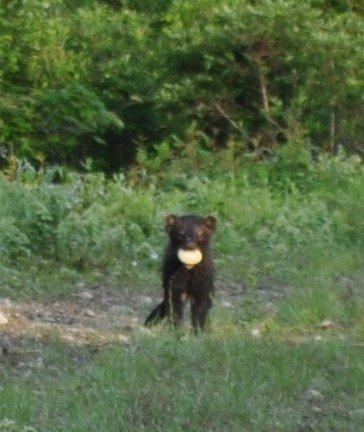
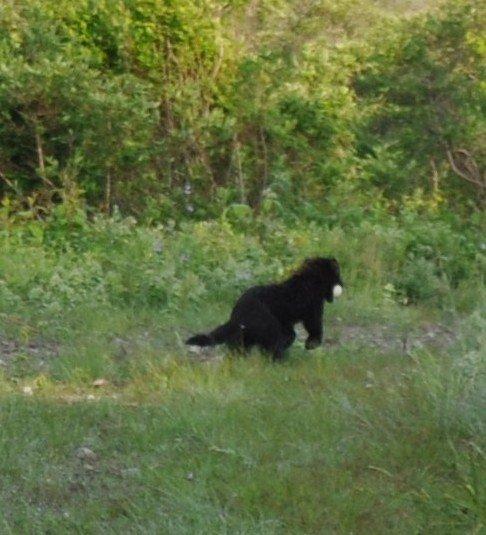
Caught in the act of stealing a wild turkey egg, this fisher hesitated briefly before heading for home.
EXPLORING THE BIORESERVE – Walks
June’s walk was to King Philip’s Spring by way of the Corduroy Road.
July’s walk will go from Fighting Rock Corner down the Mowry Path. Watch for an “Activity Alert” the first week in July for walk date, time and meeting location.
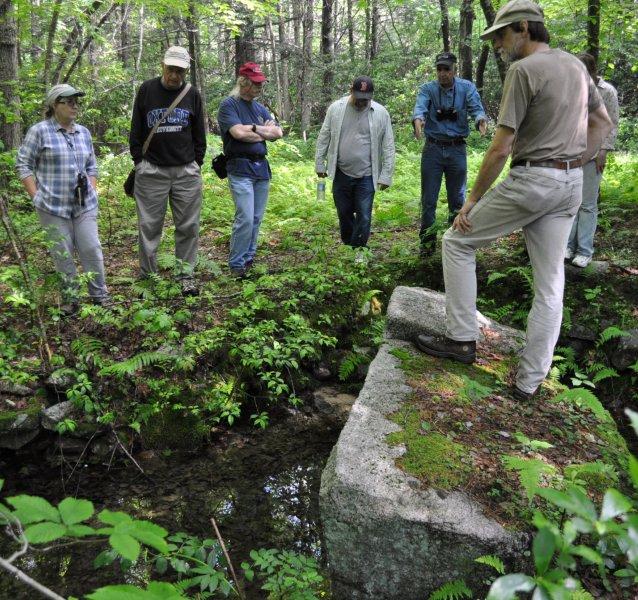
Bioreserve explorers at King Philip’s Spring only 336 years after King Philip, Weetamoe and their followers camped here.
Click on our Calendar for other activities and events.
<Back
Social