Newsletters
September 2011 - Peace Haven, Mushroom, Slugs, Weaver's Cove
WELCOME TO GREEN FUTURES!
SEPTEMBER, 2011
“Anyway, no drug, not even alcohol, causes the fundamental ills of society. If we're looking for the source of our troubles, we shouldn't test people for drugs, we should test them for stupidity, ignorance, greed and love of power.”
- P. J. O'Rourke
“Why should we care about preserving archaeological sites? ….most of human history is preserved only in archeological sites. ….the major means by which human beings have adapted to this planet, in chronological terms, left behind only archaeological sites as their most tangible legacy for the modern world. This is the fishing-gathering-hunting way of life, described by one archaeologist as one of the most remarkable success stories in the natural world. The hunting and gathering strategy exclusively characterized human life arguably for close to two million years and is now all but extinct. To my mind there is no better reason to study this unique and enduring slice of human experience.”
-Brent R. Weisman
LIES, MORE LIES …AND THE LOW STANDARDS OF OUR LOCAL NEWS MEDIA-
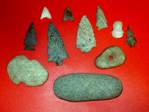
Peace Haven is without a doubt one of the most archeologically important sites in Massachusetts. Truly unique, it should have been set aside decades ago as a state park or state archaeological reserve. Few other locations in the Commonwealth can boast the wealth of cultural history and artifacts that Peace Haven contains. Its 10,000 years of continuous human habitation is nothing to scoff at!
For more information on Peace Haven go to our website at gf.gareworks.com and click on “Newsletters.” Our September 2008 and September 2009 newsletters contain background information on this historically important property.
Meditech, (Medical Information Technology, Inc.), is a leading Massachusetts medical software company. They have an existing facility in Fall River on the north shore of South Watuppa Pond adjacent to Interstate 195.
Meditech was interested in expanding and purchased or was about to purchase 138 acres of Peace Haven. Meditech said they would build their new facility on only 20 of those acres and leave the remaining 118 acres, some of the most archaeologically sensitive Peace Haven land, in its natural state and preserve it for all citizens of the Commonwealth, in perpetuity, under a conservation restriction.
Although we hated to see the loss of any Peace Haven acreage we were elated that an apparently environmentally concerned and socially responsible company was purchasing the property and willing to set aside land of cultural and environmental significance.
Suddenly, the project fell apart. Meditech pulled out blaming Massachusetts Secretary of State William Galvin and the Massachusetts Historical Commission (MHC). Apparently Meditech felt the requirement to have an archaeologist on site during construction, something other companies have willingly done when building on archeologically significant sites, was something they did not want to do.
We do not think that something so insignificant is the real reason for Meditech's decision. Something else is at play here. Inquiries to our local state representatives have not provided any answers. Their response has been that they are engaged in delicate “negotiations.”
Whatever the reason for Meditech dropping the project it wasn’t because of anything onerous required of them by the MHC. Shrill talk show hosts on local radio and city newspaper reporters failed to do even a cursory search of MHC and Massachusetts Secretary of Energy and Environmental Affairs records of the Meditech proposal before jumping on the MHC vilification bandwagon.
Read The Fall River Herald’s shameful Editorial here: http://www.heraldnews.com/opinions/x1069110843/OUR-VIEW-Mass-Historical-Commission-undermines-economic-development
No document issued by MHC ever required Meditech to “strip 21 acres of land to a depth of 2 feet.” Even more outlandish “requirements” were fabricated by those in the news media in a ridiculous attempt to portray the MHC as, “out to get Fall River.”
To The Herald’s credit they did run the following letter, from Fall River Land Conservancy’s Al Lima, attempting to set the record straight and stop the MHC bashing.
Read Al’s letter here: http://www.heraldnews.com/archive/x1069123535/GUEST-OPINION-Understanding-the-significance-of-the-Meditech-site-at-Peace-Haven#ixzz1YpJ0Vz00
Here’s our letter supporting MHC on this issue:
Dear Secretary Galvin and the Massachusetts Historical Commission,
We support the recent Massachusetts Historical Commission (MHC) decision regarding the proposed Meditech development at Peace Haven in the Assonet section of Freetown.
We commented on the Single Environmental Impact Report (SEIR) for the proposed “Meditech Office Development at Peace Haven.”
When we first heard that Meditech would locate at Peace Haven we were hopeful …after hearing their initial remarks regarding their project …that they would concentrate development on those portions of the parcel that had already been disturbed and preserve the most sensitive areas of significant cultural and archaeological importance.
We’ve long recognized the importance of Peace Haven. It is part of the Commonwealth’s early cultural heritage and is an educational and archeological asset of incalculable value.
As you know, Peace Haven is a unique archaeologically rich parcel on the Taunton River. At Peace Haven 10,000 years of human history, ecology and scenic beauty come together to form a truly special place.
We are surprised and very disappointed at Meditech’s reaction to MHC’s reasonable requirements. We are appalled at their actions and those of the local chamber of commerce, some political leaders, and local talk show disc-jockeys that have ginned-up poorly educated locals by spewing half-truths and outright lies about the MHC decision.
Calling on folks to call their elected officials …and one “news” commenter even suggested calling President Obama to “force” MHC to acquiesce to Meditech’s demands …is truly abhorrent …and ridiculous too!
The Herald and others in the news media that were so quick to criticize and demonize the MHC and Secretary Galvin owe an apology to those they unfairly demonized on the basis of false and totally inaccurate information.
BIORESERVE FAUNA OF THE MONTH - Great Grey Leopard Slug (Limax maximus)
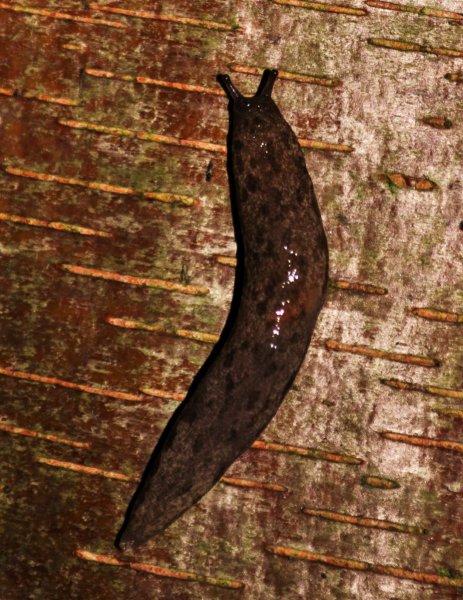
The great grey leopard slug is the largest land slug found in Massachusetts. When gliding along and fully extended its body length can reach six inches.
The animal's body color is normally pale-grey to brownish/yellowish grey longitudinally streaked and spotted with darker tones. As well as differences in tones and markings, various shades of other colors are sometimes found in this species. No two are exactly alike. Every great grey leopard slug has a different spot pattern.
Originally from Europe, this slug probably arrived in the New World stowed away on imported vegetation and agricultural stock.
Most folks know slugs as shell-less snails, but great grey leopard slugs do carry a vestigial shell under the skin on the forward part of their body. The shell is oval in shape and very thin. As in other mollusks the shell is composed of calcium carbonate.
Great grey leopard slugs have two pairs of tentacles on their head. The upper pair functions as “eyes,” sensing light. The lower tentacles are used for scent detection. Both pairs of tentacles can be retracted if the slug is disturbed and they will regenerate if damaged or lost.
Slugs move by rhythmic muscular waves on the underside of their foot. They secrete a layer of mucus on which they travel, which helps prevent damage to the foot. The slime trail left behind also helps slugs find each other.
Great grey leopard slugs hibernate in burrows underground during the winter. During the spring, summer and fall the slugs are most active during the night when humidity is highest. During the heat of the day and when the weather has been very dry, slugs will hunker down in damp areas under bark and leaf litter.
Great grey leopard slugs are hermaphroditic. They each possess both male and female reproductive organs.
They can mate with themselves, but prefer not to since it limits genetic diversity and would ultimately prove detrimental to the continued survival of the species. How do the slugs “know” this?
Great grey leopard slugs engage in a complex mating ritual. They glide around each other coming closer and closer until they make contact. They then embrace and wrestle and display their sex organs. The great grey leopard slug’s penis is half the length of its body.
Entwined together, the slugs secrete a sticky, thick strand of mucus while hanging suspended from a tree branch. While hanging in this position, they copulate.
Following mating the great grey leopard slug often has trouble disengaging. The thick mucus can hinder their ability to withdraw their inordinately long penises.
If withdrawal proves impossible, one slug gnaws off either its own, or its partner's penis. Although “bobbitization” comes immediately to mind to describe this procedure, apophallation is the correct scientific term. The missing penis does not regenerate. The slug so apophallated is now strictly female.
Eggs are deposited under rocks and wood debris. When the babies hatch, they are on their own.
Various bird species, small snakes and some amphibians prey on slugs.
The great grey leopard slug is not an agricultural pest. Unlike most slug species that devour garden plants this slug’s diet consists solely of rotting vegetation and fungi.
BIORESERVE FLORA OF THE MONTH – Hen of the Woods (Grifola frondosa)
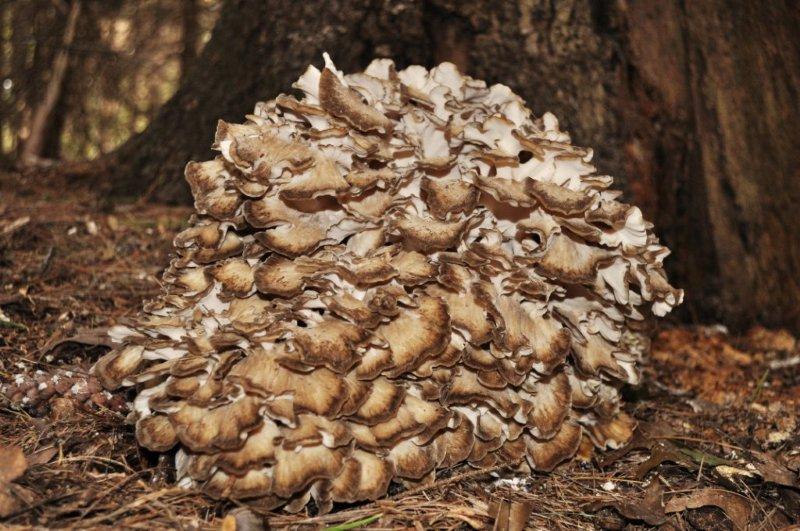
The hen of the woods is a common and popular mushroom that fruits during the fall throughout southern New England. A variety of polypore …fungi that have spore bearing pores under their caps …they appear after rainy days and cool nights on hardwoods, particularly oaks.
Mushroom loving Italian Americans know this mushroom as the “signorina.” It is called “maitake” by the Japanese and bearing that name it has become a popular medicinal health supplement and can also often be found fresh in supermarket produce departments.
The hen of the woods is being extensively studied at Sloan Kettering, Dana Farber and other cancer research institutions since earlier preliminary studies have shown hen of the woods stimulates immune system cells and possesses cancer inhibiting compounds.
The hen of the woods fruiting body is a light tan to dark brown fleshy mushroom, consisting of multiple caps, growing in rosette form from a single stalk. It is usually found, at the same time each fall, at the base of oak trees. Although this mushroom may weigh as much as one hundred pounds, most found will be in the three to ten pound range.
The hen of the woods fungus is parasitic living off its host and often eventually kills the tree. Some infected trees wall off the internal hen of the woods fungal mycelium and survive.
Hen of the woods is a much sort after mushroom. Its flesh is firm and white and the flavor is mild and savory. It is the most popular culinary wild mushroom in our neck of the woods.
A quick internet search shows hen of the woods selling for around $30.00 a pound. Save some money and pick your own. They are right now fruiting in your neighborhood woods …perhaps even in your own backyard!
OUR PLAN FOR THE OLD SHELL OIL TERMINAL SITE-
Earlier this month we held a press conference unveiling our plan for economic development on the Hess/Weaver’s Cove property at the old Shell Oil site.
It was very favorably received by those in attendance and press coverage of the event was favorable.
Leave it to the dullest, most boring columnist that The Herald employs, to throw a little rain on our parade. As usual, after reading Mike’s first paragraph, I fell asleep …but Director of Special Projects Joe stayed awake and wrote the following rebuttal.
Read about it here - http://www.heraldnews.com/opinions/x848570792/GUEST-OPINION-Columnist-off-the-mark-on-Green-Futures-plan-for-Weaver-s-Cove
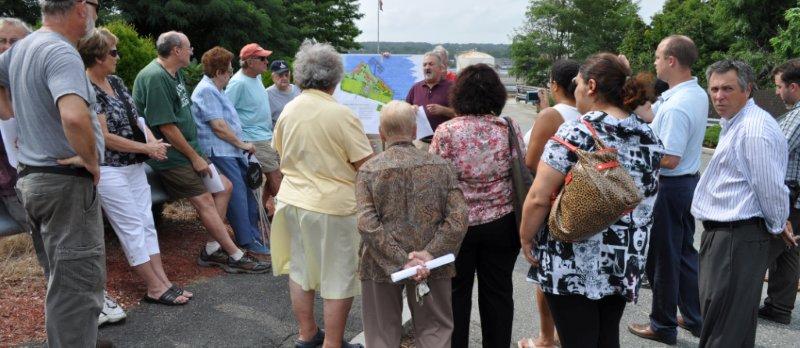
1st photo - Director of Special Projects Joe Carvalho explains our environmentally sound economic development plan for the old Shell Oil site.
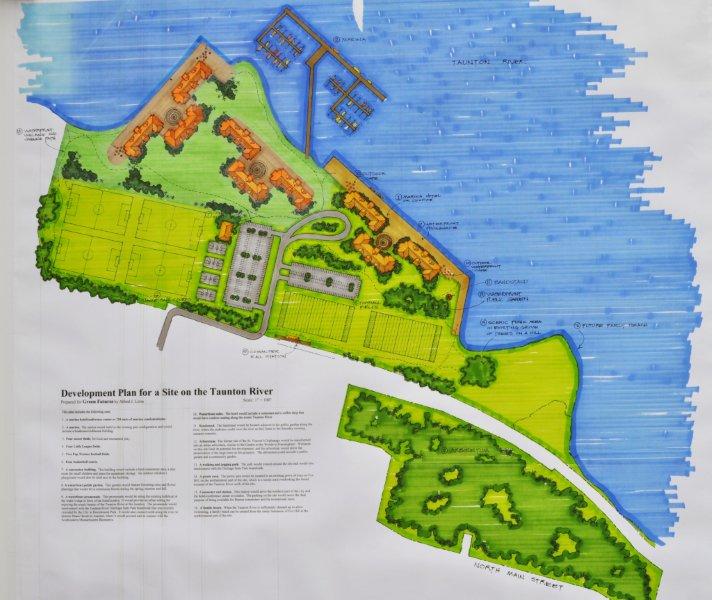
2nd photo – Our plan for the old Shell Oil site
AUTUMN HAS ARRIVED -
Set aside some of those crisp, sunny fall days and take a hike! …or ride a bike, paddle a canoe or kayak, pick apples, peep at the leaves, photograph colorful fungi, go birding, improvise an outside activity…or just sit out in the forest beneath a big old oak tree. Best time to be outdoors in New England …is right now!
Click on our Calendar to see what sort of organized things are going on.
<Back
Social