Newsletters
September 2010 - Solid Waste Plan, Hen o' the Woods, Asters
WELCOME TO GREEN FUTURES !
SEPTMBER, 2010
"Man is a clever animal who behaves like an imbecile."
— Albert Schweitzer
HEY, GASIFY THIS! –
Appears your tax dollars and mine are funding bogus “research and development” schemes to gasify just about anything you can think of to produce what the trash disposal industry calls “syngas” intended …so they say …to get rid of waste by gasifying it to power electric generating facilities.
The private and public funding of these gasification attempts takes the money that should be going toward research and development of true alternative forms of energy production …and wastes it!
We are squandering time and monetary resources reinventing the same failed gasification technologies, over and over again. The only benefit is to gasification promoters, their corporations, and their political allies.
There are dozens of proposals, from loads of gasification sharpies, popping up all over the state.
Locally, NRG Somerset started out wanting to gasify coal to power the old, filthy Montaup Electric facility in that town, but now wants to gasify “construction and demolition” material instead.
Ze-gen in New Bedford wants to move its smoke and mirrors “pilot” gasification operation to Attleboro where it says it wants to gasify creosote soaked telephone poles and railroad ties.
Fall River and Taunton seek to gasify solid waste together and Fall River would like to do the same to sewage sludge.
Other gassy entrepreneurs, across the state, are proposing gasifying bio-mass, switch grass and corn stalks, your public land forests, agricultural and landscaping residue, tires, and all sorts of other stuff.
Since gasification on a large scale is not practical, we know these facilities, if built, will become nothing more than “trash to energy” incinerators.
Every ten years MA DEP (Massachusetts Department of Environmental Protection …a.k.a. Massachusetts Department Encouraging Pollution) creates a new Solid Waste Master Plan.
The current Solid Waste Master Plan has never been fully implemented. Will the new one be?
We have very little faith in the DEP and its solid waste plan …and even less faith in the plan’s implementation. We are aware that due to the state-wide economic crisis, DEP is both understaffed and underfunded.
Despite their problems, however, DEP could be doing considerable more to find a long-term solutions to our trash disposal problems.
New trash incinerators, here in Massachusetts, have been banned for the past twenty years. Incinerators send toxic emissions into the air, exacerbate climate change, cause respiratory illness, contaminate our food with mercury and other heavy metals.
Here’s last year’s news release on the continuation of the state moratorium on new trash incinerators. Note that it leaves the door open to other forms of incineration and combustion.
Commonwealth of Massachusetts
Executive Office of Energy and Environmental Affairs
Governor Deval L. Patrick
Lieutenant Governor Timothy P. Murray
Secretary Ian A. Bowles
For immediate release: December 11, 2009
Press Release Contacts: Robert Keough — 617-626-1109 or robert.keough@state.ma.us ; Lisa Capone — 617-626-1119 or lisa.capone@state.ma.us ; Kate Plourd — 617-626-1136 or kate.plourd@state.ma.us ; Ed Coletta (MassDEP) – 617-292-5737
Patrick-Murray Administration Maintains Incinerator Moratorium, Expands Recycling Efforts
EEA outlines priorities for comprehensive recycling push; calls for review of construction and demolition material used for fuel
BOSTON – The Patrick-Murray Administration today announced that it would maintain the existing moratorium on new facilities for incineration of municipal solid waste. In addition, Energy and Environmental Affairs Secretary Ian Bowles outlined Governor Patrick’s priorities for expanding the recycling of key products like water bottles and consumer electronics, as part of a push to reduce the amount of waste sent to landfills and incinerators.
“We are serious about managing the waste we generate in a way that saves money for cities and towns, curbs pollution and protects the environment for our children and grandchildren,” said Governor Deval Patrick. "There are better ways than traditional incineration.”
“Focusing on incineration and landfills is the wrong end of the waste equation,” said Secretary Bowles. “While Massachusetts is ahead of the national average in recycling and some communities like Nantucket are leading the way, there is a lot more we can do to increase recycling and reduce disposal of useful materials.”
The Department of Environmental Protection (MassDEP) has had in place a moratorium on new municipal solid waste combustion facilities since 1990. As MassDEP prepares a new Solid Waste Master Plan, which it is expected to issue as a draft in early 2010, today’s announcement specifies that the new plan will maintain the moratorium, but also strengthen it in two ways – by reducing dramatically the amount of recyclable material going into the waste stream, and by developing stringent new performance standards for existing waste-to-energy facilities that require higher recycling rates in waste collection areas, lower emissions of greenhouse gases and other pollutants, and higher efficiency in energy recapture. MassDEP will work toward developing these performance standards for the next 10-year Master Plan.
Secretary Bowles noted that anaerobic digestion, advanced biofuels, and other proven types of waste-to-energy technology applied to organic wastes, will continue to be encouraged in the new Master Plan, but that incineration of mixed municipal solid waste will continue to be restricted to existing facilities.
To complement the incinerator moratorium, the Patrick-Murray Administration is committed to an aggressive agenda of recycling and waste reduction that gives cities and towns assistance to expand and improve their recycling efforts and requires greater responsibility from manufacturers for products – ranging from water bottles to televisions – that end up in our waste stream.
The Patrick-Murray Administration’s priorities to expand recycling and waste reduction include:
Consumer Electronics: The Administration calls for passage of comprehensive producer responsibility legislation for discarded electronics, the so-called “E-Waste” bill, relieving municipalities of this burden.
Expanded Bottle Bill: The Administration urges approval of an expanded bottle bill to cover water and sports drink bottles, which will reduce litter, increase recycling rates for containers from the fastest-growing segment of beverages, and provide additional resources to support local recycling efforts.
New Protections for Communities: The Administration will seek greater authority for MassDEP to intervene in problem landfills, such as the one on Crow Lane in Newburyport, and new authority to require waste haulers to provide full recycling services to their customers.
Helping Municipalities Increase Recycling Rates: The Administration will work with the Legislature, municipalities, and stakeholders to devise new standards and programs to help cities and towns reach higher rates of recycling by offering assistance for municipalities to adopt more effective methods, such as single-stream recycling, which eliminates the need for households to sort their recyclables.
“This initiative will return Massachusetts to national leadership in recycling,” said MassDEP Commissioner Laurie Burt. “Built on this foundation, the Solid Waste Master Plan issued next year will guide consumers, businesses, and municipalities toward a future of more recycling, and less landfills and incineration.”
At the same time, Secretary Bowles announced that he has directed MassDEP to suspend review of permit applications for facilities proposing to use construction and demolition materials (C&D) as fuel for energy generation, including the proposed Palmer Renewable Energy facility, until a comprehensive assessment of the environmental impacts of using such materials is completed.. This assessment will include a review of potential for emissions of greenhouse gases and other air pollutants related to C&D, an analysis of level of contaminants commonly found in C&D feedstocks, and a review of the most effective means for minimizing, sampling and monitoring of toxics and other contaminants of concern in these feedstocks. Further, the Secretary has directed MassDEP, in coordination with the state Department of Public Health (DPH), to conduct a review of the potential public health impacts associated with the combustion C&D.
********
100 Cambridge Street, Suite 900, Boston, MA 02114-2119 — (617) 626-1000 office / (617) 626 1181 (fax
DEP’s new, 2010, Solid Waste Master Plan is titled, “A Pathway to Zero Waste.” They picked a good title, but the plan causes great concern because of the incineration loopholes it contains. Also, DEP’s timeline to reach “zero waste” is way too long.
Last week MA DEP held a public hearing on their proposed new Solid Waste Master Plan.
Along with MassPIRG, Toxics Action, Massachusetts Coalition for Clean Air, individual citizens, and waste company shills, we were there.
Here’s the testimony we submitted:
September 21, 2010
John Fischer
Massachusetts Department of Environmental Protection
One Winter Street
Boston, MA 02108
Dear Mr. Fischer:
I wish to commend the Massachusetts DEP for preparing the excellent report, “Massachusetts 2010-2020 Solid Waste Master Plan.” The draft plan indeed has the potential to lead us to a “Pathway to Zero Waste.”
It is encouraging to read in the report that “The Commonwealth’s policy is to meet our waste management capacity need through the development of increased recycling and composting capacity, instead of through the development of long-term disposal capacity.” However, I am concerned that this laudable goal will be undermined by a loophole in the plan that will continue to allow sorted waste to be burned.
Promoters of gasification facilities are promoting this option as a solution to the state’s solid waste problems; however gasification will undermine recycling by making the incineration option possible. Burning is still burning, whether it occurs in incinerators or in gasification facilities. Gasification is also a technology that is not yet been proven to work. Allowing it to remain as an option will undermine the overall goals of the Commonwealth’s waste reduction and disposal strategies. As the report wisely states, “any new combustion capacity would last for decades…and would not be needed to manage Massachusetts waste in the long-term.”
The Solid Waste Master Plan states that strategies to reduce solid waste disposal will align with and complement greenhouse gas reduction strategies mandated under the Massachusetts Global Warming Solutions Act. However, allowing gasification facilities will undermine these goals.
An example of the conflict between the report’s goals and reality is the proposal by NRG to convert the Montaup Power Station in Somerset to a coal and C&D gasification plant. Even if such a facility could work---and there is ample evidence to doubt it---it would create a long-term capital investment that would undermine recycling in the region for many decades. It would also increase CO2 emissions in the region.
Another local example of the conflict between the report’s goals and reality is the proposal to build a trash gasification incinerator in Taunton. This facility would be allowed by DEP because, as long as the ethanol produced is burned off-site, DEP considers it exempt from the incinerator moratorium. This would be similar to allowing corner stores to sell liquor to minors, as long as they drink it elsewhere. If a facility is burning trash, it is a trash incinerator, regardless of what process or name is ascribed to it. Permitting a trash incinerator in Taunton will not only undermine recycling goals in Taunton but also in Fall River and other communities in the region. The incinerator will need feedstock to keep operating, and that means less incentive to recycle.
A third local example of the conflict between what DEP is willing to permit and the goals of the Solid Waste Master Plan is the proposal to gasify sludge at the Fall River Sewage Treatment Plant.
The mayor of Fall River and the Corporation Counsel have stated publicly their support for gasification of waste in Taunton and in Fall River. However, there is little public support for burning trash or sludge in Fall River, and any effort to place an incinerator in the city will be fought by organized citizens. We still remember the Fall River municipal incinerator, an environmental disaster.
Incinerator companies across the state are aware of these gasification loopholes in the law and are attempting to exploit them. Financial incentives in this industry are working against the excellent goals of the Solid Waste Master Plan. We in Fall River remember the experience of Molten Metals, which used the gasification process and failed. Nothing that we have seen since then demonstrates that this process will work on a large scale without environmental damage, including CO2 emissions.
Finally, we would like to advocate for a stronger connection between the goals of the Solid Waste Master Plan and the means to achieve these goals. The previous solid waste plan suffered from a disconnect between what should be done and the means to do it.
For example, there should be clear plans for increasing recycling rates for larger communities in the Commonwealth and a state funding plan to realize these increased rates. For example, Fall River could benefit from two funded positions: one to manage recycling programs and one to increase recycling rates through public education. Even though Fall River’s recycling rate is only 12%, every ton of recyclables diverted from the private landfill more than pays for itself in saved tipping fees.
State funding should be available to establish municipal MRF’s, composting facilities and other infrastructure that would dramatically increase recycling rates in cities. In Fall River, a municipal MRF could increase recycling rates to 50%. With a composting facility, the rates could probably exceed 90%. This is possible, but the plan needs to be far more specific as to how facilities like this would be built and managed and how they would be funded.
The lack of specifics in the Solid Waste Master Plan could be met by a matrix that shows, for each proposed recommendation, (1) what actions are needed to implement it---for example new regulations, laws or funding; (2) who will be responsible for implementing it---for example, DEP, the legislature, local communities and private contractors; (3) how it will be administrated and implemented; (4) what infrastructure is necessary in each region to implement it; (5) what technical assistance is needed to achieve the recommendation; (6) what sequence of actions are needed to implement it; (7) when these actions will occur; and, not least, (8) how it will be funded. Without such specificity, we believe that there is a danger that the excellent goals and objectives of the solid waste master plan will languish and not meet the deadlines stated in the plan.
Let’s not wait until 2050 to solve our solid waste problem. We can and should do better than that. There is no time to lose.
Thank you for the opportunity to comment on the 2010 Solid Waste Master Plan.
******
The hearing was informative and lively. Other than the few gasification officials trying to justify the unjustifiable, the only other moronic comments came from DEP’s Southeast Region Chief of Solid Waste, David Ellis. Ellis, during a pause in the hearing, decided he would “educate” everyone present by talking down to them in explaining his definitions of incineration and combustion. Hey, David, incineration by any other name is still incineration. Fortunately he was heckled out of the room. His attempt, however, shows that DEP appears ready to sacrifice our environment in order to accommodate the incinerator industry.
Get involved!
LNG – EIGHT YEARS AND COUNTING –
Hess/Weaver’s Cove has been very quiet lately. After getting slammed by the Coast Guard, Congressmen Frank and McGovern, the entire Rhode Island federal delegation, and officials from Narragansett Bay communities it appears the Hess/Weaver’s principals are biding their time hoping BIG ENERGY Republicans, after this next election, take back control of Washington.
Coalition for Responsible Siting of LNG Facilities President Joe Carvalho says he’s ready for another eight years of battle. Not sure we are, but the alternative is too scary to contemplate. We’ll soldier on with President Joe to eventual triumph over this ill-conceived Hess LNG project. Join the battle!

Battle-hardened President Joe continuing the fight against Hess/ Weaver’s Cove at the annual Save Bristol Harbor picnic.
OCTOBER’S BRIGHT BLUE WEATHER –
October is a great month to spend outdoors in New England. The air is dry, clean and crisp; colorful leaves brighten the landscape; mosquitoes and ticks have mostly quit for the season; fall wild flowers are in bloom. Take a daily or weekly walk on a different parcel of public open land near you. Check out the autumn scene. What birds are still around? It is a great year for acorns. Notice the different shapes from different oaks. Are the squirrels and chipmunks gathering them up for winter storage? Enjoy the changing seasons.
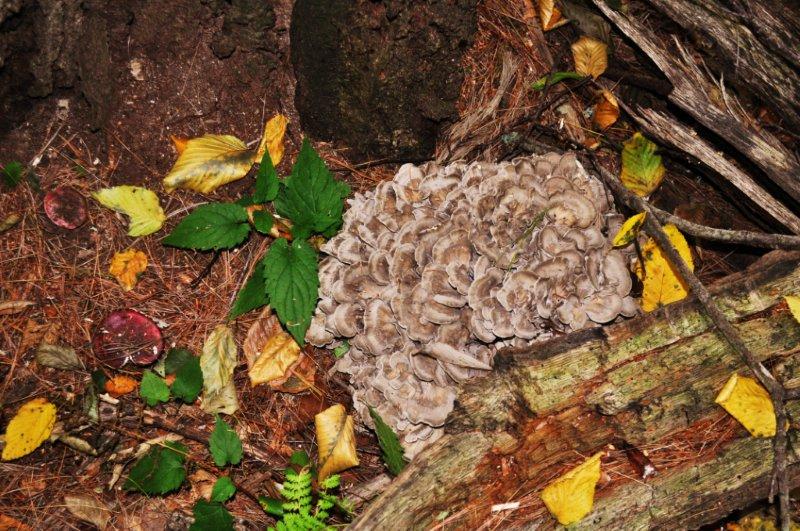
Hen of the Woods, a.k.a. Maitake (Grifola frondosa) is a much sought after delicious October mushroom found in area parks, woodlands, and forests. Fall fungi come in an amazing array of colors. Get a mushroom field guide, take it with you on your forest walks and see how many local mushroom species you can identify.

New England asters, and their associates, are blooming in the Southeastern Massachusetts Bioreserve. How many October wild flowers can you identify? They’re waiting for you, but not for long. Winter is waiting in the wings.
Check our Calendar for upcoming events and activities.
<Back
Social