Newsletters
December 2011 - Am. Holly, White-tailed Deer, 2011 Successes
WELCOME TO GREEN FUTURES !
DECEMBER, 2010
“In the depth of winter, I finally learned that within me there lay an invincible summer.”
-Albert Camus
“Spring passes and one remembers one's innocence. Summer passes and one remembers one's exuberance. Autumn passes and one remembers one's reverence. Winter passes and one remembers one's perseverance.”
-Yoko Ono
CHRISTMAS MIRACLE OR MERRY PRANKSTERS?-
Stay Tuned!
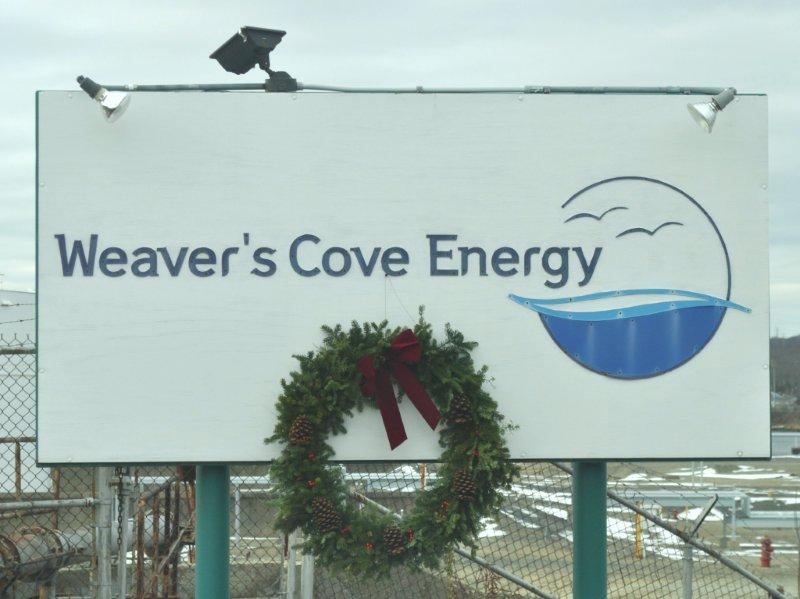
Photo from last December’s Newsletter. Hess/Weaver’s Cove LNG celebrates Christmas in Fall River by nailing a $50.00 wreath to their poorly designed and cheaply made sign. You’d think a company that has spent millions trying to force their ill-conceived, dangerous project on a community …that wants nothing to do with them …would have made a greater effort. This visual tells all one needs to know about Hess/Weaver’s Cove.
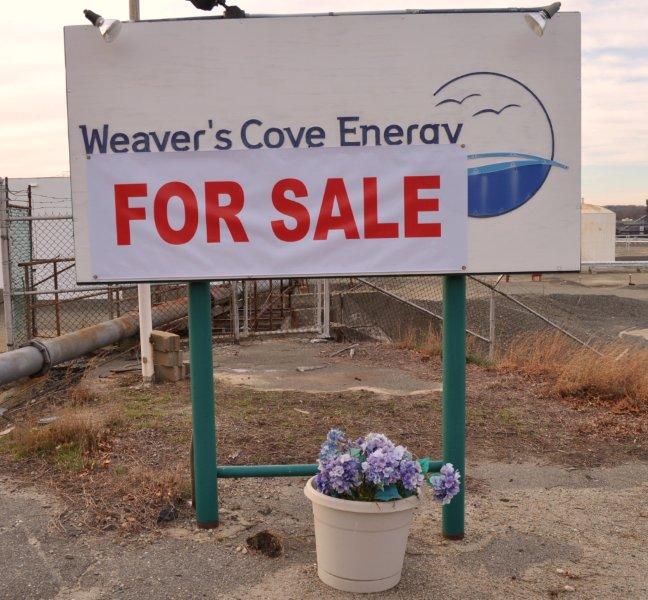
Same sign, this December.
BIORESERVE “CHRISTMAS” FLORA OF THE MONTH – AMERICAN HOLLY (Ilex opaca)
At Christmas do you deck the halls with boughs of holly?
In summer one can’t see the holly trees for the forest. In the warmer seasons of the year the holly is easily overlooked since it grows as an understory tree among the much larger and taller hickories, beeches, oaks and maples.
However, when winter arrives and all the forest’s deciduous trees and shrubs are bare of leaves, the evergreen holly trees, seemingly by magic, make their appearance in area woodlands.
“And as, when all the summer trees are seen So bright and green, The Holly leaves a sober hue display Less bright than they, But when the bare and wintry woods we see, What then so cheerful as the Holly-tree?”
-Robert Southey
Holly trees are very slow growing, easily killed by forest fires, but stump sprout readily and are extremely resistant to most tree diseases and defoliating insect species.
Due to their slow growth, centuries of commercial harvesting of foliage and berries for Christmas greens and because holly trees are at the northern limit of their range here in Massachusetts it is rare to find one taller than thirty feet in height. In our southern states it is possible to find sixty to seventy foot specimens. The record “champion” American holly is an amazing 99 feet tall living in Congaree Swamp National Park, Eastover, South Carolina. Delaware has proclaimed the American holly its “state tree.”
Holly leaves are bright green, leathery and glossy. The leaf edges contain sharp spines that stop most forest mammals from considering them a desirable food source. The leaves remain on the branches for three years, falling in their third spring when pushed off by new leaf buds. Holly bark is smooth and light gray and holly wood is strikingly white, tight-grained and hard.
Holly wood is often used with darker woods for contrasting cabinet inlays, fancy furniture, chess pieces and detailed wood carvings. In its natural white color or stained it is used in the manufacture of musical instruments and game calls.
For most Europeans and Americans it is difficult to think of holly without also thinking of Christmas. English holly (Ilex aquifolium), native to most of Europe, is closely related to our American holly and has a long association with the winter solstice, fertility, wintertime religious festivals and holidays.
The Romans used holly to honor Saturn, god of agriculture, during their Saturnalia festival held just before the winter solstice.
The Celtic Druids decorated with holly to ward off evil spirits in the winter and burned it for fertility in the spring at planting time.
Since holly leaves remain shiny and deep green throughout the long, cold winter and the holly berries stay bright red too, early Christians adopted holly as a wintertime symbol representing eternal life.
There are many wintertime/Christmas songs and carols that mention holly. Two of the oldest and most loved, that blend Christian imagery with their Pagan origins are ”Deck the Halls” and “The Holly and the Ivy.”
The Holly and the Ivy
The holly and the ivy,
When they are both full grown,
Of all the trees that are in the wood,
The holly bears the crown.
O the rising of the sun
And the running of the deer
The playing of the merry organ
Sweet singing of the choir
The holly bears a blossom
As white as lily flower;
And Mary bore sweet Jesus Christ
To be our sweet Savior.
O the rising of the sun
And the running of the deer
The playing of the merry organ
Sweet singing of the choir
The holly bears a berry
As red as any blood;
And Mary bore sweet Jesus Christ
To do poor sinners good.
O the rising of the sun
And the running of the deer
The playing of the merry organ
Sweet singing of the choir
The holly bears a prickle
As sharp as any thorn;
And Mary bore sweet Jesus Christ
On Christmas Day in the morn.
O the rising of the sun
And the running of the deer
The playing of the merry organ
Sweet singing of the choir
The holly bears a bark
As bitter as any gall;
And Mary bore sweet Jesus Christ
For to redeem us all.
O the rising of the sun
And the running of the deer
The playing of the merry organ
Sweet singing of the choir
The holly and the ivy
Now both are full well grown,
Of all the trees that are in the wood,
The holly bears the crown.
O the rising of the sun
And the running of the deer
The playing of the merry organ
Sweet singing of the choir
American holly is found from coastal southern Massachusetts south to mid-Florida and west, across the south, to east Texas.
Most trees in New England are monoecious, having both male and female flowers on the same tree. Hollies are dioecious with male and female flowers on separate trees.
Hollies in our area bloom in June. The small white flowers, male staminate, female pistillate, on their respective trees, rely on bees, wasps, moths and butterflies for pollination.
The familiar red berries, botanically called drupes (fleshy fruit having a hard stone that encloses a seed), start out green ripening to a bright red by fall.
Many species of forest birds eat holly berries. Cedar waxwings and wintering robins are particularly fond of them. Squirrels, deer, mice and voles also eat the berries.
Although we have many holly trees in the Southeastern Massachusetts Bioreserve and other local coastal woodlands there are two locations in our neck of the woods noted for their native American hollies and various horticultural varieties that you might want to visit. The Ashumet Holly Reservation is a Massachusetts Audubon Society property in Falmouth. Read about it here: http://www.massaudubon.org/Nature_Connection/Sanctuaries/Ashumet_Holly/
The Trustees of Reservations manage the Lowell Holly Reservation in Mashpee/Sandwich. Read about it here: http://www.thetrustees.org/places-to-visit/cape-cod-islands/lowell-holly.html#t5
Have a Holly Jolly Christmas!
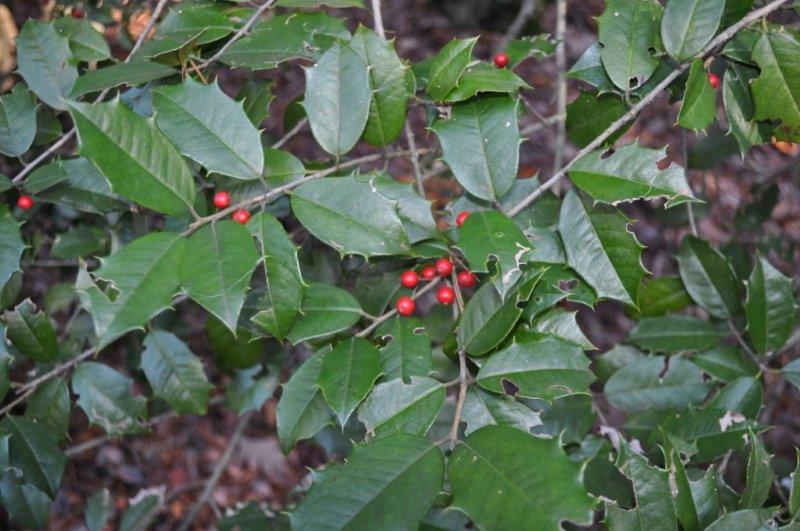
Female American Holly in the Southeastern Massachusetts Bioreserve.
BIORESERVE “CHRISTMAS” FAUNA OF THE MONTH – WHITETAIL DEER (Odocoileus virginianus)
No Christmas reindeer on the roof or in the backyard, but we do have a wild reasonable facsimile living among us.
Except for the occasional errant moose or black bear that wanders into heavily urbanized eastern Massachusetts the whitetail deer is the largest land mammal commonly encountered in area woodlands.
Amazingly plastic, whitetail deer thrive in remote forests as well as in the backyards of your neighboring housing subdivision.
Another key to whitetail success is that they are food generalists and can eat almost any vegetation. Browsers, more than grazers, deer in our area feed on more than 500 species of plants. Southeastern Massachusetts Bioreserve plants we’ve seen deer feeding on include: greenbrier, raspberry, blackberry, red maple, aspen, hay-scented fern, shadbush, blueberry, wild grape, wild rose, white ash, yellow birch, black birch, meadow sweet, wild carrot, hawkweed, dandelion, lespedeza, jack-in-the-pulpit, oak acorns, beech nuts, wild apples, smooth sumac, little bluestem, clover, timothy, sweet fern, witch hazel, hen-of-the-woods mushroom, poison ivy, viburnams, hawthorn, honey mushroom, dogwood, bearberry, wintergreen, partridgeberry, hackberry, spicebush, yew, red cedar, Atlantic white cedar, hazelnut, panic grass, quack grass, crab grass.
Like domestic cattle, sheep and goats …deer are ruminants. They have a four chambered stomach and chew a cud. In winter deer must consume 5 to 10 pounds of good quality browse per day to stay fit. Deer spend the night browsing and during the day loaf in a sunny location chewing their cud.
Mating season, commonly referred to as the “rut” occurs in our area in November. Bucks use their antlers in dominance displays and battles seeking to impress receptive does. Bucks travel widely at this time looking for does and not paying attention to their surroundings. Many end up as road-kill.
During the rut does give off pheromones that tell bucks that a doe is in heat. Bucks also thrash small trees and shrubs with their antlers and head during the breeding season leaving a scent other deer can detect. These buck marked trees are called “rubs.”
Scrapes are another way white tail deer communicate during the mating season. To make a scrape a deer uses its hooves to rake back leaves and litter down to bare soil. Buck scrapes are round or oval and two to three feet in diameter. The scrapes are usually located beneath low hanging branches which the bucks mark with forehead gland scent while urinating in the scrape. Receptive does visit these locations often. Scrapes tell other bucks, entering the area, that a resident buck is in attendance and has claimed the territory.
Locally, most fawns are born the last week in May to the first week in June. Many arrive on Memorial Day, the last Monday in May.
Is there any cuter forest critter than a fawn with its large brown eyes, long eyelashes, warm chestnut brown coat with white dappling?
Yearling does bear one fawn. Older does in good condition often have twins or triplets. An occasional doe in exceptionally good health may have four fawns.
Right from birth a fawn stays quiet and motionless instinctively stretching out on the forest floor should it sense anything that might prove dangerous. Born virtually scent free and without any movement to give away its position most predators walk by oblivious to the tender meal just a few feet away.
For the first week of their lives fawns remain in one spot and the doe stays away only coming four or so times a day to nurse her baby. After the first week the fawns are up and about and can follow their mothers. At one month old fawns are browsing and can outrun most predators. Fawns lose their spotted coats at four months old.
Six month old male fawns are known as “button” bucks because by the fall they have skin-covered boney bumps on their heads. When a year and a half old they will have grown spike antlers or if their nutrition has been good branched antlers.
Does do not grow antlers. Bucks re-grow their antlers every year. At the end of the mating season in late December through January most bucks drop their antlers. Antlers begin to regrow as the days lengthen in spring.
Antlers do not necessarily grow longer, more branched and thicker each year. Antler growth is determined by genetics, overall health, nutrition and age.
Bucks (males) are larger than does (females). Locally, our white tail deer does weigh 70 to 120 pounds, bucks (males) 110 to 180 pounds. An occasional buck may top out at over 200 pounds, but that is extremely rare.
The deer's coat is a reddish-brown in the spring and summer and turns to a grey-brown throughout the fall and winter. The deer get their common name from the white underside of its tail, which it shows as a signal of alarm by raising the tail during escape. While hiking in area woodlands the flashing white tail is all of the deer most people see as it flees from their approach.
Whitetail deer have a huge range. They can be found from mid-Canada south to Peru and northern Brazil. They can be found in all states except for Hawaii, California, Nevada, Utah and Alaska.
Originally here in New England wolves, mountain lions and humans were the chief predators of deer. Black bear, bobcat, lynx, fisher and coyotes prey on young fawns, but are not capable of taking down large healthy deer.
The elimination of wolves and lions from New England removed the whitetail deer’s most efficient predators.
Today, whitetail deer are one of the commonest mammals in area woods and forests. That such a large animal is able to live and prosper in our human altered environment is truly remarkable.
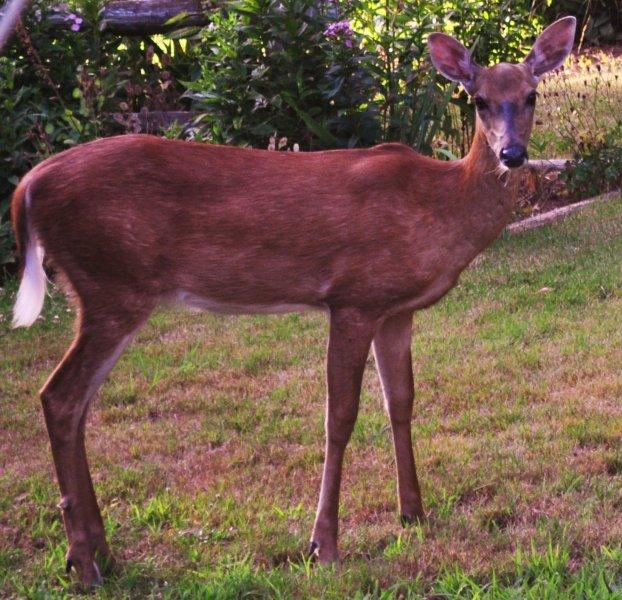
Doe, a deer, a female deer.
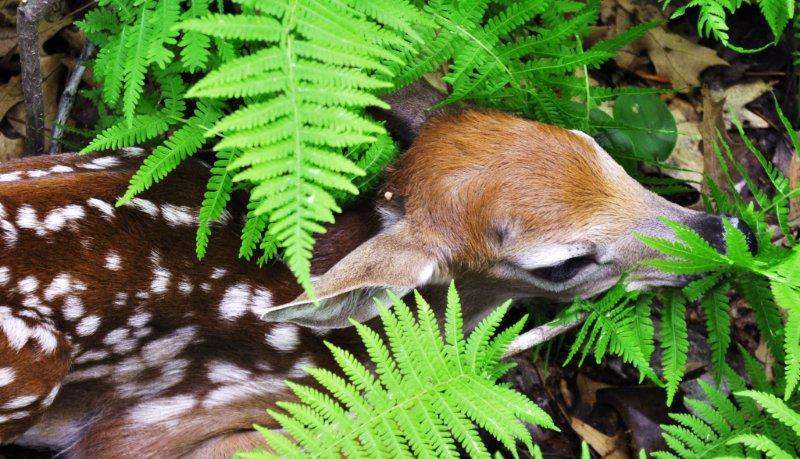
Whitetail fawn trying to be invisible.
WOW!!! Wasn’t Y2K just yesterday? – Almost 2012 …No way!
If you’re older than 12 you might remember Y2K was the abbreviation for the dawning of the “new” millennium when all computer programs not modified to account for the millennium change would grind to a halt.
Seems like Y2K was just the other day, but looking at the calendar we see 2012 looming on the horizon.
HAPPY NEW YEAR!!!
The ending of the old year and coming of the new is always a good time to check up on the past year’s successes and to plan for those things that will still need work in the new. Here are some of the environmental issues that we have worked on in 2011 and that we will continue to follow and work on in 2012.
*As the founding member of the Coalition for Responsible Siting of LNG Facilities we are pleased to see that after a long nine year battle fighting the ill-conceived Hess LNG proposal to store 4.4 billion cubic feet of natural gas in an urban area and destroy the ecology of Mount Hope Bay and the Taunton River increased domestic gas production killed the economic viability of the Weaver’s Cove project. With our federal government controlled by BIG ENERGY and totally unresponsive to the pleas of the people most affected by the Hess Project, it would have been up and running years ago if not for the fantastic work of the Coalition and its president Joe Carvalho. Kudos to all, in both Massachusetts and Rhode Island, that kept the pressure on. We must now make sure the Historic Brightman Street Bridge stays up, Weaver’s Cove leaves town, and that a responsible entity buys the property for a project that respects the environment, provides jobs and is an asset to the city and its residents. .
*A founding member of the Massachusetts Coalition for Clean Air seeking to stop plans to turn the obsolete Somerset NRG Power Station into a trash burning incinerator. We oppose all gasification incineration schemes that are not pollution-free. Congratulations to the Coalition since NRG has now abandoned gasification and wants to sell the plant. We are now providing ideas on how the property can be reused to benefit both the environment and town.
*Advocated for a wildlife underpass under Route 24 as part of the Interchange 8B project. A wildlife underpass will allow a connection between the Southeastern Massachusetts Bioreserve and the Taunton River at Peace Haven. The underpass and ancillary fencing is nearing completion and hopefully will reduce road-kill along that stretch of highway.
*Continuing advocacy for protection of the Peace Haven site in Freetown. A gorgeous parcel of open space land that has been continuously inhabited for the last 10,000 years …from Paleo-Indians down to the present day. We thought a significant portion of the site would be protected in 2011 by Meditech which wished to build on only twenty-plus acres of the property and were willing to place a conservation restriction on the remainder. Unfortunately a dispute arose between the company and the state agency responsible for protecting archeological artifacts and historic sites. This issue is still not resolved and we will be following it through the coming year.
*Support for Dominion’s Brayton Point Station for going to closed-cycle cooling. Getting past Brayton Point owners to comply with clean water regulations was a twenty year battle until Dominion bought the plant. Led by Rhode Island and the U.S. Environmental Protection Agency Dominion agreed to do the right thing. We agree with opponents that the cooling towers are huge and ugly, but if closed-cycle cooling is the only way to restore the ecology of Mount Hope Bay we can overlook ugly.
* We will continue into the new year with monthly “Exploring the Bioreserve” walks. Thanks to members Roger and Liz for heading up this effort. These walks are an important tool in building a Bioreserve constituency.
*Pushing the state for the acquisition of in-holdings and adjacent parcels of significant habitat to fully complete the acreage needed for a sustainable Southeastern Massachusetts Bioreserve.
*Now that Massachusetts has legalized gaming, continuing to oppose any gaming facilities adjacent to or that require access through protected public open space lands. We oppose the selling of any public open space land to any so-called “sovereign nation.”
*Continuing to monitor road grading/paving in the Southeastern Massachusetts Bioreserve so that the environment is protected during road construction and repairs.
*Supporting environmentally friendly and sustainable alternative energy projects.
*Notifying our members and e-subscribers of environmental issues important to our region and supporting environmental initiatives of similar local, state and federal organizations. Continuing to “think global …act local.”
We do all this as a totally all-volunteer organization. Donations to continue what we do are always welcomed. Full membership is still only $10.00 a year. As a 501 (c) 3 non-profit organization your donations are tax deductible.
If you wish to make a donation of any amount please send it to Treasurer, Green Futures, P. O. Box 144, Fall River, MA 02724-0144 …or, alternatively, go to gf.gareworks.com and click on “Get Involved With Us.” Thank you.
EXPLORING THE BIORSERVE WALK – By Moonlight!
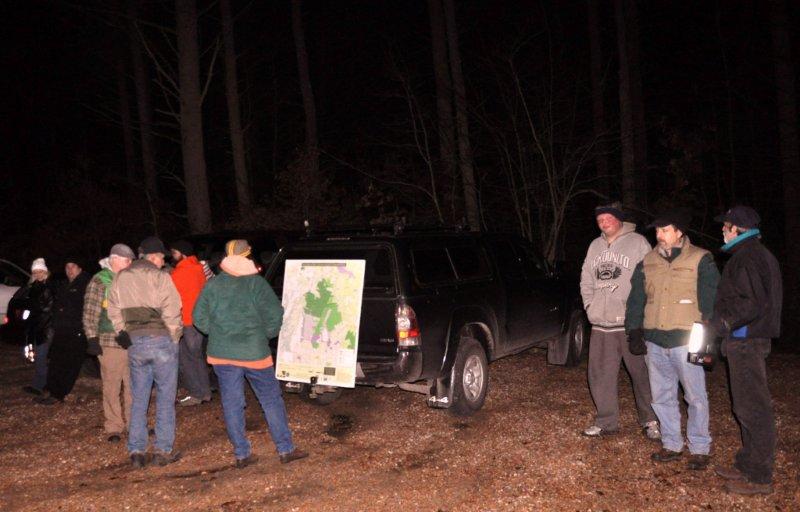
A few of the full moon hikers checking out the walking route on the Bioreserve map.
December’s full “Cold Moon” found a bunch of intrepid hikers out in the Bioreserve walking by the light of the full moon …and a few flashlights.
Bundled up for the winter weather kept everyone warm and in good cheer as we made our way down to King Philip’s Spring.
While at the spring we were briefly serenaded by a chorus of coyotes who, it appears, were having a difficult time figuring out what humans were doing out in the forest so late at night.
On the hike back we also heard two barred owls call way off to the northeast from where we were. And, when we arrived back at the trailhead we were served cider, hot chocolate and mini-muffins. Fantastic! Thank you Roger and Liz!
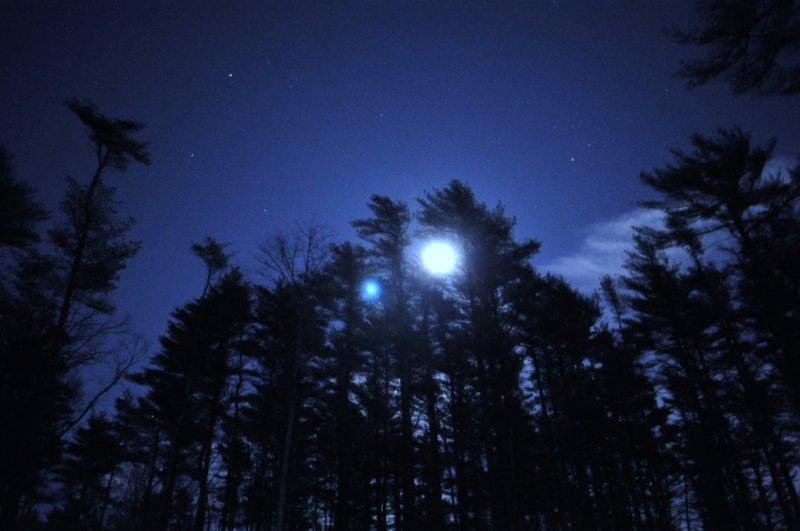
December’s Cold Moon rising over the forest.
Wintertime – For real, boreal things to see and do …click on our Calendar!
<Back
Social