Highlights
July 2024 - Bioreserve Education Center, July Hike Again
INFO ALERT - TTOR, RESTORE THE SHOCKLEY SWAMP TRAIL!
FOR ONCE, DO THE RIGHT THING.
The Trustees of Reservations (TTOR) conveniently forgot they promised to construct and staff a Bioreserve Environmental Education Center when they bought into the initiative to create a bioreserve a little over twenty years ago.
They reneged on that promise after failing to find any "old money" or attract sufficient new dues paying members. What did they expect in an environmental justice community? In Massachusetts an environmental justice community is one where the population is economically disadvantaged, contains folks with low levels of educational attainment and where minorities make up at least 40% of the population. The Southeastern Massachusetts Bioreserve has environmental justice neighborhoods within its boundaries. No doubt disappointed, TTOR fled Fall River. Little money and few local members, TTOR eventually fired their wonderfully effective environmental educator and mostly left the Bioreserve until they found some trails gas grant money to bring them back for another nibble at the Bioreserve.
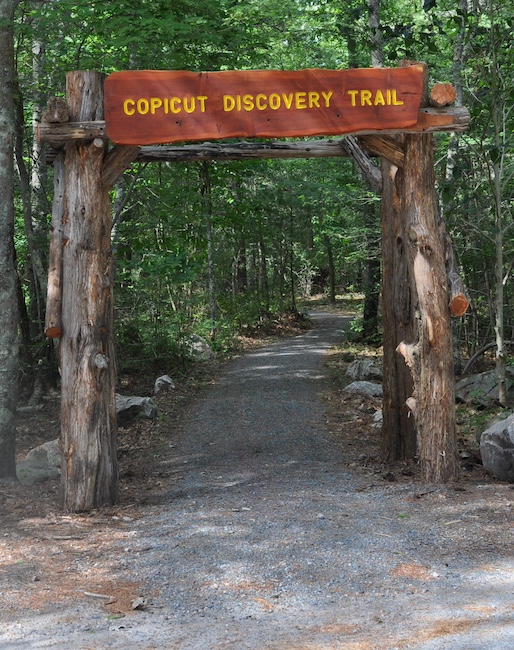
They had the real thing. A real trail, with varied habitat in a mostly hardwood forest. Here it is now; they destroyed a bit of the Bioreserve to create a faux nature trail. All kids deserve the real thing.
More about this issue and photos too from our "April Highlights" here: http://gf.gareworks.com/?content=woxql63G6j9UzMqA
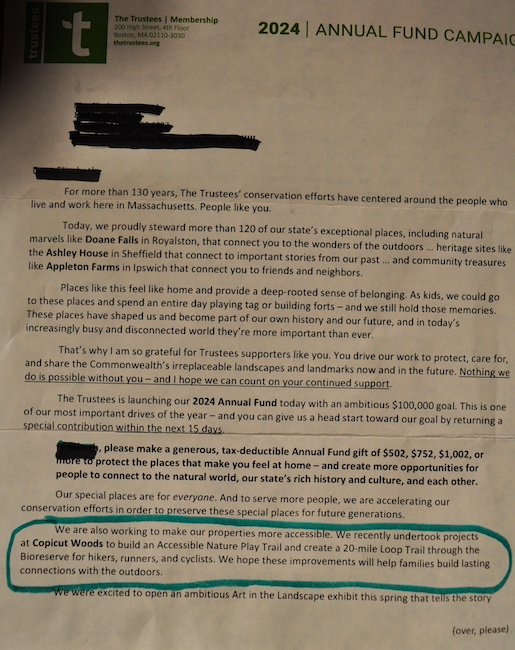
Note paragraph at bottom of letter circled in green. No mention that their Copcut Woods property is within the Southeastern Massachusetts Bioreserve, no mention of BIPOC children or other silly woke jargon they used in their grant application to access gasoline tax money from the state to damage the landscape, no mention that this construction of their "discovery" trail would be in a dedicated bioreserve.
We doubt this faux nature trail will, "help families build lasting connections with the outdoors." It is the wrong thing in the wrong place.
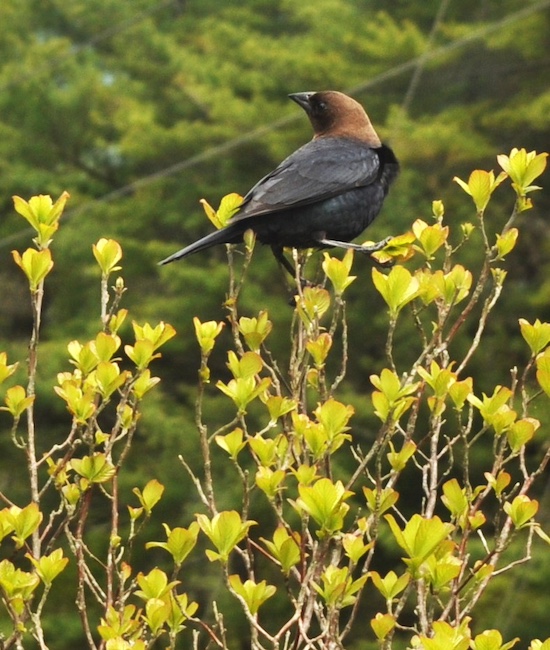
What happens when you fragment our remnant forest? Here's one example.
When you fragment the forest you lose native species that evolved with that forest. Here in Massachusetts dozens of native species of flora/fauna are dependent on our presently fast disappearing forests and woodlands.
Let's look at one New England non-native species that thrives in fragmented forests, the cowbird. When the forest is fragmented the cowbird moves in and kills off native species. Cowbirds evolved and belong on the Great Plains, not in the New England forest. On the Great Plains cowbirds were nomadic, following huge herds of bison feeding on the insects and ticks that tormented the bison and on insects that the bison stirred up as they moved along on migration. With the near extinction of the bison, clearing of the great eastern forest (our forest) and the appearance of farms and livestock, the cowbird switched from the fast disappearing bison to domestic cattle. Originally having to follow bison in order to survive, cowbirds evolved the strategy of laying their eggs in other birds' nests and then quickly moving on. Nest parasitism enables the cowbird to have other species hatch their eggs and raise their young while they stay with the herd. In the early spring cowbirds return with the earliest migrants often arriving with warblers, vireos and others. Wide trails and other man-made openings in the forest make ideal locations for cowbirds to locate and scout for victims.
----------------------------------------
ACTIVITY ALERT - July walk in the forest was cancelled due to predicted rain and thunderstorms. The thunderstorms didn't materialize ...but the rain did.
This coming Saturday, July 20, we will try again.
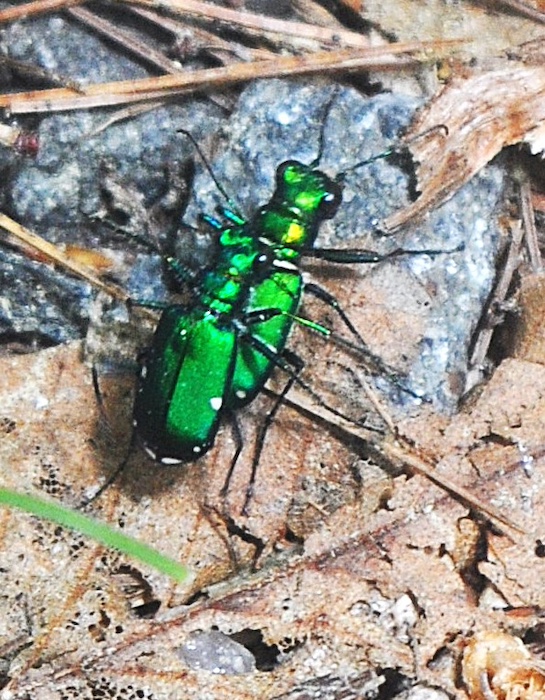
Insects come in an amazing array of sizes, shapes and colors. They are cold-blooded critters, which means they cannot regulate their body temperature. Their body temperature will be the same as the temperature outside. They love summer and sun.
Here we have an apparently happy pair of emerald green six-spotted tiger beetles. They are fierce and fast, beautiful and beneficial as they prowl the summertime forest looking for flies, mosquitoes, inchworms and other beetles and small insects to eat. They are harmless to humans as they scurry about the sunny forest floor. Watch for them as you walk along. More on the six-spotted tiger beetle here- info: https://en.wikipedia.org/wiki/Cicindela_sexguttata#:~:text=4%20External%20links,metallic%2Dblue%2Dgreen%20elytra.
July Walk this coming Saturday, July 13 . Meet at 8 a.m. at the intersection of Indian Town Road and Yellow Hill Road. Fall River, MA.
Roads in much of the Southeastern Massachusetts Bioreserve are in poor condition. Access our meeting location from the Westport side of the SMB via Blossom Road.
Length of walk 4 miles. Water and snack always a good idea. Wear shoes/boots suitable for walking forest trails and uneven ground. Rain cancels walk.
Mosquitoes may be a nuisance. Insect repellent containing DEET or picaridin is good to have when hiking in the forest from now through November.
<Back
Social