Newsletters
May 2011 - Turtles, Snake, Geranium, John Gilmour Sherman
WELCOME TO GREEN FUTURES!
MAY, 2011
Summer afternoon - summer afternoon; to me those have always been the two most beautiful words in the English language.
-Henry James
“The turtle lives 'twixt plated decks …Which practically conceal its sex. I think it clever of the turtle …In such a fix to be so fertile.”
-Ogden Nash
YEAR OF THE TURTLE –
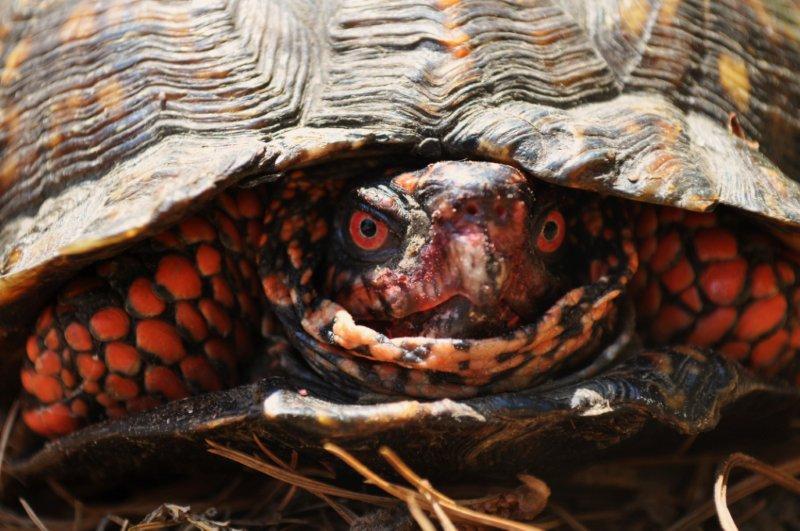
This male box turtle (males have red eyes, females brown) lives in the Southeastern Massachusetts Bioreserve. Massachusetts’ only terrestrial turtle species, the box turtle is slowly disappearing. A box turtle’s shell, unfortunately, did not evolve to protect these slow moving creatures from today’s cars and trucks.
The Massachusetts Division of Fisheries and Wildlife, other organizations and concerned individuals have declared 2011 the “Year of the Turtle.”
Local turtle species move about in June seeking sunny, sandy areas in which to dig a hole and lay their eggs. This is when they are most vulnerable …often encountered trying to cross roads. Helping a turtle cross a road, providing you can do so safely, is a good thing to do. Most road crossing turtles, at this time of the year, are females carrying the future generation. If helping a turtle cross a road, always move the turtle in the direction it was going. If you just move it back to the side where it just came from, it will promptly try to resume its journey and cross again once you leave.
Small species can simply be picked up and carried. Large snapping turtles can be intimidating and you do not want to get bitten. Grasp the base of the tale or rear of the shell, keeping the neck and head pointed away from you, and slide to the desired side of the road. Alternatively you can slide them along, in the direction they are going, using your foot. Just remember to slide from the rear.
The Division of Fisheries and Wildlife and Partners in Amphibian and Reptile Conservation will be sponsoring turtle events throughout the year. Go to http://www.mass.gov/dfwele/dfw/nhesp/conservation/herps/turtle_calendar.htm to view their calendar.
On May 27 the public was invited to help celebrate the Year of the Turtle by releasing baby red bellied cooter turtles into Burrage Pond in Hanson.
These endangered turtles were “head-started” by students in area schools. Schools that wish to participate are given hatchling red bellies in the fall and the students feed, weigh and measure them throughout the school year for release in May.
This greatly benefits the red belly babies since instead of hibernating directly after hatching in the fall, they instead get to eat all winter so on release they are many times larger than their wild peers and more likely to escape predation.
Here’s part of the news release from Fisheries and Wildlife:
As part of the Partners in Amphibian and Reptile Conservation (PARC) Year of the Turtle awareness campaign, the Massachusetts Division of Fisheries and Wildlife (DFW), invites the public to a release of young "head started" endangered Northern Red-bellied Cooters and a Turtle Celebration from 10-Noon on, Friday May 27, 2011 at the DFW's Burrage Pond Wildlife Management Area in Hanson/Halifax. This family-friendly event will provide turtle enthusiasts a special opportunity to release Northern Red-bellied Cooters, to see other live native turtles found here in Massachusetts, participate in a radio telemetry turtle tracking exercise with a biologist and learn from biologists and other turtle conservationists about the threats to turtles and ways you can help them here in Massachusetts. This event will be occurring rain or shine.
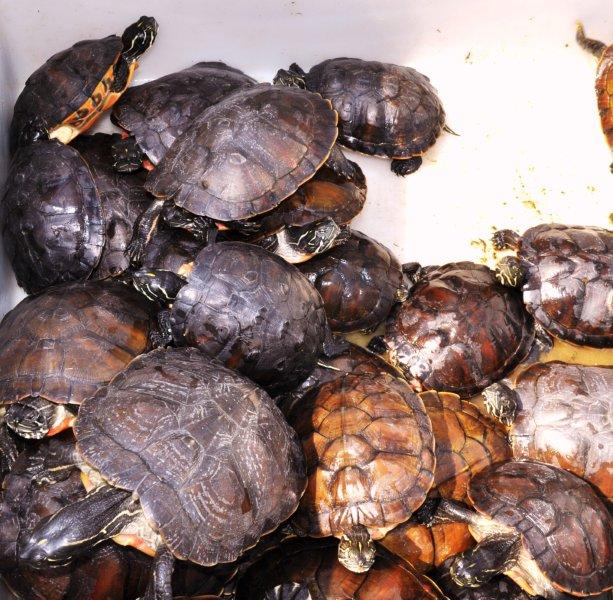
Bin of “head started” young red bellied cooters waiting to be released.
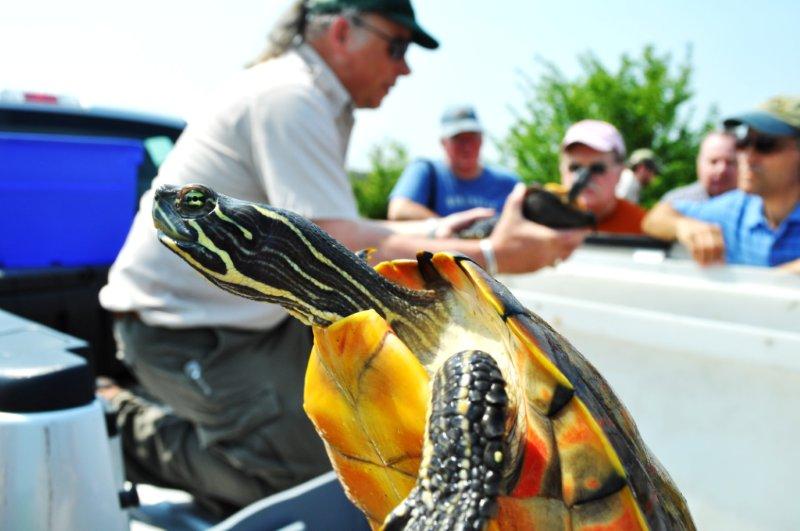
While a wildlife biologist, in the background, talks about a red bellied cooter …an eager one attempts an escape from the plastic bin.
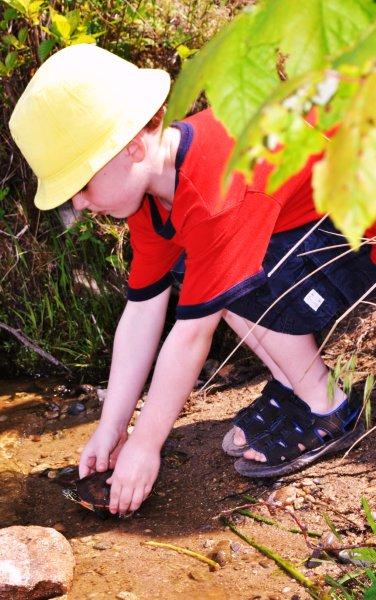
Youngster releasing youngster into Burrage Pond.
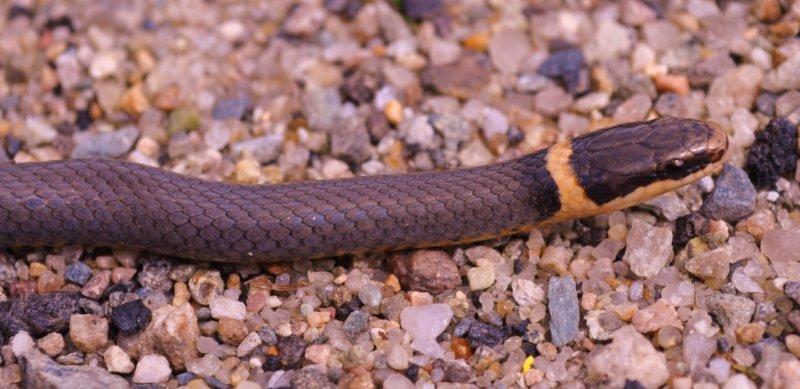
BIORESERVE FAUNA OF THE MONTH – Ringneck Snake (Diadophis punctatus)
The ringneck snake is probably the Bioreserve’s most common reptile. Small, secretive and nocturnal they are rarely encountered unless one is specifically looking for them. They usually spend their daylight hours resting under rotting logs, pieces of bark, stones and rocks in wooded areas
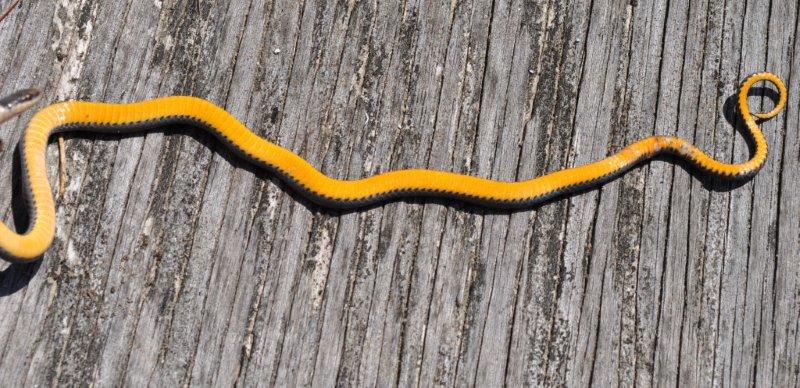
Uniform slate-gray in color, they are very slender with a bright yellow ring just back of the head. Caught by an enemy the ringneck thrashes about exposing its bright yellow underside hoping to startle its attacker thereby facilitating an escape. When under such stress, the ringneck also exudes an unpleasant smelling musk that is persistent and adheres to whatever it touches resisting removal.
Adults are normally twelve to eighteen inches in length. A very old, well-fed ringneck may be as long as two feet.
Ringnecks are mating as you read this. In early summer females will lay four to eight cylindrically shaped eggs in rotted stumps or under woody forest debris. Newly hatched ringneck snakelings appear in late summer and are three to four inches long at birth.
Ringnecks frequent damp, low-ground areas where salamanders, their favorite prey, are found. In the Bioreserve the red back salamander (Plethodon cinereus) is at the top of the ringneck’s food list, but they also eat other salamanders, earthworms, spring peepers and other small frogs.
BIORESERVE FLORA OF THE MONTH – Wild Geranium (Geranium maculatum)
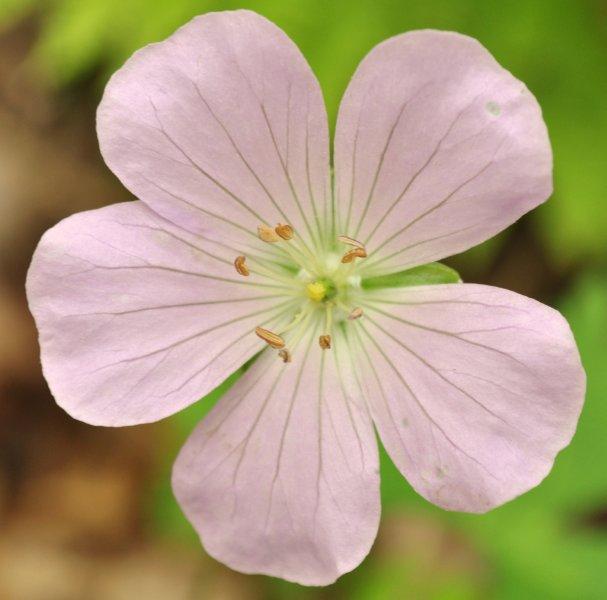
The wild geranium is a common spring wildflower in area woodlands. It is flowering now …May thru June.
Wild geranium is perennial, grows from a rhizome and reaches two feet in height. The flowering stem has opposite leaves. Basal leaves and the leaves of the flowering stems are similar in appearance. All leaves are hairy and deeply palmate with five lobes. Leaf margins have secondary lobes. The leaves are coarsely toothed.
It does best when growing from moist, humus-rich, acidic soil under partial shade. It is one of our easiest native woodland flowers to grow in a home wildflower garden.
Geranium is derived from the Greek word for “crane.” The wild geranium’s long, thin seed pod resembles a crane’s beak. The seed capsules split when the seeds are fully mature. The splitting of the capsules propels the seeds away from the parent plant hopefully to an adjacent spot where there will be similarly favorable soil for germination. This form of seed dispersal means one generally finds colonies of wild geraniums rather than just single, individual plants.
An earlier name for the wild geranium was alumroot. Since ancient times the mineral alum was used as a coagulant, styptic, astringent, anti-inflammatory and antibiotic. Wild geranium’s tannin rich rhizome has these same properties and was highly valued in early New England. A poultice made from the mashed rhizome was used to treat burns. Wild geranium root tannins were also used by Indians for tanning hides.
Today, some folks still use wild geranium tinctures and extracts medicinally and it can be found in health and herbal stores.
THANK YOU MR. SHERMAN –
John Gilmour Sherman was a prominent Fall River psychologist who passed away in 2006. Sherman was a graduate of Fall River’s Durfee High School and became a behavioral psychologist and chairman of the psychology department at Georgetown University. He studied with renowned behaviorist B.F. Skinner.
In his will, Sherman donated two parcels of land, adjacent to the southwest corner of the Southeastern Massachusetts Bioreserve, to the Greater Fall River Land Conservancy.
Totaling twenty acres, the land contains headwaters of Bread and Cheese Brook and helps toward reaching the Bioreserve goal of 15,000 acres …the minimum acreage needed to ensure the viability in perpetuity of our Bristol coastal forest and its inhabitants.
The dedication ceremony took place on Blossom Road and was coordinated by Greater Fall River Land Conservancy President Al Lima and Watuppa forester Mike Labossiere. In attendance at the dedication ceremony were members of the Sherman family, neighbors, Greater Fall River Land Conservancy members, The Trustees of Reservations and the mayor of Fall River.
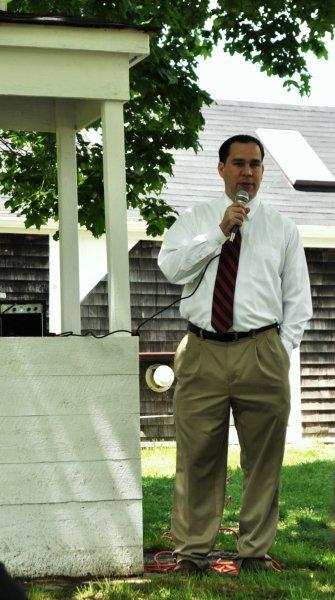
Fall River Mayor Will Flanagan welcomes folks to the Sherman land dedication ceremony.
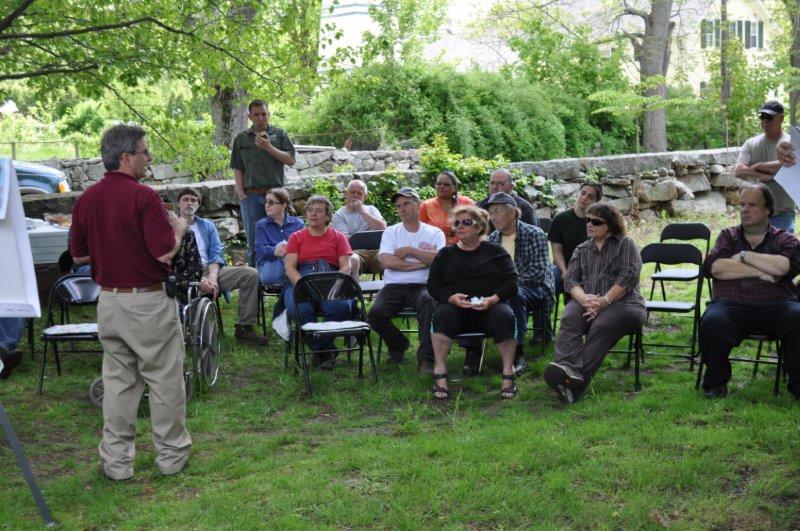
Mike Labossiere explaining the history of the Sherman donation to those in attendance at the land dedication ceremony.
MONTHLY WALKS –
Click on our calendar for our monthly walks titled, Explore the Bioreserve. One is scheduled for June 11. This is a great time of year for outdoor rambles.
<Back
Social