Newsletters
December 2010 - Casinos, Fishers, Membership
WELCOME TO GREEN FUTURES !
DECEMBER, 2010
“Each new year is a surprise to us.”
-Henry David Thoreau
“Ooooh that smell
Can’t you smell that smell
Ooooh that smell
The smell of death surrounds you.”
-Lynyrd Skynyrd (Ronnie Van Zant, Allen Collins)
FECKLESS FLANAGAN’S FOOLISH FALL RIVER FOLLY –
Can’t you smell that smell?
No, not the aroma rising from Allied Waste’s Mount Trashmore, but the stink emanating from the sneaky, illegal, vile agreement between the City of Fall River, the Mashpees and their Malaysian investors to site a slot-barn casino on the 300 acres given to the city for industrial development in exchange for a conservation restriction on Fall River’s municipal water supply watershed when it was incorporated into the Southeastern Massachusetts Bioreserve (SMB).
New Mayor Flanagan pulled a rookie mistake when instead of familiarizing himself and his administration with the legislation that created the SMB and the restrictions placed on the use of the land, he blindly pushed ahead with an illegal casino proposal having been snookered by various “Indian” groups salivating to be the first with Indian gaming in Massachusetts.
As you may know, if you’ve been reading our humble e-newsletter for any length of time, the creation of the SMB is the greatest thing that could have happened for the wild flora and fauna of Bristol County, the protection of a regional drinking water supply, outdoor recreational activities, and environmental education.
A work in progress, the SMB is still a few thousand acres short of its recommended size. A size that is necessary, according to state ecologists involved in its creation, to preserve in perpetuity a representative example of the plant and animal life that has called this area home since the retreat of the last glacier more than ten thousand years ago.
As we’ve mentioned in prior articles, we do not take a position on gaming/gambling. We do have a strong position on maintaining and protecting the integrity of the SMB. An Indian gaming enterprise, adjacent to the Bioreserve, would eventually lead to loss of Bioreserve acreage. Also, “sovereign nation” Indian control could mean they would not have to comply with or follow environmental rules and regulations in developing their “sovereign” land.
Here’s “The Herald” article on the latest Flanagan casino smack-down! Think the mayor will be humbled by this, contrite?
We doubt it.
Appeals Court judge upholds injunction against Fall River casino land deal
By Michael Holtzman
Herald News Staff Reporter
Dec 21, 2010
A Massachusetts Appeals Court judge Tuesday denied the city’s request to overturn a preliminary injunction stopping the casino land deal.
There were also new indications Mayor Will Flanagan will pursue a different strategy for the 300-acre site.
Judge Scott Kafker denied the Redevelopment Authority petition without prejudice one day after holding a hearing with lawyers for the Redevelopment Authority and the “Ten Taxpayers Group” that sought the injunction.
Kafker upheld two Bristol County Superior Court rulings. “The issue of whether the 10 taxpayers have standing to challenge the transaction” should be developed at the lower court level, he wrote in a three-page decision.
The Redevelopment Authority approved a $4.5 million sale and $16.5 million option agreement for 300 acres off Route 24 with the Mashpee Wampanoag tribe on Oct. 19.
Attorney Lesley Rich of Somerset filed the suit two days later.
The basis of the suit was that the state Bioreserve Act stipulated industrial development on this former tract of the Freetown State Forest and prohibited casino use — the purpose of the land sale.
Casino gaming also remains illegal in Massachusetts.
Flanagan said he does not recommend further court appeals.
“My decision will not be to continue with the appeals process,” Flanagan said. “I believe a higher appeal would be unwarranted at this time based upon the Appeals Court decision.”
He said that action to presumably halt the appeals is really the Redevelopment Authority’s, although members have followed the lead of the mayor and Fall River Office of Economic Development Executive Vice President Kenneth Fiola the past seven months.
For the first time since the land sale and legalization of casino gaming began to falter, Flanagan said he planned to pursue a dialogue “with all interested parties.”
“We need to have a serious conversation to make a determination of what the next move would be,” he said.
On the table, he said, would include the original plan completed a year ago during the Correia administration to start a state-supported biomanufacturing park to include an anchor tenant in partnership with the University of Massachusetts Dartmouth.
The $4.5 million cash infusion was intended to buy a site for UMass Dartmouth’s biofacility in the area of its Advanced Technology and Manufacturing Center at Martine Street and Eastern Avenue, while the city pursued casino gaming to create jobs and jolt the economy.
Flanagan acknowledged the mounting hurdles. “I would not consider a resort-style casino project to be dead,” adding, “In fact, if somebody has a suggestion how to keep both — a casino and bio-park — alive, I’d welcome their input.”
Rich, offering his opinion, said, “It’s up to the city to withdraw from the contracts (with the Mashpees), go and change the law (prohibiting a casino on the land) and enter a proper process.”
Rich, representing the Pocasset Wampanoag tribe, said of the 300 acres, “I think they should probably move on with a biopark. There are plenty of places for a casino when the time comes.”
Among the parties Flanagan said he’d approach to discuss the best options after the series of court losses would include the Redevelopment Authority, Fiola’s FROED and representatives of UMass Dartmouth and Gov. Deval Patrick’s office.
Secretary of Housing and Economic Development Gregory Bialecki, whose office was integral in the transfer and sale for a biomanufacturing park, would also likely weigh in, Flanagan said.
When asked about the City Council’s role, Flanagan said he planned to meet with councilors individually or in small groups.
“I would consider them an interested party, and their input also would be sought,” Flanagan said of the council with whom he’s had sporadic contact in his first year and been criticized by some members on this issue.
Kafker’s brief written decision said there were “complex matters” to decide whether the “Ten Taxpayer Group” could legally challenge the land sale. In legal parlance, it’s called “standing.”
The state statute related to such a taxpayer group suing lists district school committees, water/sewer districts and “others,” which Rich contended would include a redevelopment authority.
That question is complicated, Kafker said, by the relationship between the Redevelopment Authority, the city and FROED since Rich filed the suit solely against the authority.
But Kafker said the Bristol Superior Court justice who approved the temporary injunction, Judge Richard Moses, is “better positioned to develop the record.”
That’s because a trial with depositions and other detailed filings would be needed to decide the suit’s merits beyond the short-term preliminary injunction, the lawyers agreed before Kafker at Tuesday’s hearing.
Kafker, therefore, suggested Moses, who heard the suit and motions in Superior Court, would better “address any factual issues necessary … including the relationship, financial and otherwise, between the Fall River Redevelopment Authority and the city of Fall River, and whether any tax revenues of the city of Fall River are committed by the purchase and sale agreement.”
The Redevelopment Authority’s motion whether the “Ten Taxpayer Group” had standing when Moses awarded the injunction in October and November “appears to have been undeveloped,” Kafker concluded.
Meanwhile, the Redevelopment Authority has apparently spent more than $50,000 in legal fees, about $44,000 reported as of Nov. 1.
On the unresolved issue of whether the plaintiffs hold “standing,” Rich said, “The city is trying to get off on a technicality on the ‘Ten Taxpayers.’”
He reiterated what he told Kafker that he’d add the city as a defendant to offset state statute requirements.
-------------------
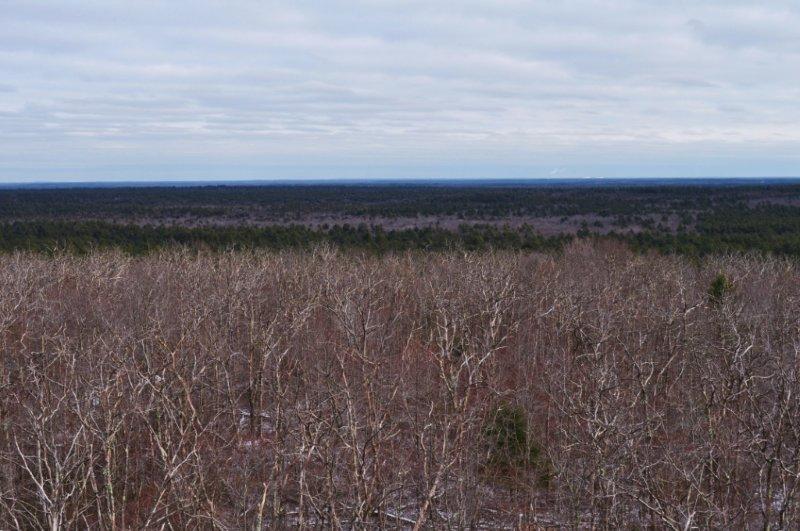
View looking east from the Copicut Hill Forest Fire Lookout Tower across the Southeastern Massachusetts Bioreserve. Look close along the horizon and note the small smoke plume right of center. That plume is emanating from Covanta’s SEMASS Trash Incinerator in Rochester, Massachusetts.
MR. AND MRS. FISHER PLEAD, “NOT GUILTY” -
Just about every week there is an article or two in the local news media about rapacious fisher “cats” dining on beloved house cats and screaming in the night “like women” from suburban woodlots and neighborhood forested areas.
There is usually an interview with an irate or weeping cat owner who relates a story of letting pussycat out one night and then never seeing it again. The new animal on the block, the fisher “cat” …must be to blame.
Well, we’re not convinced these household cats have been gobbled up by local fishers. Let’s take a look at the accused, an intriguing bit of mammalian fauna that has only recently come back home.
First of all, the fisher in not a “cat.” The fisher, Martes pennanti, is a member of the weasel family. They are a native New Englander absent from our neck of the woods for over a hundred years.
Fishers are dependent on forests with substantial areas of closed canopy where their favorite squirrel prey can be found in abundance. When the first Europeans entered the New England forests, fishers were abundant and a valued fur resource. With agricultural land clearing and the subsequent deforestation of New England, except for the remote far northern forests of Maine and New Hampshire, the fisher was soon extirpated from central and southern New England.
It is estimated that we here in southern New England lose about fifty acres of land to development each day. Despite this loss, the cut-over forests that remain have grown back over the past fifty to one hundred years. The return of the forest has brought with it the fisher and other forest dependent wildlife such as black bear, raven, moose, and various other species long absent from southern New England. With an exponentially expanding human population, how long they and the required forest habitat can endure
remains to be seen.
Since local folks have had little experience with the fisher now living nearby in the wooded area just beyond their backyards; if anything goes wrong in the neighborhood, the fisher must be the one that did it.
Pet cats, which should never be outside on their own, begin to disappear and the fisher is blamed. Barks, screams, and other “scary” unidentified noises are heard in the woods at night and once again the fisher gets the blame.
The internet has a huge amount of erroneous information on the sounds fishers make. In listening to sounds on various sites, reputedly made by fishers, we have heard grey fox barks, screech owl tremolos, coyote howls and yips, barred owl screeches and some we couldn’t identify but know were not uttered by Mr. or Mrs. Fisher and/or their kits.
Fishers are usually silent. When nervous they make a chuckling sound and a squall somewhat similar to the sound an agitated raccoon would make. If cornered by a dog or large predator they will growl, snarl, hiss, and spit. Most other members of the weasel family make similar sounds. They do not, “scream like a woman!”
Fishers are not as large as most people think.
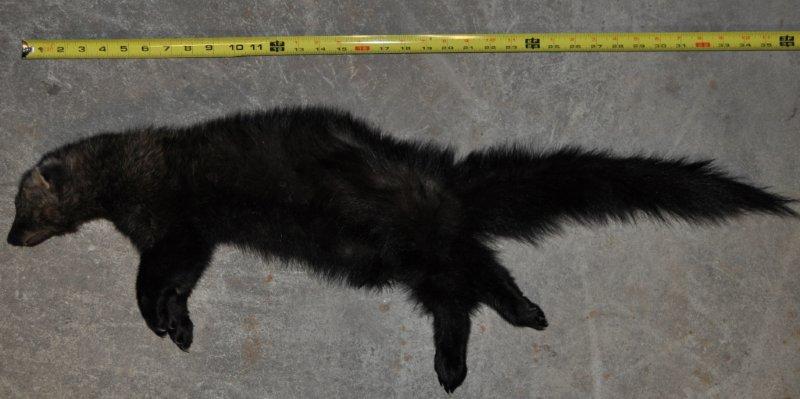
This photo is of a recent road-killed female fisher from the Southeastern Massachusetts Bioreserve.
The tape measure indicates she is about twenty-one inches long, from her head to base of tail. She weighed five pounds.
Male fishers are larger than females and can weigh as much as ten or twelve pounds. Not nearly as heavy as most people falsely estimate when viewing a bushy furred fisher in their backyard woods.
A Felis catus, house cat, averages about twenty inches from nose to tail and weighs, depending on breed, anywhere from three to twelve pounds. Much larger than squirrels and not an animal a fisher would normally want to hassle, although a really large male fisher may take a cat or two.
So, did a fisher eat your missing cat? Probably not. If you foolishly let your cat out for the night and it disappears, don’t blame the fisher. The real culprit, dining on Fancy Feast fattened cat, is probably Mr. and Mrs. Coyote and their pups.
2011- ABOUT TO HAPPEN (Wasn’t the millennium, “Y2K,” just the other day?)
Membership is not a prerequisite for receiving our random email “alerts” and our monthly e-newsletter. It would be nice though, and we could do much more for our shared environment, if we had more members. If not a dues paying member, please consider joining. We are, for the most part, a friendly group of folks sharing a concern for our environment, community quality of life issues, and sustainable living.
In this area of Massachusetts, where the environment has long been taken for granted and has often been sacrificed for short-term economic gain, your participation in our environmental advocacy and education efforts would make a difference.
Members allow us to do amazing things. Check out this list of a few past environmental successes …and then check some of the environmental issues that we are presently working on.
Some Past Accomplishments:
· Stopped attempts by scurrilous development interests and their political lackeys from stealing 1,000 acres of your public open space land.
· Acted as the catalyst for the creation of the Southeastern Massachusetts Bioreserve, the largest public open space parcel in Bristol County. The Southeastern Massachusetts Bioreserve ensures native species diversity will continue to exist, protects public water supplies, and provides an area for environmental education and appropriate outdoor recreational activity.
· Made public the heavy metal contamination of fish in local waters …highest levels in the state. Lobbied state agencies for testing of fish from adjacent water bodies.
· Along with Toxics Action, closed the Fall River trash incinerator. A filthy facility that from the first day it opened …until its last …never met clean air standards.
· Organized two Quequechan River festivals; published The Taunton River Heritage Guide; A River and its City; and a Quequechan River coloring and activity book for elementary school children titled, Your Quequechan River Heritage.
· Helping to end the thermal pollution of Mount Hope Bay by supporting Rhode Island and the U.S. Environmental Protection Agency in requiring Dominion’s Brayton Point Station to go to closed-cycle cooling. Applauding Dominion for finally getting on board.
Some Present Actions:
· As the founding member of the Coalition for Responsible Siting of LNG Facilities we are still fighting the ill-conceived plan to store 4.4 billion cubic feet of natural gas in an urban area and destroy the ecology of Mount Hope Bay and the Taunton River.
· A founding member of the Massachusetts Coalition for Clean Air seeking to stop plans to turn the former Montaup Power facility in Somerset into a trash burning incinerator. Working to stop sham “gasification” incineration projects.
· Advocating for protection of the Peace Haven site in Freetown. A gorgeous parcel of historically significant open space land that has been continuously inhabited for the past 10,000 years …from Paleo-Indians down to the present day.
· Supporting the continued acquisition of significant habitat, as it becomes available, to the Southeastern Massachusetts Bioreserve.
Dues are only $10.00 a year! Haven’t changed since our inception almost twenty years ago.
If interested please make check payable to Green Futures and send to Green Futures, Attn: Treasurer, P.O. Box 144, Fall River, MA. 02724-0144. If possible, please consider an additional contribution. Every year brings an unanticipated expense or two. Thank you.
As a 501 (c) 3 non-profit organization your donations are tax deductible.
----------------------------------
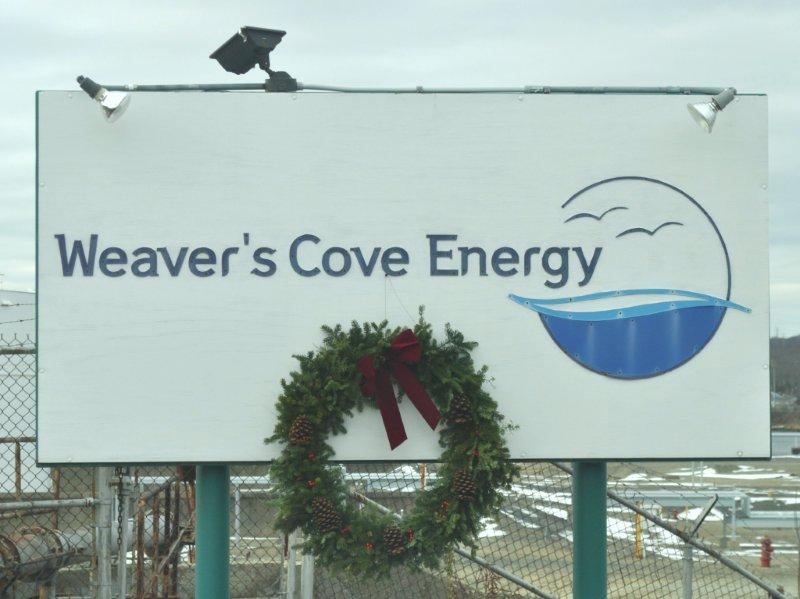
Hess/Weaver’s Cove LNG celebrates Christmas in Fall River by nailing a $50.00 wreath to their poorly designed and cheaply made sign. You’d think a company that has spent millions trying to force their ill-conceived, dangerous project on a community …that wants nothing to do with them …would have made a greater effort. This visual tells all one needs to know about Hess/Weaver’s Cove.
------------------------
Click on our Calendar for winter things to do.
<Back
Social