Newsletters
August 2012 - Coal, Japan's Nuclear Power Problem,Water Lily
WELCOME TO GREEN FUTURES !
AUGUST, 2012
“Take your stinking paws off me, you damned dirty ape.”
- George Taylor (Charlton Heston - Planet of the Apes)
“If we destroy the mountain, do you know how much electricity we get out of that mountain for the coal? An entire mountain provides an hour’s worth of electricity for the U.S.”
- Mike McKinney, University of Tennessee Geology Professor
CLEAN COAL – An oxymoron!
Looking forward to a future …without coal!
Coal Free Massachusetts is a broad coalition of environmental, health and social justice organizations intent on ending the burning of coal for power generation in Massachusetts by the year 2020.
Read about Coal Free Massachusetts, here: http://coalfreemass.org/
Is there any such thing as “clean coal?” http://www.coal-is-clean.com/
Read about the Coal Free Massachusetts action that took place on July 11 at Dominion’s Brayton Point Station, here: http://www.heraldnews.com/newsnow/x736419646/Clean-air-activists-gather-in-Somerset-to-launch-anti-coal-initiative
And, at Dominion’s power plant in Salem, here: http://www.salemnews.com/local/x1301511478/Coalition-aims-to-shut-states-coal-plants and, here: http://www.boston.com/yourtown/news/salem/2012/07/all_photos_by_ryan_mooney.html
Read about the protest at FirstLight’s Mount Tom coal burning plant, here:http://www.masslive.com/news/index.ssf/2012/07/holyoke_activitsts_push_for_an.html

Mountain of coal at Dominion’s Brayton Point, Somerset, Station.

Dominion’s Brayton Point Station

Coal Free Massachusetts news conference in Somerset.
NO NUKES IS GOOD NUKES – Japan learning?
Read this: http://www.huffingtonpost.com/2012/07/16/japan-nuclear-protest-tokyo_n_1675709.html
And, this: http://www.nytimes.com/2012/06/20/world/asia/japan-did-not-use-us-radiation-data.html?_r=1&src=recg
Here’s a most interesting sentence from the first article, above: “Some 150,000 people evacuated from a 20-kilometer (12-mile) zone around the plant because of radiation fears, and the area is deemed unsafe to live in more than a year later.”
“Unsafe to live in” …duh!
From our April 2011 Newsletter: http://gf.gareworks.com/?content=db9rkW4jwhkSiSBM
BIORESERVE FAUNA OF THE MONTH – Human (Homo sapiens)
There are seven species of great ape. Only one is found in the Southeastern Massachusetts Bioreserve (SMB) and we all know which one that is.
Humans are the only members of the genus Homo in the primate order. Primates are social mammals having complex brains, flat snouts, forward facing eyes and opposable thumbs.
Other great apes are the western gorilla (Gorilla gorilla), eastern gorilla (Gorilla beringei), chimpanzee (Pan troglodytes), bonobo (Pan paniscus), Sumatran orangutan (Pongo abelii) and Bornean orangutan (Pongo pygmaeus).
Biologically humans share 96% of their DNA with the two species in the genus Pan, humans’ closest great ape relative today. Although 96% of the DNA is similar, there are significant differences in some chromosomes, other chromosomes are nearly identical.
Some characteristics unique to the human species are large brain in comparison to body mass, flexible thought process including reasoning and problem solving, bipedalism, symbolic language, use of fire and cooking of food, clothes, art and culture, ritual and religion.
We think these are all very good things because without them humans would have probably gone extinct eons ago. Sapiens tiny teeth, weak claws (nails), slow speed and lack of furry coat make for easy preparation at dinner time for the larger carnivores of the world.
Compared to other mammals found in the SMB humans are surely the oddest in appearance. Tailless and virtually hairless, except for the top of their heads, humans present a strange sight when seen standing upright on their inordinately large hind legs. Their tiny forelegs or arms are usually carried vertically alongside their bodies except when communicating with others of their species when they tend to wave their forelegs about.
The only other SMB mammal that employs bipedal locomotion …when it wants to move really fast …is the meadow jumping mouse (Zapus hudsonius).
The first humans in the SMB probably arrived between 10,000 and 12,000 years ago at the end of the Pleistocene period as the Wisconsin Glaciation began to wane, a part of the Laurentide Ice Sheet that for centuries had covered all of what are now Canada and the northern United States.
Few in number, early SMB humans were small family groups of Paleolithic hunters following the caribou, musk oxen, mastodons …and maybe Scrat? …who were also following the glacial retreat.
Fast forward to today and those few dozen early humans have become 3,655,615 (2011 census) humans living within 65 miles of the SMB.
On inholdings within the SMB and on neighboring parcels that abut the SMB we estimate there are presently close to 1,000 Homo sapiens living there. Add in those humans visiting or travelling through and that makes humans the most abundant large mammal likely to be encountered in the Bioreserve.
Sexual dimorphism is the condition in which males and females of a species are morphologically (shape/appearance) different from each other. The peacock is easily identified as a broadly dimorphic species, male and female very different in form. Dimorphism between sexes in the Canada goose is barely noticeable.
In humans, there are differences in external genitalia, pelvic structure and breast function. Male humans have extensive facial hair and lower pitched voices. Males are generally physically larger than females.
Unlike most mammals, humans do not have an estrous cycle. In species with estrous cycles females are only sexually active, “in season” or “in heat”, during definite times of the year when they are ovulating. Those are the only times most species show an interest in mating. Example: Female wolves, weasels, bears and most other mammals come in heat, are receptive to males, only once a year for a few days.
Human females can be sexually active at any time. Being able to mate at any time is a huge survival advantage to a species that reproduces slowly and has offspring that are completely dependent on their parents for a long period of time.
Some biologists believe that humans developed this ability to mate at will to foster increased pair-bonding for long-term cooperative child rearing. If males can’t tell when a female is ovulating they must continue to have sex with her frequently. Keeping the male close and interested was necessary for species survival.
Humans give birth to usually one baby, sometimes two, rarely more, nine months after mating. Human babies are completely dependent on their parents for their physical and emotional needs. Sexual maturity is reached in the second decade.
Like rats, swine and a broad range of mammalian food generalists humans are omnivores feeding on a wide variety of animal and plant species. Depending where on the planet they live, humans leave few food sources unexploited.
Today, there are over seven billion humans worldwide. Humans are one of a few species that can control, alter and master their environment. Whether they can master themselves and accept responsibility for their actions is debatable.
What do you think?
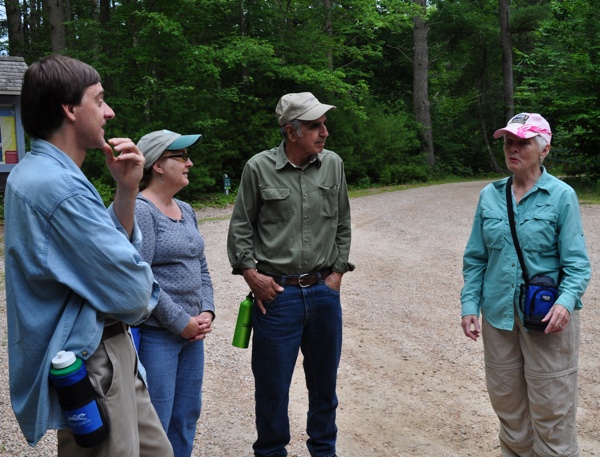
A small group of Homo sapiens seen in the Bioreserve.
BIORESERVE FLORA OF THE MONTH – White Water Lily (Nymphaea odorata)
The fragrant white water lily is a very ubiquitous aquatic plant. It can be found growing in suitable habitat in every state and province.
The lily flowers are three to six inches in diameter and have bright yellow stamens cupped in an encircling array of pointed white petals. The white water lily can be found growing from the water’s edge to as deep as six feet underwater.
The white water lily grows from large rhizomes (horizontal stems that sends out shoots above and roots below) that are rooted in the mud of swamps, ponds, slow moving rivers and lakes. The circular leaves, six to ten inches in diameter, green on top and reddish-purple underneath, have a slit on one side that leads from the outer leaf edge to where the stem is attached at the leaf center. The leaves, as well as the flowers, float on the surface of the water.
The lily rhizomes sprout leaves and flowers during the warmest days of summer. The large, strongly scented flowers open to the morning sun and close in the afternoon. On cloudy, rainy days they may not open.
On hot summer days many aquatic invertebrates and small fish find shade and security under broad water lily leaves. If you spend time kayaking or canoeing where water lilies are found, paddle over and turn over a water lily leaf. How many pond snails, crustaceans and aquatic insects do you see sheltering there?
Muskrats, beavers, ducks and swans eat the rhizomes, leaves and seeds. Indians used the white water lily as a food plant.
Early in the summer the young leaves can be gathered and boiled. The unopened flower buds can also be boiled or breaded and fried.
The seeds are rich in oil, starch and protein and like the starch-filled rhizomes can be gathered in the fall and dried for winter use.
In the SMB white water lilies can be found in quiet backwater areas of Watuppa Pond, easily seen from Wilson Road. If hiking in the Doctor Durfee’s Mill area of the SMB be sure to notice how white water lilies just about completely cover the surface of the old mill pond.
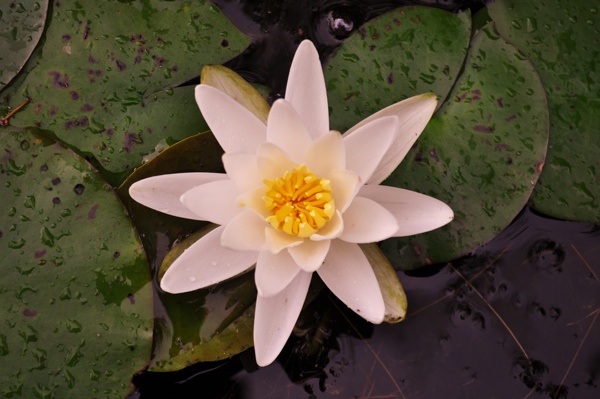
White water lily blossom.
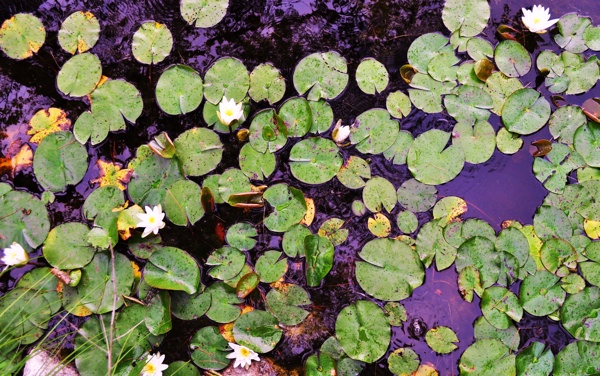
White water lilies at Doctor Durfee’s Mill Pond in the Bioreserve.
SOCIAL MEDIA - http://www.facebook.com/pages/Green-Futures/155978287850127
Back during the dark days of winter some of our more social members suggested we have a “facebook” page. A vote was taken and the reclusive misanthropes lost.
Check it out at the e-address, above. Don’t forget a “like.”
August – Summer almost over? Oh No!
By August subtle signs of autumn are sneaking into summer.
Having raised their young, swallows are gathering in flocks getting ready for their big journey south.
If you spend time at a local saltwater beach in August …and are observant …you’ll see the beginning of the fall shorebird migration that follows the Atlantic coast as they head south.
In August the cicadas are trilling, the crickets are chirping and the katydids are incessantly calling. The annual insect crescendo is slowly building toward their grand autumn finale.
Spend some time outdoors this season. You don’t want to miss any bit of a New England summer.
Click on our “Calendar” for activities and events.
<Back
Social