Newsletters
March 2014 - Rattlesnake Brook,Mourning Cloak Butterfly
WELCOME TO GREEN FUTURES !
MARCH, 2014
“As far as I’m concerned, it’s a damned shame that a field as potentially dynamic and vital as journalism should be overrun with dullards, bums, and hacks, hag-ridden with myopia, apathy, and complacence, and generally stuck in a bog of stagnant mediocrity.”
-Hunter S. Thompson
“No winter lasts forever, no spring skips its turn.”
- Hal Borland
LISTENS GOOD, TALKS NICE, TAKES ACTION? -
We recently met with Massachusetts Department of Conservation and Recreation (DCR) Commissioner Jack Murray and sundry DCR staffers to discuss and find solutions to the damaged hillside at Rattlesnake Brook and other areas within the Southeastern Massachusetts Bioreserve (SMB) that have been damaged due to illegal off-road vehicle (OHV) activity.
Later, that same day, we brought our concerns including the need for land damage repair, enforcement of rules regulations and laws governing OHV activity and staff and funding necessary for all that needs to be accomplished, to the DCR Stewardship Council. The Council is composed of thirteen members who talk nice too, but appear to be always short of time to listen to concerns during citizen input time at the end of their meetings.
What purpose does the Council serve? According to their website, “The Council is an independent body that assists and oversees DCR in its efforts to establish policies and programs to realize the goals set forth by the Massachusetts General Court and to meet the public’s expectations that its parks, reservations and forests will be protected and available for the enjoyment of the millions of people who visit these facilities each year.” We shall see.
We are pleased and thank Commissioner Murray for coming down to meet with us …we know how busy he is and what a huge state agency he is tasked with managing. Others who listened attentively to our concerns, we also thank. All spoke of possible solutions and plans were discussed on how to proceed and solve the problems. So far, so good …we now eagerly await the action. Stay tuned!
A huge shout-out, “THANK YOU,” to those groups and organizations that have gone on record supporting the repair and restoration of the damaged slope and Rattlesnake Brook. We will list them all in a future newsletter.
The following video shows some very selfish and ignorant individuals destroying, in a few hours, the rocks, gravel, sand and soil it took glaciers and Rattlesnake Brook thousands of years to deposit and create.
Do you see any law enforcement or DCR personnel rushing in to stop this vandalism of our property? We don’t either. From the size of the ruts and gullies this has been going on for quite some time. See here: https://www.youtube.com/watch?v=j_rhftc0_Gk
We need more supporters so we’re running last month’s appeal one more time. Please contact a group or organization you are familiar with and get their support for nudging DCR to do the right thing.
Can you help us?
We are trying to repair and save public forest land within the Freetown State Forest, especially the Rattlesnake Brook Corridor and also set up a forest management plan for the Southeastern Massachusetts Bioreserve of which Freetown State Forest is a part.
We are seeking the Boards of organizations (SEE LIST) who support this effort (SEE PROPOSED MOTION) to vote and notify GREEN FUTURES (info@greenfutures.org) by e-mail or (Green Futures, POB 144, Fall River, MA 02724-0144) by postal system of their support.
We plan to submit letters of support to the Massachusetts Department of Conservation and Recreation (DCR). If you know of any organizations and/or board members please contact them and let us know too.
If you know of any organization or association not on the list, below, please solicit their support and let us know at info@greenfutures.org. Doesn’t have to be only environmental/land trust organizations, but also neighborhood, religious, fraternal, civic, etc. that you might be familiar with or a member of.
If you or those you approach for support need more info and/or photos go to our website gf.gareworks.com and then, under Menu, click on “Current Projects.” In Current Projects, click on “Repairing Damaged Land and Restoring Rattlesnake Brook.”
Here’s a sample of what we need:
On (month, date, 2014), the (Board, Committee, Directors, Membership, etc.) of the (organization or group’s name) voted to (support, sign on to, etc.) Green Futures’ proposal to the Massachusetts Department of Conservation and Recreation regarding the Fall River-Freetown State Forest, Rattlesnake Brook and forest management planning within the Southeastern Massachusetts Bioreserve dated December 30, 2013.
Thank you!
Motion:
RE: FALL RIVER/FREETOWN STATE FOREST
We propose MA DCR
- Repair damage to hillside and Rattlesnake Brook caused by illegal OHV activity, now.
- Create a long-term forest, stewardship management plan with the Southeastern Massachusetts Bioreserve Partners and stakeholders.
- Massachusetts DCR fund all law enforcement, management, and damage repair if OHV are allowed anywhere on DCR managed property within the Southeastern Massachusetts Bioreserve. This part of the plan be incorporated in #2 above.
- Match OHV use to the available management and enforcement capacity (funding and staff). This will assure that resources exist to guarantee adequate legal enforcement.
Seeking Their Support:
*Westport River Watershed Alliance – 1151 Main Rd., Westport, MA 02790 – director@wrwa.org
*Taunton River Watershed Alliance – POB 1116, 1298 Cohannet St., Taunton, MA – TRWAPresident@savethetaunton.org
*Massachusetts Audubon Society - 208 South Great Rd., Lincoln, MA 01773 – jclarke@massaudubon.org
*Dartmouth Natural Resources Trust - 404 Elm St., Dartmouth, MA 02748 – info@dnrt.org
*Greater Fall River Land Conservancy – Tel: 508.672.8217
*The Trustees of Reservations - 830 S Drift Rd, Westport, MA 02790 - Tel: 508.636.4693 - jdubois@ttor.org
*Conservation Law Foundation – 62 Summer St., Boston, MA 02110-1016 - Tel: 617.350.0990 - sreid@clf.org
*Sierra Club Massachusetts -10 Milk St., #632, Boston, MA 02108 – Tel: 617.423.5775 - office@sierraclubmass.org
*Environmental League of Massachusetts -14 Beacon St., Boston, MA 02108 – Tel: 617.742-2553 – info@environmentalleague.org
*The Nature Conservancy Massachusetts - 99 Bedford St., 5th Floor, Boston, MA, 02111 – Tel: 617.532.8300 - massachusetts@tnc.org
*Sea Run Brook Trout Coalition - PO Box 1024, Newburyport, MA. 01950 – Tel: 508.538.1857
*Environment Massachusetts - 44 Winter St., Ste. 401, Boston, MA 02108 – Tel: 617.747.4400
*Wildlands Trust – PO Box 2282, 165 West St., Duxbury, MA 02331 – Tel: 781.934.9018 – info@wildlandstrust.org
*The Trust for Public Land - 10 Milk St., #810, Boston, MA 02108 – Tel: 617.367.6200
*Ducks Unlimited - One Waterfowl Way, Memphis,TN 38120 Tel. 901.758.3825
*Save the Bay - 100 Save The Bay Dr., Providence, RI 02905 – Tel: 401-272-3540
*Westport Fishermen’s Association - PO Box 83, Westport Point, MA 02791 – wfa@westportriver.org
*Buzzards Bay Coalition - 114 Front St., New Bedford, MA 02740 – Tel: 508.996.6363 – info@savebuzzardsbay.org
*Natural Resources Defense Council - 40 West 20th St., New York, NY 10011 – Tel: 212.727.2700 – nrdcinfo@nrdc.org
Others
TREES CAN SAVE US –
As we’ve unfortunately discovered, over the past year, there are divisions and/or programs within the Massachusetts Department of Conservation and Recreation (DCR) whose roles should be rethought. Not eliminated, just brought up to date on caring for and managing our public lands and ensuring maximum native species diversity in this very urban state. That’s not an easy job, nurturing and protecting what others would prefer to extract and sell.
No one should be allowed to commercialize our public forests and parks. DCR subsidizing the logging industry and fragmentation of our public forests for private gain should have ended years ago. Apparently and sadly many foresters and others can’t see the forest for the board feet. Many are one dimensional folk, stuck in a previous era when all that was important was “getting out the cut.”
Read Helen Moyer, “Stop Logging on Public Land” here:
Here’s one on climate change from the Washington Post: http://www.washingtonpost.com/world/asia_pacific/kerry-calls-climate-change-a-weapon-of-mass-destruction-derides-skeptics/2014/02/16/1283b168-971a-11e3-ae45-458927ccedb6_story.html
TOXICS ACTION –
Toxics Action Center’s annual conference will be March 2, Sunday, at Northeastern University, Boston, Massachusetts.
Teri Blanton, Kentucky mountaintop removal activist will be the keynote speaker.
Of local interest will be a workshop: Brayton Point Coal Plant and the Journey for Responsible Retirement of Coal.
The panelists leading that workshop will be Jeremy Brecher, Labor Network for Sustainability; Sylvia Broude, Toxics Action Center; Cindy Luppi, Clean Water Action; Pauline Rodgrigues, Coalition for Clean Air South Coast.
Read about it here: http://www.localenvironmentalaction.org/
COMMUNITY PRESERVATION ACT (CPA) –
The Fall River CPA Committee has scheduled an informational meeting April 7, Monday, 2014, 6:00 p.m. at Fall River City Hall in the City Council chambers.
Information will be presented on how to apply for Community Preservation Act (CPA) funding. An open CPA Committee meeting will be held at 6:00 p.m., the informational meeting will follow.
Fall River residents, neighborhood and civic organizations are encouraged to attend.
BIORESERVE FAUNA OF THE MONTH – Mourning Cloak Butterfly (Nymphalis antiopa)
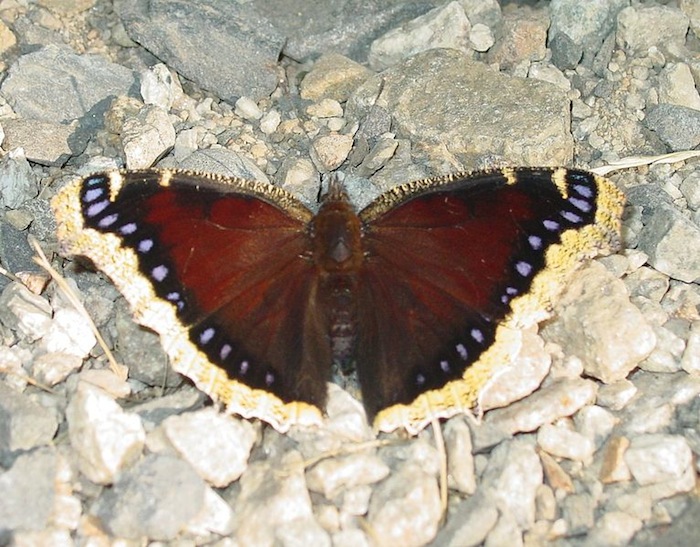
Photo courtesy Wikimedia Commons
In March the first butterfly to be seen out and about on sunny days is the mourning cloak. Windy March is a harsh month in New England with plenty of wet snow, rain and nighttime temperatures often below freezing. Not the kind of weather one normally associates with butterflies. So, what are they doing out now and where did they come from?
Let’s first take a close look at one of these hardy butterflies. The mourning cloak is a large forest butterfly with a 3 to 4 inch wingspan. The wings are a dark purplish-brown to maroon with a pale to dark yellow, ragged, irregular edge. Iridescent blue spots line the inner edge of the yellow band. These colors are the colors of traditional cloaks people wore, in the past, when they were in mourning …hence the name of this butterfly. The underside of the wing is colored a camouflaging pattern of grey and brown and the wing edge has the same yellowish band pattern as the upper surface of the wing. Males and females look alike.
Mourning cloaks are out so early in the spring because they are mature mourning cloaks looking for mates and they all went into hibernation last fall in the very same areas where we are seeing them now. Where have they been hibernating? In hollow trees and hidden away under loose and shaggy bark of dead trees.
Mourning cloaks, like all other butterflies are “cold blooded” and their temperature is the same as that of their surroundings. When temperatures drop below freezing the moisture in their cells would freeze and kill them except that mourning cloaks produce an anti-freeze chemical that protects their body when temperatures begin to drop in the fall. By winter they have sufficient amounts deposited in their cells to prevent them from freezing.
Once the overwintering mourning cloaks leave their hibernaculums they must warm-up before they can fly. They walk to a sunny spot on a tree trunk or position themselves on a branch high in a tree facing the sun. Dark colors absorb more heat from the sun than light colors. As the sun moves east to west they adjust their dark colored wings accordingly to absorb the highest amount of solar radiation possible.
Once their wings are warmed males fly to a sunny clearing and display seeking to attract receptive females. The male will usually return to the same clearing each day and mate with the females drawn to that location. Males are territorial and fiercely defend their individual sunny locations from other males. A healthy, vigorous male may patrol and defend as much as 1200 square feet of territory.
Shortly after mating the females lay their light green eggs on twigs and leaves of willow, birch, aspen hackberry, elm and hawthorn. The eggs are densely packed together and are arranged spirally around the twig or massed together if on a leaf.
Twelve to fifteen days later tiny green-bodied black-headed caterpillars hatch from the eggs. Unlike the young of most of our local butterflies the morning cloak caterpillars, when small, stay together and move about as one unit feeding together on tender, spring leaves. If disturbed they will all act in unison twitching about and staying close together giving the appearance of a larger animal perhaps moving to attack.
Older caterpillars are black with red feet and red dots along their backs, covered in black spines. As they mature, getting ready to pupate, they wander about, individually, searching for the ideal location to attach. They secrete a small silk pad to a twig or other object which they cling to and transform into a tan and grey chrysalis. The adult butterfly emerges from its chrysalis after 12 to 15 days.
When adult mourning cloaks emerge from hibernation what do they eat? Especially when it is often way too early for flowers to be blooming. Although mourning cloaks will feed from flowers in the summer, in early spring they feed on tree sap often following around sapsuckers and other woodpeckers and feeding from the holes in the bark left by the woodpeckers. In fall, rotting fruit is a major food source.
The range of the mourning cloak is circumpolar. In North America they are found across the continent from the edge of the tundra to central Mexico.
The mourning cloak has many predators. Although their camouflaged underwings, when folded, resemble dried leaves many mourning cloaks are eaten by large predacious insects such as the praying mantis and small wasps that parasitize them. Voles, mice and shrews will eat chrysalises and most forest insect eating birds and bats will take adults.
Our common mourning cloak has some very uncommon behaviors. Watch for them on sunny days in early spring.
BIORESERVE FLORA OF THE MONTH – Wintergreen (Gaultheria procumbens)
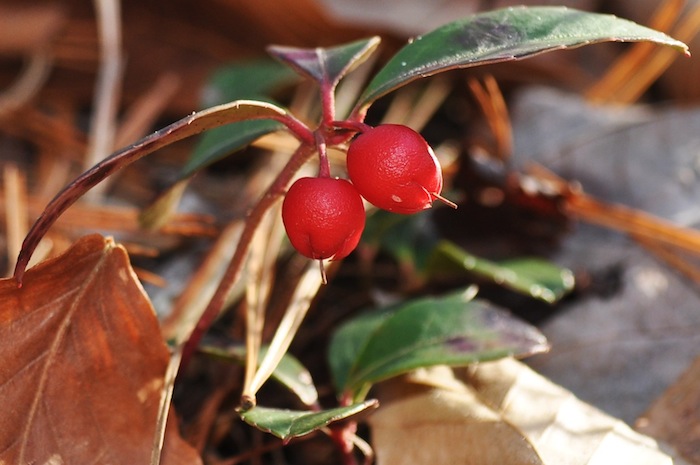
Wintergreen, aka checkerberry, teaberry, is a low growing shrub in the heath family. The heath family also includes other common Southeastern Massachusetts Bioreserve shrubs such as mayflower (trailing arbutus), azalea, cranberry, blueberry, rhododendron, laurel and huckleberry. Heath family members do best growing from acidic, infertile soils in oak and pine forests.
Evergreen wintergreen grows to a height of 6 inches, but most shrubs you see carpeting the forest floor are only an inch or two high. Crush one of the dark green oval leaves or bright red berries and you immediately get the oil of wintergreen scent. Wintergreen is used as a flavoring in candies, toothpaste, mouth wash, medicine and tea. Many people are familiar with the wintergreen aroma from having chewed Teaberry Gum. Most commercial wintergreen flavor used in products today is synthetic Methyl salicylate and other chemicals.
Wintergreen blossoms open during the summer. The flowers are bell-shaped and white to pink in color. The wintergreen berry is fleshy and red and about a quarter of an inch in diameter. They are edible and can be added to cookies, muffins and other baked goods or used in making wintergreen flavored ice cream.
Wintergreen shrubs grow from horizontal stems, shallowly rooted, that sprout lateral new shoots along its length creating a colony from a single plant,
Wintergreen is found from Newfoundland west to southeastern Manitoba and then south to Minnesota, Wisconsin then east of the Mississippi River south to Alabama and Georgia.
Some forest wildlife that feed on wintergreen’s leaves and berries include white tail deer, ruffed grouse, wild turkey, chipmunk, white foot mouse and red back vole.
Taunton River Heritage Coloring Book and the next chapter of Al Lima's Taunton River Heritage Guide
Our coloring book is now online! You may download one page or the whole book. Go to our homepage for the link.
Also, Chapter 4 of the guide is now viewable. Go to Current Projects for the link.
Early Spring - Pick some pussywillows!
Spring arrives this month …but it is sometimes hard to tell. Returning early birds will begin singing and in lawns and gardens snowdrops and crocuses will be blooming. Out in the woods soft and downy pussywillows will be blooming too. The promise of summer is in the air. Click on our calendar to see what organized things there are to do. Enjoy!
<Back
Social