Newsletters
July 2011 - Biking, Hiking, Borer Beetle, Golden Ragwort
WELCOME TO GREEN FUTURES !
JULY, 2011
“It is by riding a bicycle that you learn the contours of a country best, since you have to sweat up the hills and coast down them. Thus you remember them as they actually are, while in a motor car only a high hill impresses you, and you have no such accurate remembrance of country you have driven through as you gain by riding a bicycle.”
--Ernest Hemingway
“When I see an adult on a bicycle, I do not despair for the future of the human race.”
-H.G. Wells
BIKING-
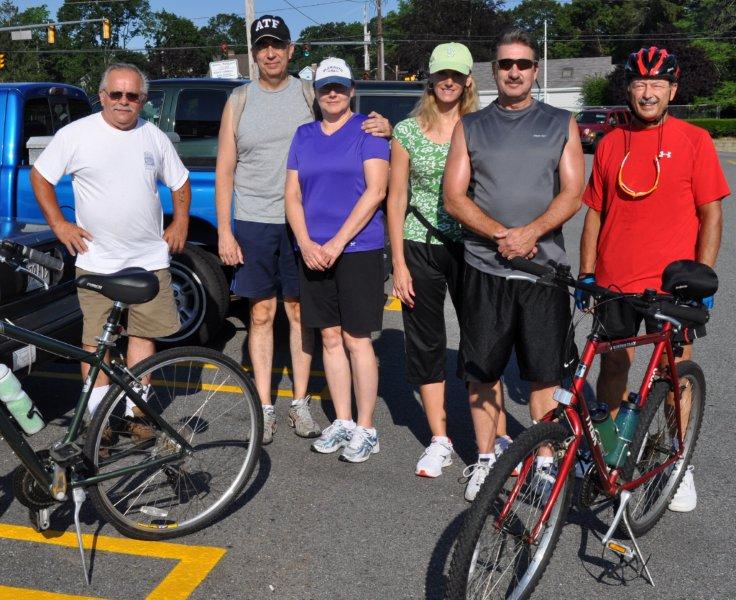
Some of the members of the Fall River Bike Committee about to set out on a bike ride through the north end of Fall River and the Southeastern Massachusetts Bioreserve.
Left to right: Orlando Figueiredo, Brian and Karen Pearson, Rebecca and Jim Cusick, George Banville
The Fall River Bike Committee was formed last year to advocate for bicyclists, bicycle paths, and other bicycle type activities here in Fall River and the surrounding area.
The Committee is currently advocating for a bike path connecting Fall River to New Bedford using the current rail line that runs from Fall River, up the Quequechan River valley, then through Westport and Dartmouth to New Bedford. The Committee also belongs to a regional bike committee that is fighting for this bike path as well as for bike path connections throughout the Massachusetts south coast region.
When it comes to bicycle rides, the group attempts to ride once a week. They’ve held organized rides through Fall River, Westport, Dartmouth, Freetown, the East Bay Bike Trail, Fairhaven/Mattapoisett Bike Path, Tiverton, Bristol, Newport and other localities.
All welcome. Bicycle speed …or lack thereof ...is not a problem. Some members go fast, some go slow, and some just pedal along at a steady pace enjoying the countryside and the experience. Consider participating in one of their rides. Great scenery, interesting history, great outdoor exercise in your natural environment and …most importantly …good people.
Anyone interested is urged to contact Brian Pearson, Chairman, at btrekman@comcast.net. He will ensure that you are informed of meetings and upcoming bike rides.
HIKING-
“A vigorous five-mile walk will do more good for an unhappy but otherwise healthy adult than all the medicine and psychology in the world.”
-Paul Dudley White
“I only went out for a walk and finally concluded to stay out till sundown, for going out, I found, was really going in.”
-John Muir
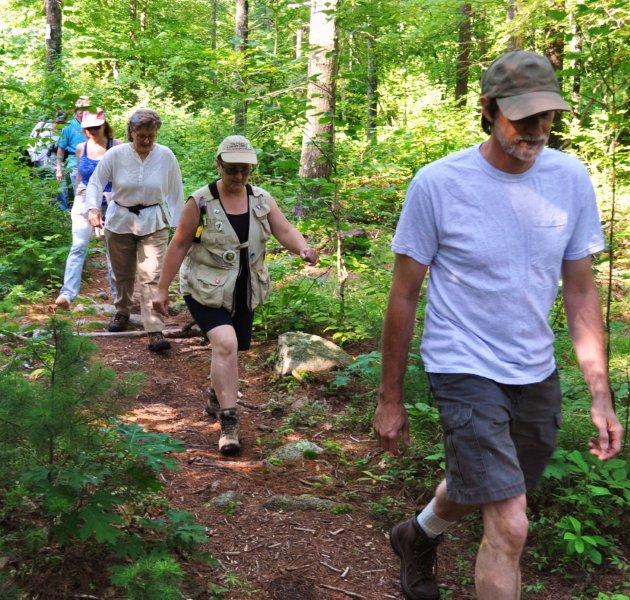
Led by Roger, this month’s Exploring the Bioreserve Walk took folks down Horseshoe Trail, across Miller Brook, over to Copicut Hill with views from DCR’s Copicut Hill Fire Lookout, down Dead Man’s Trail to Brightman Trail.
Next month’s Exploring the Bioreserve Walk is scheduled for August 20. Meet at 9 a.m. at Fighting Rock Corner (intersection of Wilson, Bell Rock, and Blossom Roads).
Join us on the walk. Learn the fascinating history of Fighting Rock …and where the rock is now. The walk will also follow the old Indian trail known as Mowry Path. Walk in the footsteps of Weetamoe and King Philip.
From Mowry we will walk to Hogs Rock, around Doctor Durfee’s Mill Pond, over the Esker Trail, and then back to our starting point at Fighting Rock Corner. Estimated length of walk is 5 miles.
Water, snacks, insect repellent suggested. Wear walking shoes/sneakers. No sandals/open-toed shoes.
BIORESERVE FAUNA OF THE MONTH – Broadnecked Root Borer Beetle (Prionus laticollis)
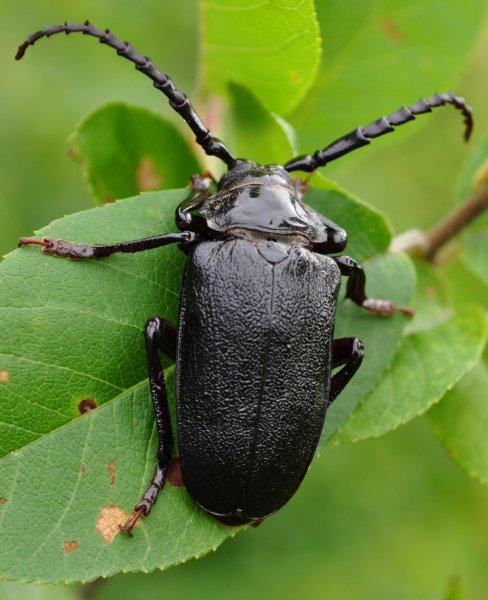
The broadnecked root borer beetle is a large black beetle that feeds on the roots of various hardwood trees. Not to be confused with the extremely destructive Asian longhorned beetle. The broadnecked is a native species.
Male broadnecked root borers have long antennae. The females’ antennae are barely one third the size of the males.
Adult broadnecked root borers emerge from the soil in early summer. The beetles are nocturnal and during the day remain hidden beneath loose bark. The larvae feed on the roots of various live trees and shrubs. Adult males fly throughout the summer, seeking females. The females are large and heavy and do not fly. The females deposit 300 to 500 eggs either singly or in groups in the soil near the base of host trees.
The eggs hatch in two to three weeks; the beetle larvae dig down to the roots and begin feeding.
The larvae remain underground feeding on the roots for as long as five years. In early spring, mature larvae pupate and transform into adults.
Old mature forest trees and those weakened by disease or invasive caterpillar outbreaks, as has happened to many of our gypsy moth ravaged oaks in the Bioreserve, are most susceptible to attack.
Normally, in a healthy forest, broadnecked root borer beetles are not a problem.
BIORESERVE FLORA OF THE MONTH – Golden Ragwort (Senecio aureus)
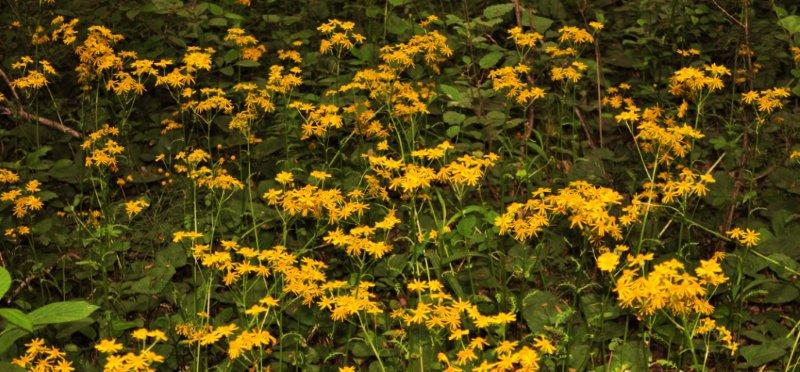
A member of the usually fall blooming aster family, the golden ragwort is an attractive, bright yellow, spring blooming wildflower.
Golden ragwort is found along woodland swamp edges growing in light shade from wet soil that is rich in organic matter.
This native perennial reaches two feet in height. At the base of each plant, there is a small rosette of basal leaves. A flowering stalk develops from the center of each rosette.
Along this stalk, there are usually two or three alternate leaves. The alternate leaves are smaller in size than the oval basal leaves and feathery in shape.
The stalk terminates in a bright yellow flowerhead. The blooming period occurs from mid to late spring and lasts about three weeks. Small forest bees are the chief pollinators, attracted by the golden ragwort’s rich nectar.
Golden ragwort was an Indian herbal used to treat menstrual, menopausal and other related female health issues. To the early European colonists the golden ragwort was known as squaw root and it became a major ingredient in many eighteenth and nineteenth century patent medicines.
Lydia Pinkham’s Herb Medicine, for female disorders, listed golden ragwort as “life root” in its list of “active” ingredients.
Golden ragwort is rarely used today because of the potentially harmful alkaloids it contains. It must be very carefully administered and there is modern doubt as to its efficacy. More research is needed.
LNG PLAYING POSSUM? – Last one out please turn off the lights
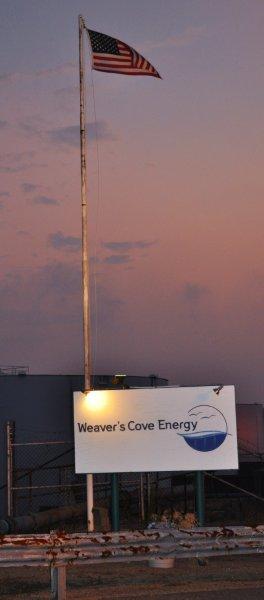
Waiting for the scoundrels to pack their carpetbags, lower the flag, nail up the “for sale” sign, turn off the lights and head north on Route 79/24.
Well, their website is gone and there are fewer vehicles in their parking lot, but we have noticed, over the past few weeks, a few of the Weaver’s Cove scoundrels entering and exiting the Hess property on New Street.
Are they packing their bags …or just keeping a low profile and plotting to stay?
Let’s see, construction on the Historic Brightman Street Bridge’s huge and ugly …and well-fendered/bumpered replacement …is just about done. Maybe?
Stay tuned!
CHECKING UP ON YOUR FOOTPRINT –
A few months back we were invited to a Southeastern Environmental Education Alliance (SEEAL) meeting that was held at the Ocean Explorium in New Bedford. The purpose of the meeting was to find ways to engage entire South Coast communities and individuals in reducing carbon dioxide (CO2) emissions …to shrink our “carbon footprint.” SEEAL named this initiative the South Coast Energy Challenge.
Just this week we received an email from one of our subscribers informing us that SEEAL’s South Coast Energy Challenge website is up and running.
The South Coast Energy Challenge seeks to initially mobilize 35,000 households to reduce CO2 emissions by 120.5 million lbs. in three years. The Challenge allows one to save money while conserving energy and protecting our shared environment.
Check it out at www.SouthCoastEnergyChallenge.org
CALENDAR –
Summer in New England doesn’t last long. Get outdoors and enjoy! Click on our Calendar for upcoming activities.
<Back
Social