Newsletters
February 2011 - Bioreserve Ghosts, Somerset NRG, Swan
WELCOME TO GREEN FUTURES!
FEBRUARY, 2011
"The problem with political jokes is they get elected.”
- Henry Cate
“However big the fool, there is always a bigger fool to admire him.”
- Nicholas Boileau
P. T. BARNUM WAS RIGHT –
Yes, there is at least one born every minute and with the increase in population since Barnum’s day …we’re probably now popping out more than one a minute!
Barnum also supposedly said, “Any publicity is good publicity.” We’ll risk that danger to report foolish goings-on in the Southeastern Massachusetts Bioreserve (SMB) by a few “paraabnormal” nitwits who probably never got to watch Scooby-Doo when they were children.
As you know, the Southeastern Massachusetts Bioreserve is the last sizable bit of original forest landscape in Bristol County. Surrounded by urban development and sprawl it will continually need friends and advocates. There will always be unscrupulous developers and their political lackeys looking to destroy what they don’t want to …or care to …understand.
We, The Trustees of Reservations, and many other groups and individuals have worked long and hard educating on the importance and extolling the benefits of the SMB. We encourage folks to participate in outdoor recreation: hiking, biking, nature study/ photography, painting and drawing, archeology and geology, cross-country skiing, birding, blueberry picking, mushrooming, and all the other wonderful outdoor things that one can enjoy doing on that marvelous chunk of original Massachusetts public green space. We don’t want to see folks afraid of the forest.
Just about everyone enjoys a spooky story, especially when told at night while gathered around a campfire …however we have heard from a few folks in SMB abutting towns fearful of spending time in the forest because of silly, sophomoric tales of the “paranormal” they’ve been hearing from folks who have obviously taken the Ghostbusters movies much too seriously.
One individual told us they actually paid to participate in a “paranormal” van tour of the Bioreserve where they were told absolutely ridiculous stories of “spirits” haunting the forest, a phantom driverless pick-up truck…whatever that is …maybe like Washington Irving’s Sleepy Hollow Headless Horseman? Mournful spirits that prowl the forest late at night, usually female and attractive of course, and ghost damsels perched somewhere on the edge at Assonet Ledge. One fiction is a ridiculous tale of an Indian maiden who jumps to her death in the pool below.Yes, the same old Indian Romeo and Juliet tale we’ve all heard before from just about every rocky ledge and waterfall in New England.
What we find really spooky is that the dolts telling these tales know so little about the real history of the SMB. Where Assonet Ledge is today, there wasn’t any ledge there “yesterday.” In the nineteenth century the Fall River Granite Company decided to quarry the granite from an exposed lump of the underlying batholith. The Assonet Ledge is nothing more than a hundred and fifty year old former granite quarry. No spirits living there …evil or benign.
Yes, there are occasional strange visions seen by some young folks in the Assonet Ledge area of the SMB. However, the folks seeing the visions are not seeing “spirits” …they are imbibing them and/or smoking marijuana.
The SMB is a fascinating place without any scary stories. The closest thing to forest ghosts are the bats flying about on summer nights and the flying squirrels that sail from tree to tree in the moonlight.
Hey, we ain’t afraid of no ghost!
Here’s a YouTube link worth a chuckle - http://www.youtube.com/watch?v=7dsPqMVQb3Q&feature=player_embedded#
MOTHER NATURE ALWAYS RECYCLES -
It is always interesting observing the natural world around us. Below are two photos of animals that unfortunately failed to look both ways before crossing local roadways. They now provide sustenance and a glimpse into the lives of some other critters and demonstrate Mother Nature’s amazing recycling program.
We didn’t have a camera with us when we first noticed a deer carcass off the side of the road in early January. A few weeks later, finding ourselves in the same area, we checked and saw from the tracks in the snow that two coyotes and a fisher had consumed most of the deer. In subsequent visits we noticed the coyotes had moved on taking three leg bones with them, but the fisher continued to work the carcass …and is still doing so as you read this. Also, we found many common winter birds …blue jays, chickadees, downy woodpeckers, tufted titmice, etc. …picking scraps off the bones and adjacent forest floor.
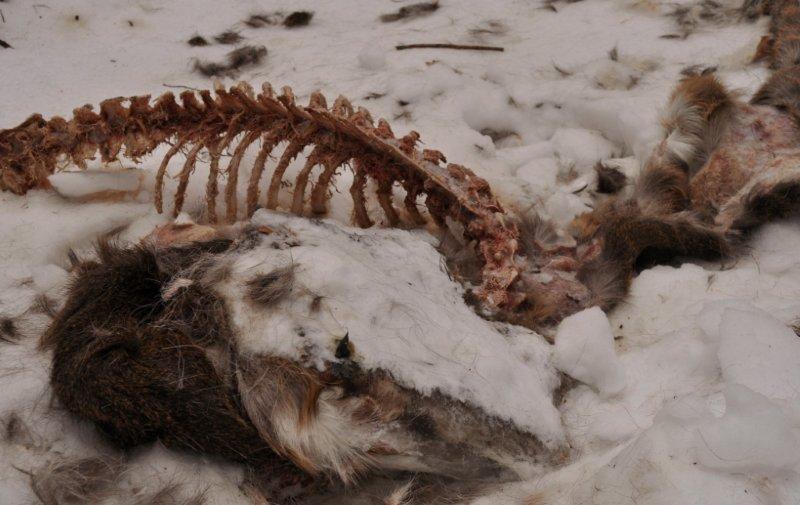
All that remains the third week in February.
This past week we noticed a coyote in the brush by the side of the road. Coyote tracks were in the snow. Although the ever hungry coyote will eat a dead comrade, nothing had touched this carcass yet except for some mice cutting hair to take away to line their nests. Turkey vultures and ravens should soon locate it and with warmer weather, insects and other invertebrates will appear and dine large too.
We’ll keep watch and bring our camera. Stay tuned.
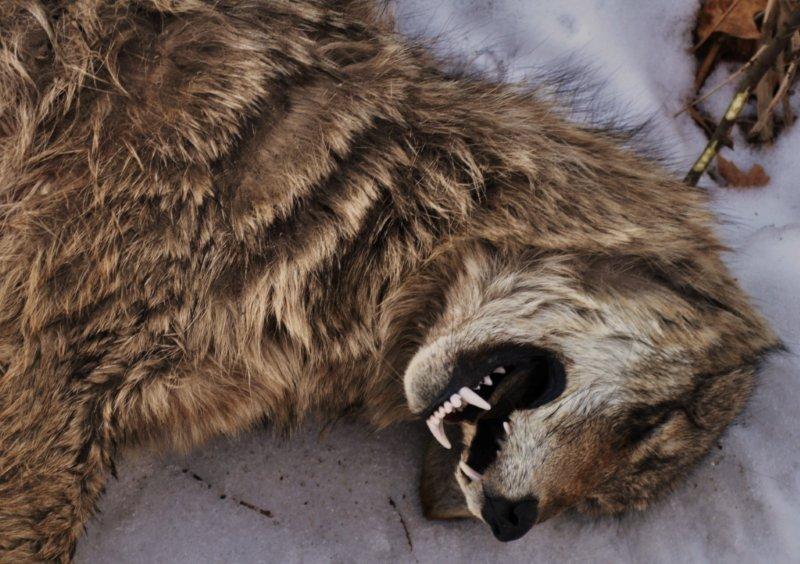
Dead coyote. My, what long, sharp, white teeth you have!
WE CAN ALL BREATHE EASIER –
At the moment NRG Somerset has given up on gasifying whatever struck its fancy at the former Montaup Power facility.
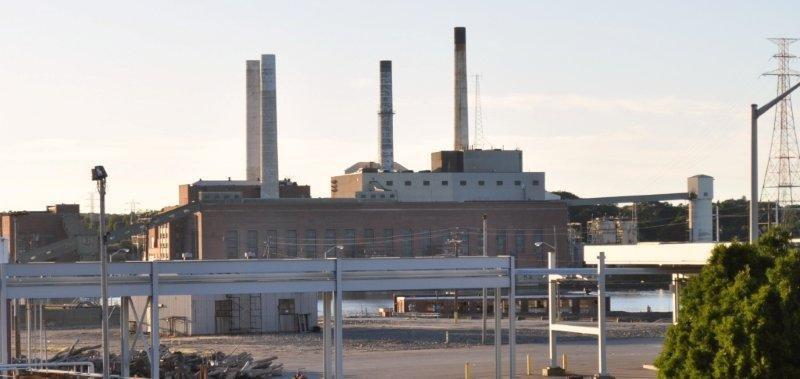
We’ve covered the gasification issue extensively in recent newsletters (August 2010, September 2010, November 2010).
Congratulations to the Massachusetts Coalition for Clean Air, of which we are a part, and the Conservation Law Foundation for keeping up the pressure on NRG to jettison its ill-conceived gasification proposal.
Here’s the Herald News’ take on the good news-
Feb 23, 2011
By Grant Welker
Herald News Staff Reporter
The owner of the Somerset Station power plant has abandoned plans to re-open the coal-powered facility, which has been shut down for more than a year, by using a energy-creating process called plasma gasification.
NRG Energy, which ran the Riverside Avenue plant, withdrew an application to the state Department of Environmental Protection for approval to re-open the plant with what the company calls a more environmentally friendly process. The company is now evaluating what to do with the property, which could include selling it or using it for purposes other than a power plant, according to spokesman David Gaier.
“The decision not to move forward in Somerset was a multilayered decision,” Gaier said, which was based upon a state moratorium on the energy process NRG was looking to use, a difficult market for selling energy, and lawsuits against the proposal. NRG also lacked a power-purchase agreement.
Potential uses for the riverfront site aren’t yet clear. A real estate team has been assembled to consider options, which don’t include the use of natural gas or plasma gasification, Gaier said.
The Conservation Law Foundation, a group that fought approval for re-opening Somerset Station, said the decision by NRG to abandon the plasma gasification plans is proof that retrofitting old coal power plants is not viable.
“This is really the first step in making Massachusetts coal-free, so it’s a huge victory,” said Shanna Cleveland, a staff attorney for the Conservation Law Foundation. She said she wasn’t surprised by the decision. “Coal simply isn’t the energy of the future.”
The group will continue monitoring NRG and Somerset Station to ensure the site is being kept safe and that no toxins are being released while the plant is closed, Cleveland said. She also vowed to work with residents and officials to find a viable use for the site.
NRG’s decision to withdraw its plasma gasification application brings to a close at least one era for Somerset Station.
The plant was shut down in January 2010 following a state mandate that it either switch to a clean energy production or stop operating. The future of the station was left in limbo by a state policy that bans plasma gasification, and lawsuits by the Conservation Law Foundation and others.
NRG won approval in January 2008 to use a mix of 65 percent coal and 35 percent biomass, but a number of factors blocked the company from using the method. Massachusetts officials urged NRG to use only biomass — but then the state placed a moratorium on the use of biomass while studies were done to find the best longterm policy.
NRG had more recently sought approval from the DEP to use a mix of construction and demolition material and wood in the plasma gasification process. The material would be heated up to about 10,000 degrees to break it down into basic components called synthetic gas, or syngas.
NRG said the energy process would be clean, with little waste, and wouldn’t require clear-cutting forests for wood.
The Conservation Law Foundation opposed coal gasification, saying it would emit arsenic and lead into the environment.
The indefinite closure of Somerset Station also leaves the town with far less tax revenue than it once received. In 2006, the plant paid $526,000 in personal property tax, which factors in the plant’s productivity. In 2010, the plant paid only $73,000.
Brayton Point, by contrast, paid $9.6 million in personal property taxes that year.
SEXUAL HARASSMENT OF THE BIRD KIND …A SWAN SONG –
Anthropomorphism: Attribution of human motivation, characteristics, or behavior to inanimate objects, animals, or natural phenomena.
Not wanting to be lumped in with the “animal rights” wackos we realize animals run mostly on instinct and are not troubled by ethics …good and bad, right and wrong, justice, etc. …and moral questions do not appear to concern them..
We witnessed an interesting swan drama this past week, but first a little info. on our charismatic local mute swans (Cygnus olor).
Mute swans are not native to New England. They are a Eurasian species and were first imported in the late nineteenth century by the obscenely wealthy to grace the lawns and grounds of estates in Newport, Rhode Island; Long Island, New York’s Hamptons; and at other coastal locations where the swells spent their summers in vacation “cottages” by the sea.
Despite attempts, over the years, at limiting the growth of escaped and feral mute swan populations, by various wildlife agencies concerned with the impact of the alien waterfowl on native waterfowl species, the wild mute swan population continued to grow since those first introductions and they are now found from Maine to Virginia.
Mute swans are not mute. The make a soft honking or blatting sound and sing their “swan song” when injured or in distress. Here in southeastern New England they are our largest flying bird and one often hears the thrumming sound of their mighty wings cleaving the atmosphere before the bird is detected visually. With a body that can weigh as much as thirty pounds they need every inch of their eight foot wingspan to stay airborne. They possess amazing endurance and with a tailwind can cruise along at over forty miles an hour.
Male swans are called cobs and can be told from the svelter females by the large black bump, also called a cob, at the base of the bill. Females are called pens and when fully mature also have a cob, but much smaller than that of a male.
Down through history swans have become major symbols of beauty, grace, love, purity, and elegance. Swans are also extremely aggressive in protecting their territory and their young …called cygnets …from other waterfowl and from anything else they might perceive as a potential predator. Despite the fact a swan has not a tooth in its head, when fully pumped-up with feathers erect, hissing and snapping its bill, thrashing its eight foot wings, and standing five feet tall from the bottom of its big, black webbed feet to the top of its head, even the ever hungry wily coyote often backs down.
This fearsome aggressiveness in defense, offense and in battling over mates was noted by the early Celts and Vikings and the swan played a different role in their myths and society …a different symbol for those folks than what it is to us today. The swan is an iconic creature and has been a popular art motif through the ages.
There are a number of Greek myths with swans in important roles. One of the most well known is that of Leda and the Swan.
Leda was the Queen of Sparta and wife of Tyndareus. She was very attractive and caught the eye of Zeus. As we know from our high school Greek Mythology classes Zeus was married to Hera, but that didn’t stop him from lusting after any number of mortals and immortals. Sort of like our Bill Clinton except, of course, Bill is not a god.
Now, Hera kept a close watch on Zeus because she was wise to his philandering ways. Zeus had to be pretty clever to fool old Hera so he disguised himself as a feisty, virile mute swan and paid Leda a visit. Whether Zeus-swan raped or seduced Leda depends on who recorded the tale, but shortly thereafter Leda gave birth …laid? …two eggs.
Out of one egg hatched the twins Castor and Pollux. Out of the other egg popped Helen. Helen was the most beautiful woman in all of Greece becoming the ever faithful Helen of Troy.
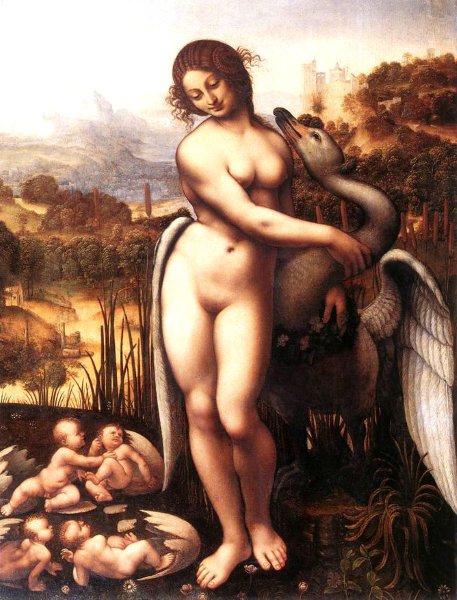
Copy of Leonardo da Vinci’s Leda and the Swan
English poet William Butler Yeats found the tale artistically inspiring too and composed the following:
Leda and the Swan
A SUDDEN blow: the great wings beating still
Above the staggering girl, her thighs caressed
By the dark webs, her nape caught in his bill,
He holds her helpless breast upon his breast.
How can those terrified vague fingers push
The feathered glory from her loosening thighs?
And how can body, laid in that white rush,
But feel the strange heart beating where it lies?
A shudder in the loins engenders there
The broken wall, the burning roof and tower
And Agamemnon dead.
Being so caught up,
So mastered by the brute blood of the air,
Did she put on his knowledge with his power
Before the indifferent beak could let her drop?
So, we were recently walking the shoreline in Tiverton, Rhode Island, on a glorious sunny late winter day when we noticed two mature cobs vying for the attention of a seemingly shy pen that kept swimming in odd little circles, out in a cove off Narragansett Bay.
We noticed that other swans in the area were paired up …swans are monogamous but quickly find another mate should a partner die. All the cobs we saw were attempting to mate, but the pens were not yet ready to accept their advances.
An explanation on waterfowl mating will help explain what we soon witnessed. Mating occurs on the water and is over very quickly although a waterfowl pair will mate multiple times, in quick succession, when the female is receptive.
If one has spent any time watching and/or feeding waterfowl in the spring …ducks, geese, swans … usually in urban parks where they gather in unnaturally large numbers because of the food hand-outs, one will often witness “bachelor” males single out an unattached female and chase after her. Normally, waterfowl mate when the female accepts the attention from her mate by lowering her body profile in the water and extending her neck and head. The male climbs on the female’s back grabbing the back of her neck with his bill to hold his position for mating.
During the mating season, in large park duck gatherings, one can often spot the few unpaired females of low flock status by their soiled or missing back feathers and bare spots on their necks caused by gangs of bachelor males mobbing these females and mating with them constantly. Occasionally, the female drowns from all this unwanted attention.
Back on the shore in Tiverton we noticed the pen that was attempting to avoid the two aggressive cobs by swimming in small circles was only doing so because she had one foot entangled in a mooring line left out from the previous boating season.
When the pen would hit the end of the rope, the tension on the rope would lower her body in the water. One or both cobs would take that as an invitation to mate and climb upon her back. Two twenty to thirty pound cobs on her back completely submerged her body and both cobs would have their bills attached to the back of her neck pulling in opposite directions.
We watched hoping that in the brief period when the cobs backed off she would be able to free herself from the mooring line, but she would soon hit the end of the rope’s length again, her body would lower …and the males would climb aboard once again.
We believe in letting nature take its course and if a swan was being carried off by a coyote or broke its neck in a battle over territory with another swan …well, that is the way of the wild.
“Our” swan however was in big trouble solely due to man and the abuse she was receiving was distressing to witness. We decided to see what we could do to rescue her. First we called Rhode Island Audubon. They don’t have the resources to stage wildlife rescues and referred us to the Rhode Island Wildlife Rehabilitators “hotline.” They couldn’t do anything either and gave us phone numbers of local “animal control” to call. If it’s not a dog or cat animal control usually doesn’t get involved. We left messages …but no one returned our calls.
We also learned that “wildlife rehabilitators” will accept injured wildlife if brought to their door, but apparently none are able or willing to mount a rescue in the field …although if it involved a peregrine falcon, bald eagle, mountain lion or some other rare bit of megafauna we think one would find them more accommodating.
As evening approached we left the unfortunate swan who was barely attempting to escape her suitors anymore. The cobs were repeating their same instinctive moves everytime she reached the end of the line.
Walking away we heard this faint flutelike “oodle, oodle, ooo.” Turning, we saw the pen’s opened bill as she began to once more sink into the bay under the weight of the cobs.
We were hearing her swan song.
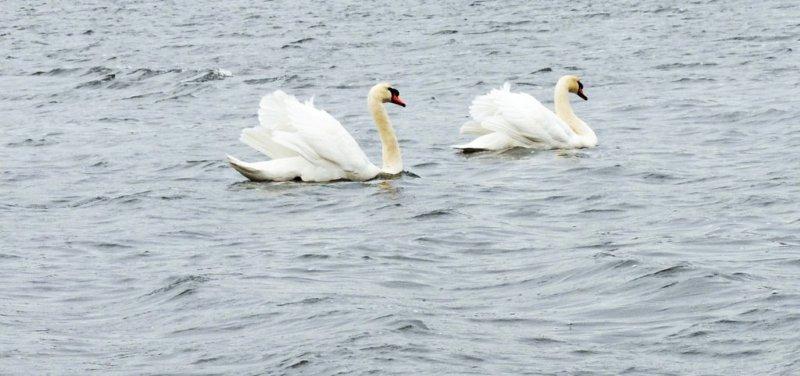
The next morning the two single cobs were still in the area.
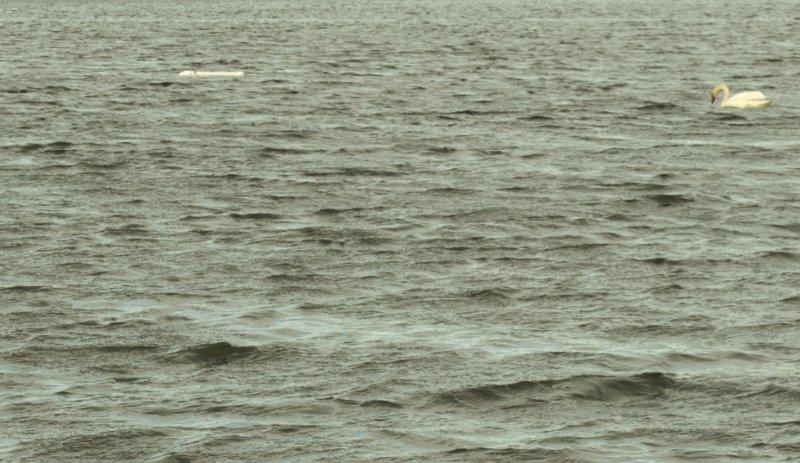
Next morning dead pen still attached to mooring line, left side of photo. One of the two cobs on right.
YES, SPRING IS AROUND THE CORNER –
Any crocuses blooming in your neighborhood yet? The pussywillows should be popping open in wetland areas. Get ready for spring!
Click on our Calendar to see what’s going on in our shared environment.
<Back
Social