Newsletters
March 2010 - LNG, Salamanders
WELCOME TO GREEN FUTURES!
MARCH, 2010
“Action is the antidote to despair”
- Joan Baez
“All things that love the sun are out of doors;
The sky rejoices in the morning’s birth’
The grass is bright with raindrops; on the moors
The hare is running races in her mirth;
And with her feet she from the plashy earth
Raises a mist; which, glittering in the sun,
Runs with her all the way, wherever she doth run.”
-William Wordsworth
“EGREGIOUS MISSTATEMENTS AND MISREPRESENTATIONS” –
So said Gordon before the Rhode Island Senate’s LNG Task Force, March 9, 2010, while presenting his usual tired, old, dog and pony show. We guess he was talking about himself?
If Hess Hack and shameless LNG promoter Gordon Shearer doesn’t start changing his act soon, his nose will be dragging on the ground.
Yes Gordon, half truths …lies of omission …are lies!
Let’s just look at one small part of Gordon’s half-truths presentation:
"Mr. Chairman, as you yourself observed, the only other bay in the U. S. with the same type of values as Narragansett Bay is Chesapeake Bay. I won't debate the issue, but I will observe that for four decades there has been an operating LNG terminal in the Chesapeake Bay, with an offshore berth, and cryogenic unloading lines buried in a tunnel under the Bay. For those four decades the recreational life of the Chesapeake has continued with little problem. There is no reason to think the same would not be true in Narragansett Bay."
The truth is not in this man!
Comparisons between Narragansett Bay and Chesapeake Bay, in relation to LNG transport, off-loading and storage …are ridiculous. Narragansett Bay is tiny (120 +/- square miles) compared to the huge Chesapeake (4,480 +/- square miles). When it comes to his project in Narragansett/Mount Hope Bay …(Mount Hope Bay is a measly 13 square miles in area) …compared to Dominion's, Chesapeake Bay, Cove Point facility ...there is no sane comparison!
Gordon said, “I will observe that for four decades there has been an operating LNG terminal in the Chesapeake Bay.”
Not true, Gordon. Dominion’s Cove Point, Maryland, terminal was constructed in 1972. It was mothballed in 1980. It was reactivated in 2004.
Gordon, apparently, is willing to say anything in his attempt to sell this ill-conceived project. A project that will ruin our bays, river, and our quality of life here in southeastern New England.
One Hess/Weaver’s Cove LNG flack was recently on local radio touting the safety of LNG supertankers as compared to oil tankers …which “occasionally,” he said, “have catastrophic spills, but LNG ships don’t.”
Again, more half-truths. LNG ship transport is a relatively new activity. There are fewer than 400 LNG supertankers operating world wide. Compare that to the more than 5,000 oil transport ships sailing the seas today. If the numbers were reversed, do you think LNG supertankers would be accident free? Once again, no comparison.
The first oil tank ships set sail in 1863 …powered by the wind. The first LNG carrier was the Methane Princess (great name for a princess …don’t you think?). It began transporting LNG in 1964. The Methane Princess had an “incident” one year later in 1965 (see accident list, below).
As can be seen, one cannot honestly compare the two. Oil transport has almost a hundred and fifty year history. LNG is still in diapers.
Have there been any LNG accidents and incidents in its short history? You bet, here they are:
LNG – NOT ACCIDENT FREE
Cleveland, Ohio - 1944 – LNG tank failure. 128 people killed, 225 injured, 30 acre area completely devastated. The Cleveland disaster put an end to any further LNG use in the U.S. until the 1960s.
Methane Princess Spill - 1965 – Spill while unloading. LNG escaped from an improperly closed valve. Fractures appeared in ship’s deck plating.
Jules Verne Spill, Algeria - 1965 – Overfilled Tank No. 1. Overfilled tank resulting in fracture of tank cover and the adjacent deck plating. Resulted from unfamiliarity with equipment on the part of the cargo handling watch officer.
Canvey Island, U.K. – 1965 – LNG leaked while unloading. Incident seriously burned one person.
Esso Brega, La Spezia, Italy – 1971 – Release of an estimated 2,000 tons of LNG vapor from a sudden increase in LNG cargo pressure. Caused by LNG “rollover.” Roof of tank damaged. No ignition took place.
Montreal, Quebec, Canada – 1972 – Explosion in the LNG liquefaction plant of Gaz Metropolitan. Caused by human error. Valves were not properly closed. Natural gas ignited when an employee was trying to light a cigarette.
Staten Island, New York, U.S.A. – 1973 – Tank fire. 40 workers killed while repairing LNG tank. LNG that had leaked into the ground around the tank liner and concrete tank wall berm was ignited by a spark from equipment being used by the workmen.
Canvey Island, U.K. – 1973 – LNG spill. LNG spilled while unloading resulting in a flameless vapor explosion, called a “rapid phase transition” (RPT).
Massachusetts Barge Spill – 1974 – Spill while loading. Power failure resulted in valve closure that caused a pressure surge. Spill involved 40 gallons of LNG. Several fractures occurred in the deck plates of the barge.
Aquarius Spill – 1977 – Release of 125,000 cubic meters of LNG. Result of failure of gauge system and the high-level alert alarm had been placed in the override mode to eliminate nuisance alarms. No damage to ship.
Arzew, Algeria – 1977 – LNG cryogenic valve failure. Failure of valve caused one fatality.
Das Island, United Arab Emirates, - 1978 – Pipe failure at LNG tank. Pipe connection on a LNG tank failed. Vapor from the outer shell of the tank caused a large heavier than air cloud. Did not ignite and cloud eventually dissipated.
Cove Point, Maryland – 1979 – LNG leak from pump. Gas accumulated in electrical box and when employee threw circuit breaker to stop pump, the gas exploded. 1 killed, 1 injured.
Mostafa Ben Bouliad Spill, Cove Point, Maryland – 1979 – Check valve failure. Valve fails and showers a small quantity of LNG onto ship’s deck. Fractures deck plating.
Pollenger Spill, Everett, Massachusetts – 1979 – Valve leak. Discharging LNG at the Distrigas Terminal a valve leaked a few liters of LNG which fractured the tank cover plating of Cargo Tank No. 1.
Japan LNG Spill – 1983 – Tanker accident. Ship lurches backwards while docked and unloading. LNG transfer arms sheared off. Unknown amount of LNG spilled. No fire.
Bontang, Indonesia – 1983 – Major LNG explosion. Equipment failure at a LNG plant. Closed valve caused overpressurization resulting in explosion. Debris projected over 50 meters away.
Tanker Isabella – 1985 – Valve failure. LNG release fractured deck.
U.S. Department of Energy’s Nevada Test Site, Mercury, Nevada – 1987 – Accidental ignition of LNG. Large scale tests of LNG on water were being conducted by D.O.E. to study the effectiveness of “vapor fences” in reducing the extent of downwind dispersion of LNG vapor clouds. During Test #5 the vapor cloud accidentally ignited propelling debris and pipe insulation outside the fence.
Algerian Tanker Accident – 1989 – Wind blows ship against pier while loading. All of ship’s LNG transfer arms sheared off. Moderate LNG release. Deck plating damaged. No fire.
Bachir Chihani, Ship Failure – 1990 – Hull cracks open on high seas. Fracture of the inner hull plating of the 130,000 meter vessel. Had already unloaded and not carrying LNG at the time.
Indonesian Liquefaction Facility – 1993 – LNG spill. LNG entered underground storm sewer system and rapid gas expansion ruptured sewer lines.
Trinidad/Tobago, LNG Tanker Engine Failure – 1999 – Tank ship damages pier. Engine failure of LNG ship allows tank ship to collide with pier.
Elba Island, Georgia, Cargo Ship Hits LNG Pier –2000 – Cargo ship collision. Accident causes damage to Elba Island LNG off loading pier.
Mediterranean Sea off Gibraltar, Ship Collision – 2002 – United States Nuclear Submarine U.S.S. Oklahoma City surfaces and strikes LNG Tanker Norman Lady. Minor damage to both vessels.
Skikda, Algeria, LNG Explosion – 2004 – Steam Boiler explodes triggering an LNG escape that results in LNG vapor cloud explosion. LNG Plant burns for 8 hours. 27 dead, 74 injured. Blast damage extended 6 miles from the explosion site.
Norway, Tanker Engine Failure – 2004 – Evacuation of town considered when ship almost grounds. Ship adrift is finally secured by ocean going tugs before hitting rocks.
Trinidad/Tobago, LNG Fire – 2004 – Turbine Explosion. Turbine at LNG Plant explodes triggering LNG fire. No injuries.
SALAMANDERS’ BIG NIGHT –
Oh, what a night!
The Trustees of Reservation’s Salamander Soiree was a great success. Dozens of enthusiastic adults and children had fun learning about our amphibian friends and the threatened vernal pools that they call home.
Here are some photos of that magic evening:
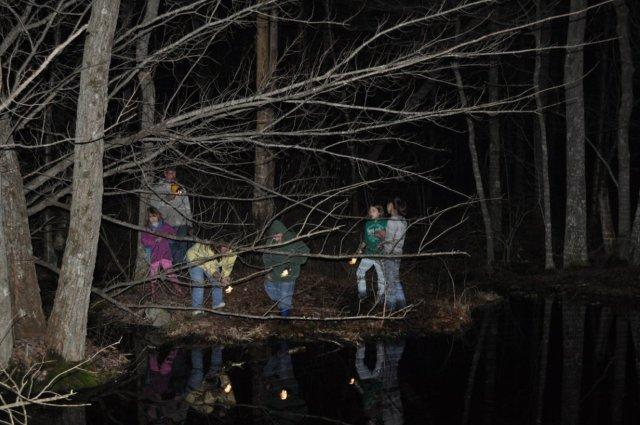
Checking for spotted salamanders and wood frogs on the far side of the vernal pool.


Exchange students from Cape Town, South Africa, wield nets to give all a close-up look at the salamanders, tadpoles, and frogs.
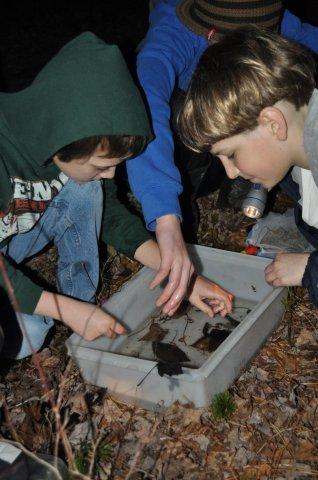
Kids check out vernal pool inhabitants.
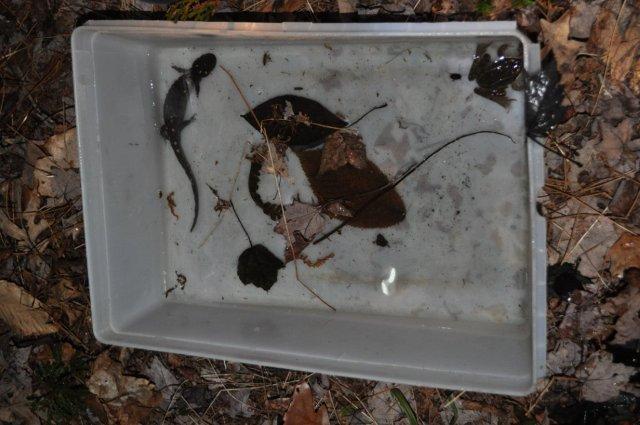
Spotted salamander in upper left, wood frog upper right.
MYSTERY STONES IN THE FOREST –
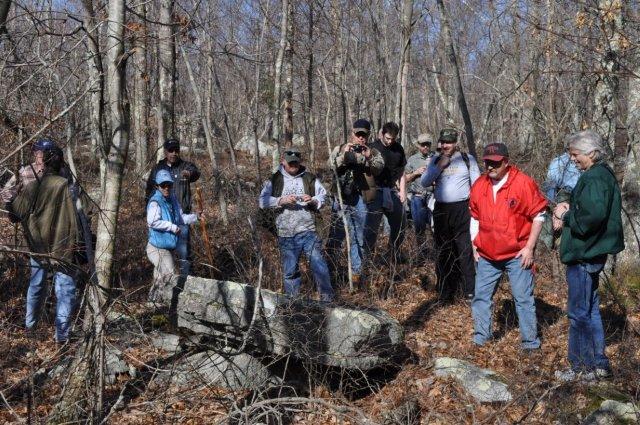
We had two dozen folks on our grand tour to all four mystery stones. We had a beautiful day for a walk in the forest and for mystery stone viewing.
Many theories were advanced. We are compiling them for inclusion in a future newsletter. Stay tuned.
---------------------------------------------------------------------------------------------------
Spring has arrived; don’t let it slip away without getting out in your natural environment. Click on our Calendar for fun spring things to do.
<Back
Social