Newsletters
June 2009 - LNG, Big Walk
“If you tell a lie big enough and keep repeating it, people will eventually come to believe it.”
-Joseph Goebbels
“You can convince anybody of anything if you just push it at them all of the time. They may not believe it 100 percent, but they will still draw opinions from it, especially if they have no other information to draw their opinions from.
-Charles Manson
LNG – Redux
Observation shows that, yes, you can fool some of the people all of the time, all of the people some of the time, but that you can’t fool all of the people all of the time.
That aphorism hasn’t stopped Hess Weaver’s Cove Energy’s flacks and toadies from spending millions of dollars attempting to fool all of the people all of the time.
In their attempt to win over the populace, from day one, Hess Weaver’s Cove has been making outlandish comments on the supposed benefits of their project and broadly disseminating false information that most, thankfully, can see right through.
Lies and the lying liars telling the lies goes back to the very beginnings of this ill-conceived LNG siting project nine years ago.
Here’s the article from nine years ago that begins the great lie that takes us down to the present lies we’re still hearing about this ill-conceived project in 2009.
Developer makes move for Shell Oil site
Herald News – James Finlaw
FALL RIVER--A large parcel of waterfront property with a checkered environmental past is about to be purchased by the construction firm currently building the new Brightman Street Bridge.
Sometime during the next several days, Jay M. Cashman Inc. of Boston is expected to purchase the 68-acre property in the North End of the city from the Shell Oil
Several oil tanks dot the property, which served as Shell Oil’s Fall River terminal from 1929 until it closed in 1995. The site also features a lengthy pie r which juts out into the Taunton River.
Jay Cashman Inc., one of New England’s largest marine construction firms, is also in the business of renting and leasing marine equipment such as barges and cranes. The company currently runs its equipment leasing operation from its facility in East Boston.
According to Cashman Vice President Alan D. Perrault, the company became aware of the Shell Oil site while working on the new Brightman Street Bridge.
Though the company will retain its East Boston location, Perrault said the Fall River site will eventually become the primary facility for Cashman’s marine equipment leasing business.
"We lease a fair amount south of Cape Cod, so Fall River would be good for us," explained Perrault.
Perrault said the Fall River site would allow the company’s barges to avoid the Cape Cod Canal, expediting the delivery of rental equipment to all points south.
"Eighty percent of our equipment is probably active south of the Cape Cod Canal, so Fall River is actually better than Boston," he said.
Perrault said the company will initially use the site to store the equipment they are using to build the new bridge. He said the company will not be making any significant changes to the property, such as constructing new buildings or razing existing structures.
The oil tanks, visible from Route 79 and North Main Street, will remain in place. Perrault said the company may use the three newest tanks to store concrete or liquid asphalt in the future.
The only immediate change at the site will occur at the pier.
On Oct. 26, Cashman filed a notice of intent with the city’s Conservation Commission, to conduct maintenance and reinforcement work on the pier and borings.
Perrault said the company wants to bolster and strengthen the existing wooden pier so it can support the weight of a crane and conveyor belt. The crane will be used to offload barges, while the conveyor belt will be used to move materials along the length of the pier.
The Conservation Commission has jurisdiction over anything built within 100 yards of a water body or wetland, and must approve of Cashman’s plan before any work at the pier can be undertaken, said city Environmental Affairs Officer Priscilla Chapman.
The Conservation Commission will meet with officials from Cashman at its Dec. 6 meeting at Government Center.
Because the sale and purchase of the land is not yet finalized, Perrault would not disclose the amount Cashman would be paying for the land.
While the new site offers the marine construction company a convenient location, it comes with significant environmental baggage.
From 1920 to 1929, the land was home to an oil refinery operated by the New England Oil Refining Co. Shell Oil Co. then operated its facility at the site for 66 years.
During that time a substantial amount of petroleum by-products entered the soil, contaminating the land. The state Department of Environmental Protection, DEP, gave priority status to the clean-up of the site in 1989.
Shell hired Handex of New England in 1990 to begin the clean-up. According to a 1990 report, Handex had recovered a total of 19,623 gallons of petroleum by-products from the ground beneath the terminal.
For the past several years Shell has had an Coggin & Fairchild, an Illinois-based environmental consulting firm, oversee the clean-up of the site.
The site’s troubled past does not seem to concern Perrault, who indicated that Shell, not Cashman, would continue to be responsible for the clean-up process.
"There is some ongoing work that Shell has to do. Shell is responsible for what historically was there, and they agreed to clean it up," said Perrault.
Fall River Office of Economic Development Executive Director Kenneth Fiola said the FROED has had a series of meetings with officials from Jay Cashman Inc. and has been pleased with the result.
The impending sale "will allow the Shell site to remain a part of Fall River’s working waterfront," he said. "We are encouraged by the fact that Cashman is a very reputable and successful contractor here in New England."
Fiola also said he believed the new facility would create employment opportunities.
"It should generate more job opportunities for Fall River residents and the residents of surrounding communities," he said.
The only concern Fiola and Mayor Edward M. Lambert Jr. have concerning the sale of the land, is that neighborhoods abutting the site will be negatively impacted by Cashman’s presence.
In the early 1990s, contamination at the site entered the groundwater of property just north of the tank farm. The pollution prompted the St. Vincent’s Home, which owned the land at the time, to sell the contaminated property to Shell.
"Our biggest concern is the portion of the property that is on the North Main Street side, and abuts residential neighborhoods there," said Fiola.
Lambert shared Fiola’s worry.
"We want to ensure that it is developed in a way that is compatible with the city’s plans and development ... I think we would want to work closely with them to determine how much it gets developed," said Lambert.
Perrault said Cashman has no plans to build, or conduct business on the portion of the site located near North Main Street.
He said the company’s use of the 68-acre property will be relegated to the shoreline and pier area.
There’s a little history for you and, of course, in the backdoor came Weaver’s Cove once the property had been acquired by Cashman. The Weaver’s Cove principals and Cashman were well acquainted with each other since they all had owned, managed or worked for companies along Everett’s Chelsea Creek.
They were fooling just about everyone and no doubt chortling over the progress being made in ramming their project into an urban area, against the will of the people, until savvy Congressman Jim McGovern shrewdly moved to save the Historic Brightman Street Bridge from destruction and then came the Coast Guard’s findings on the dangers involved in attempting to thread a fifteen hundred foot long vessel through that narrow bridge effectively killing Hess Weaver’s Cove Energy’s plans. Gordon Shearer, CEO and President of Hess LNG, was stymied. How could he store 4.4 billion cubic feet of gas in a densely populated community if he couldn’t get it there.
Shearer and company soon came up with an entirely new plan to fill his humongously huge tank with gas and it would by-pass that pesky bridge issue. Didn’t matter that the new “plan” had never been attempted anywhere before …they know their mission is to make millions supplying New England with “cheap” gas and nothing is going to get in their way.
The “new” equally ill-conceived LNG transport proposal changed to include a huge concrete “berthing platform” just this side of the Massachusetts/Rhode Island state line in Mount Hope Bay where the LNG supertankers would be offloaded into a four plus mile cryogenic pipeline that would take the gas up the Taunton River to Hess Weaver’s giant storage tank, thereby avoiding the bridge issue.
This new Hess Weaver’s Cove plan is now undergoing the same supposed “scrutiny,” from local, state and federal regulatory agencies that the original plan underwent. And as the process moves forward, Hess Weaver’s Cove has ramped up their public relations efforts to further obfuscate and confuse.
So here we are, once again attending usually biased regulatory agency meetings where the outcome has often been determined well before the hearing is even held.
Objectivity be damned! As example, one of the more interesting discoveries, at a past Federal Energy Regulatory Commission (FERC) hearing was when Coalition for the Responsible Siting of LNG Facilities President Joe Carvalho noted that all of the FERC materials on a hearing dealing with the Hess Weaver’s Cove issue arrived in boxes with “Baker-Botts” boldly printed on the sides.
Baker-Botts is the international big energy law firm hired by Hess Weaver’s Cove LNG to facilitate the permitting of their project. Collusion between Baker-Botts and FERC? “Good ole boy” network at work? What do you think?
Fast forward to the present and FERC calls a meeting on Hess Weaver’s Cove’s “new” engineering plan involving the bay berthing platform and cryogenic pipeline. Hess Weaver’s Cove asks FERC to require those members of the public attending the hearing to sign a “non-disclosure” statement because, according to Hess Weaver’s Cove, “this information contains specific engineering, vulnerability and detailed design information.”
Hess Weaver’s Cove also files with FERC “Responses to (FERC) Engineering Information” and asks their filing be placed under “CEII” (Critical Energy Infrastructure Information).
Rather ironic, don’t you think, since Hess Weaver’s has been telling us, all these years, that LNG does not explode, has a perfect safety record and is essentially benign. If an accidental or intentional release of LNG should occur, it would rapidly dissipate. If these statements are true, then why attempt to keep LNG shipping and siting information secret?
Fortunately, the latest secret LNG meeting turned into a total embarrassment for Gordon Shearer and other Hess Weaver’s Cove scoundrels when two brave elected officials attended their meeting and refused to sign the Hess/FERC “non-disclosure” form.
Read about it from the Herald News article as reported by Marc Munroe Dion.
Gag order protest shuts down LNG meeting
Swansea — June 16, 2009
Somerset Selectman Lorne Lawless and Rhode Island state Rep. Raymond Gallison, D-Bristol, together forced the cancellation of a Federal Energy Regulatory Commission meeting Tuesday at the Venus de Milo by refusing to sign a nondisclosure agreement FERC said must be signed by all those attending the meeting.
The meeting, open to the public, was intended to allow Weaver’s Cove to present to FERC plans for a liquefied natural gas pipeline that would run from an offshore berthing platform up the Taunton River to the proposed Weaver’s Cove LNG facility.
The offshore facility would be in Somerset waters about 1 mile from the nearest shoreline and 2 miles south of the Braga Bridge. It would connect to the proposed facility via a 4-mile buried pipeline. The facility would include berthing structures to secure LNG tankers during unloading operations and support transfer piping and controls.
Weaver’s Cove Energy CEO Gordon Shearer said that if approved, the offshore facility would eliminate the need to use the smaller tankers currently proposed to navigate under the Brightman Street Bridge.
“We are refusing to sign a nondisclosure agreement,” Lawless said Tuesday.
“We feel this against our interest as public officials,” Gallison said. “They are refusing to let me in.”
Gallison's and Lawless’ refusal to sign the form led Terry L. Turpin, FERC Chief of the LNG Energy Branch, to cancel the meeting and seek advice from FERC’s legal counsel.
Both Lawless and Gallison said they were willing to be arrested.
“They won’t start without me,” Gallison said. “They’re going to have to arrest me.
“If I sign this, the way I read it, I can never talk about this ever again.”
Gallison said that would prevent him from conveying needed information to his constituents.
“My position is, if you’re going to start, then we’re coming in,” Gallison told Turpin.
“Then we won’t have the meeting,” Turpin said.
“There’s no wiggle room in the regulations,” Turpin said “We have to cancel.”
Weaver's Cove Energy CEO Gordon Shearer said he was willing to wait as long as Gallison wanted to wait.
“If he wants to waste his day and hang out with us, that’s fine,” Shearer said.
“That’s not going to work,” said Turpin.
“The company is fairly irate,” Turpin said.
Turpin canceled the meeting and then waited about 15 minutes for a call from FERC in Washington, D.C.
“What they told me was that everyone has to sign the nondisclosure agreement or you don’t have a meeting,” Turpin said. “I’m packing my bags.”
“I think it’s a very unfortunate circumstance,” Shearer said. “There will be another meeting, in Washington, and that will be a loss of opportunity for local people.”
Turpin would not speculate about the time or location of the next meeting.
“He’s being rewarded for his bad behavior,” Shearer said of Gallison.
Shearer said confidentiality is needed in such meetings.
“The meeting was to discuss the technical design of the pipeline,” Shearer said. “This involves a lot of proprietary information. FERC generally protects such information.”
Told the next meeting might be in Washington, Gallison was adamant.
“I’ll be there, too,” Gallison said, saying he would once again refuse to sign the nondisclosure agreement.
Amazingly …or is this all part of some grand FERC/Hess conspiracy …FERC flips!
FERC flips stance on gag order
June 18, 2009
Herald News – Marc Munroe Dion
Fall River —
Somerset Selectman Lorne Lawless and Rhode Island state Rep. Raymond Gallison, D-Bristol, were jubilant Thursday after the pair heard that the Federal Energy Regulatory Commission will no longer require attendees at its public meetings to sign nondisclosure agreements.
Tuesday, Gallison and Lawless forced the cancellation of a FERC meeting at the Venus de Milo by refusing to sign a nondisclosure agreement. Both men said at the time that if the meeting went forward, they would attend without signing the agreement. Both men said they were willing to be arrested. The meeting was canceled by FERC Chief of the LNG Energy Branch Terry L. Turpin.
The meeting, open to the public, was intended to allow Weaver’s Cove to present to FERC plans for a liquefied natural gas pipeline that would run from an offshore berthing platform up the Taunton River to the proposed Weaver’s Cove LNG facility.
The offshore facility would be in Somerset waters about 1 mile from the nearest shoreline and 2 miles south of the Braga Bridge. It would connect to the proposed facility via a 4-mile buried pipeline. The facility would include berthing structures to secure LNG tankers during unloading operations and support transfer piping and controls.
Weaver’s Cove Energy CEO Gordon Shearer said that if approved, the offshore facility would remove the need to use the smaller-sized tankers that are currently proposed to navigate under the Brightman Street Bridge.
“The director of FERC, Jon Wellinghoff, called today to apologize to me and to say that we should not have been asked to sign a nondisclosure agreement,” Gallison said Thursday.
“He told me there will be other public meetings in this area and no one will ever have to sign the agreement,” Gallison said.
Gallison said Wellinghoff told him that FERC would change the procedure of requiring a nondisclosure agreement, “immediately.”
“I’m very encouraged,’ Gallison said. “This would have been prior restraint of political commentary.”
“What I feel is that Ray and I stood our ground,” Lawless said. “The nondisclosure agreement was restraining us from doing our jobs as public officials.”
Lawless said that Tuesday, Weavers Cove Energy CEO Gordon Shearer said the next meeting would be in Washington, D.C.
“He doesn’t get to decide,” Lawless said Thursday.
Tamara Young-Allen, a public relations specialist at FERC, confirmed what Gallison and Lawless said.
“He did apologize,” she said of Wellinghoff. “He did say that no meeting will be held that will require a nondisclosure agreement.”
“My only statement is that we’re investigating the legalities of this situation,” said James Grasso, a spokesman for Weaver's Cove.”
Finally, to make this month’s review of the LNG debacle complete, here’s Gordon Shearer’s hilarious letter where he starts by criticizing FERC, but then quickly, although still piqued, sucks-up. Shearer doesn’t want to burn his bridges (no pun intended).
What a miserable cabal of unscrupulous characters!
BIG WALK
As you know, the BIG WALK is a wonderful educational and advocacy event familiarizing folks with the natural beauty and important historical, biological, cultural and natural resources of the Southeastern Massachusetts Bioreserve.
We, at Green Futures, held the first BIG WALK sixteen years ago in an attempt to rally support for the Freetown State Forest and advocate for additional open-space acreage in the area now officially know as the Southeastern Massachusetts Bioreserve.
This year’s BIG WALK across the Southeastern Massachusetts Bioreserve was organized and conducted by The Trustees of Reservations.
The day started cool and damp. It ended sunny and warm. Perfect weather for a fourteen mile hike.
This was the 16th BIG WALK and Green Futures’ members Roger and Liz have happily hiked 15 of them. Quite the accomplishment!
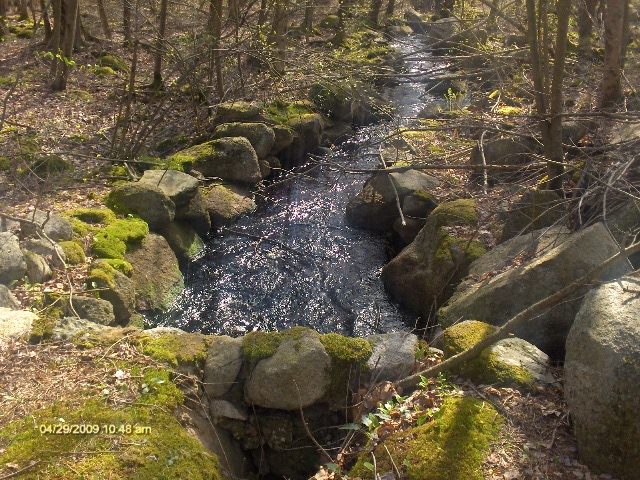
Here’s a photo of Blossom Brook taken by Liz as she hiked past.
If you missed the BIG WALK this year, plan on walking the 17th BIG WALK in spring 2010.
Click on our Calendar. Summer doesn’t last long in New England. You don’t want to miss it.
<Back
Social