Newsletters
January 2014-State Forest Erosion, Winterberry Holly, Hare
WELCOME TO GREEN FUTURES !
JANUARY, 2014
“One punk slob on a dirt bike makes more noise, takes up more space, inflicts more damage than a hundred horsemen or a thousand walkers.”
- Edward Abbey
“It is even harder for the average ape to believe that he has descended from man.”
- H. L. Mencken
ONE YEAR ANNIVERSARY – Heading for two?
This December marked one year in trying to get the Massachusetts Department of Conservation and Recreation (DCR) to do the right thing, not the expedient thing, for Rattlesnake Brook and its valley.
Along with repairing the damaged land caused by their negligence, we believe DCR must monitor motorized activity on our public land in their care and enforce the laws and regulations governing such activity.
We are appreciative of the efforts to protect the forest made by local and regional DCR staff. It’s the DCR brass, ensconced away in their Boston cubicles, that keep kicking the land damage and illegal off-road vehicle can down the road.
We were told last spring that law enforcement “stings” targeting illegal off-road vehicle activity would be conducted. They did not happen. The illegal activity continued and so did damage to the land. We were then told “stings” would probably begin in the summer …and when that didn’t happen …well, we were told, “stings” will begin in the fall. We and the forest are still waiting.
Since DCR apparently sees dirt-bike riding as an “approved” recreational activity on our public lands, one would think they would monitor the activity, enforce the laws and repair any damage resulting from the activity. Nope!
Here, below, are 2 recent You Tube videos showing kids having a great time. It looks like a lot of fun. Unfortunately their dads apparently feel they can ignore the rules and regulations and ride wherever they want. This is not unusual at Freetown. This is commonplace.
What are these kids learning from their fathers?
Why weren’t they stopped and fined? Bikes towed? A few $500 “illegal trespass by motor vehicle” fines would go far in stopping scofflaws. In this era of social media, word would travel fast among the “I don’t have to follow OHV rules” crowd.
Watching these videos only once, we immediately noticed the following infractions: riding off the official dirt bike track, riding on public ways, illegal trespass on railroad property, riding through and scouring out the wildlife corridor at Route 24, riding on the Spectra gasline, riding off state property onto private land.
https://www.youtube.com/watch?v=PvoRemRXgMQ
https://www.youtube.com/watch?v=2drdm2ZzY-I
Once again, since DCR approves of this activity on land they manage in the Freetown State Forest section of the Southeastern Massachusetts Bioreserve here’s what we believe they should be doing:
1- There isn’t any “open range” in densely populated Massachusetts. Move the remote … out of sight, out of mind …dirt-bike parking lot to Payne Road near the forest office so that dirt-bike riders know they are riding on DCR state forest property that has staff onsite for supervision of forest activities and that there are rules, regulations and laws that must be followed.
2 - The existing “official” dirt-bike trail “just happened” over many years and must be re-routed, in some areas, to avoid wetlands, stream crossings, sensitive ecological zones, loose friable soils and steep slopes.
3 - Create a single-loop, one way, dirt-bike track of a length that DCR can monitor and that can be maintained.
4 - Land is finite. Population continues to increase. Quotas on riders and/or reservations to ride may have to be implemented. No non-resident dirt-bike riding by those residents of states, such as Rhode Island and Connecticut, that forbid OHV activity on their public lands.
5 - Very important!!! Match dirt-bike use to the available management and enforcement capacity (funding and staff). This will assure that resources exist to guarantee management and adequate legal enforcement.
A RIVER AND ITS CITY REDUX

“A River and Its City” is back in print.
The influence of the Quequechan River on the development of Fall River, Massachusetts.
How the Quequechan River influenced the development of Fall River, from its beginnings as a Colonial village, through its emergence as a great cotton textile manufacturing center.
Authored by Alfred J. Lima
Contributions by Kenneth M. Champlin, Everett J. Castro
Edition: Second Edition
Book signing at the Fall River Historical Society, 451 Rock Street, Fall River, Massachusetts on the 21st of December, Saturday, 12 noon to 3 p.m. The book can also be purchased here https://www.createspace.com/4380290 and here
http://www.amazon.com/River-its-City-development-Massachusetts/dp/0981904378
BIORESERVE FLORA OF THE MONTH – Winterberry Holly (Ilex verticillata)
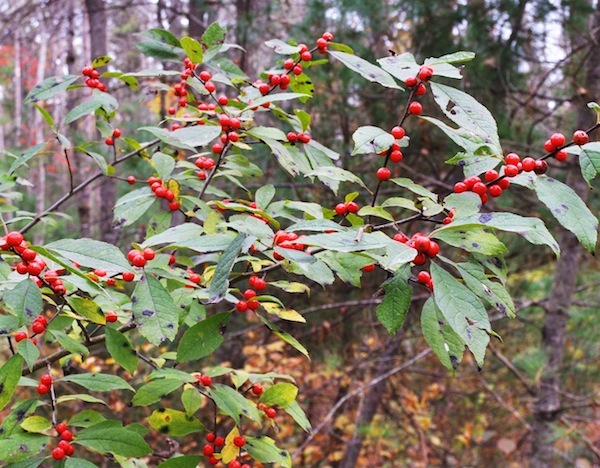
Whoa! …what’s going on here … a holly with red berries but without those prickly leaves?
If there is one tree that almost everyone can identify in our local woods it is the American holly. One that few can identify is the American holly’s deciduous relative, winterberry holly.
Winterberry holly is native from southern Ontario south to eastern Minnesota and Wisconsin and then south, east of the Mississippi River, to eastern Alabama. In the northeast, it can be found from west-central Newfoundland south to South Carolina and northwestern Georgia.
This holly grows best in rich, damp, acidic soil along woodland streams and wetlands. It is occasionally found as an understory shrub in somewhat drier forest uplands.
Winterberry shrubs reach 15 feet in height and often grow in small colonies although single shrubs are sometimes encountered. Leaves are alternate, glossy green, 3 to 4 inches long and oval, narrow at the stem end and broader just below the tip of the leaf. The leaves have toothed margins and turn yellow and then black in autumn just before leaf fall.
Flowers are small, inconspicuous, clustered together. Each individual flower is less than a quarter of an inch in width with 6 to 7 greenish-white petals. Winterberry blooms in early to mid-summer. Like the American holly it is dioecious, separate male and female shrubs. A male holly must be within a quarter mile if a female is to bear fruit. Forest flies, gnats and bees carry the pollen necessary for female hollies to produce berries (drupes) containing viable seeds.
The bright red berries average a quarter inch in diameter and are clustered on the branches. A large female winterberry holly, with branches festooned with shiny red berries, is an unforgettable sight. Such shrubs rarely go unnoticed and often suffer from overzealous Christmas greens collectors.
If untouched by man …or birds …the berries will remain on the branches throughout the winter.
To read about winterberry’s evergreen relative, go here: http://gf.gareworks.com/?content=abTgYEbx0fU4Q5aG
BIORESERVE FAUNA OF THE MONTH – Snowshoe Hare (Lepus americanus)
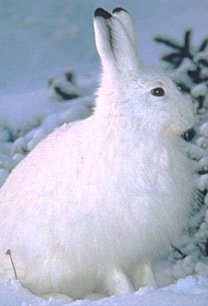 Photo NPS
Snowshoe hare in winter.
Now you see it, now you don’t. Snowshoe hares are camouflaged for all seasons. In the summer this dark brown hare fades into the forest shadows. In winter, the completely white hare is difficult to see against the snow. Spring and fall finds the hare somewhat brown and somewhat white.
Most folks think of snowshoe hares as inhabitants of the vast north woods, but they are also native to southern New England and their range extends down the spine of the Appalachian Mountains to eastern Tennessee and western North Carolina. In the west snowshoe hares are found in the Rocky Mountains south to extreme northern New Mexico and Utah and in the Sierra Nevada Mountains south to California. Probably due to climate change, the southern edge of snowshoe hare range has been slowly retreating north.
Although called snowshoe rabbits in some regions, they are not rabbits. There are many physical differences between hares and rabbits. Hares give birth to precocial (fully furred, open eyed, mobile and able to feed themselves) young, called leverets. Rabbit babies are called kits and are altricial (naked, eyes closed, dependent on their mother to feed them) at birth. Adult hares are larger than rabbits and have longer ears and legs. Hares are also faster than rabbits and live above ground. Rabbits seek shelter in burrows
Snowshoe hares inhabit thick forests with an even thicker understory of evergreen saplings and shrubs. During the day they sit quietly in their form (depression that corresponds to the size of the hare scratched out alongside logs, tree trunks or brush piles) venturing forth in the evening to feed. These hares are predominately crepuscular (active at dawn and dusk).
Adult snowshoes are 16 to 22 inches long and weigh 2 to 4 pounds. In summer they have dark brown coats that blend into the woody background shadows. In winter, they have thick, white fur that begins to appear along the back in September, as daylight shortens and by December they are snow white except for a small amount of black at the tips of their ears.
Their “snowshoe” moniker comes from their huge, furry feet with long toes that splay out when running from predators allowing the hare to escape by supporting the fleeing hare on top of soft, fluffy snow.
Hare breeding season starts in late winter and runs through the summer. The males, bucks, fight fiercely over the females, does. Bucks and does engage in an elaborate mating ritual consisting of nose rubbing and high speed chases with short abrupt stops and high leaps in the air with the hares often landing in the opposite direction. The doe eventually allows herself to be caught and mating occurs.
The hare gestation period is 35 to 40 days. The first litter usually arrives in April. Hares may have anywhere from 1 to 4 litters each year and give birth to from 1 to 5 leverets each time. Mother hares carefully hide each leveret nearby, but separately, in dense vegetation. Keeping them separated prevents losing her entire litter should any be discovered and devoured by a predator.
The leverets come together once a day, at twilight, to nurse. After nursing they return to their individual forms. The leverets are weaned when a month old and soon disperse to claim a territory of their own.
Snowshoe hares eat a wide variety of vegetation. In the summer they mainly eat grasses, ferns, clover and new leaves, shoots and buds. During winter they feed on twigs and bark of birch, willows and various forest understory shrubs and on conifer needles, such as those of hemlock, white cedar and white pine.
Just about everything else living in the forest will eat snowshoe hares. Long legs, big ears, keen eyesight and a running speed of 35mph help ensure species survival. In New England here are some critters that a smart hare will flee from: coyotes, bears, red foxes, grey foxes, long tail weasels, short tail weasels, mink, skunks, fishers, lynx, raccoons, opossums, bobcats, king snakes, black racers, red tailed hawks, rough legged hawks, goshawks, great horned owls, snowy owls, barred owls and bald eagles. Even red squirrels will kill and eat just born leverets if they stumble upon them.
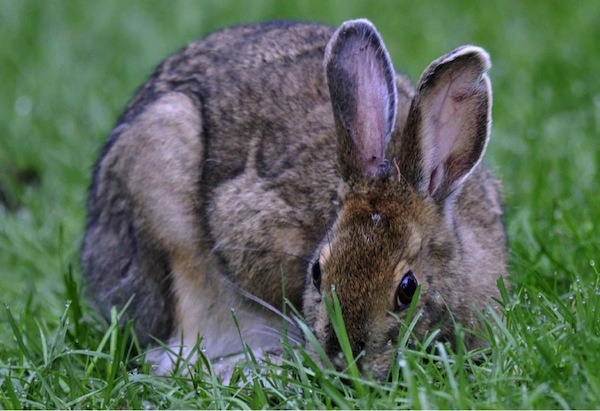
Snowshoe hare in summer – Photo U.S. Fish and Wildlife Service
MAYBE BLAME THE JAPANESE AND FUKUSHIMA?
http://www.youtube.com/watch?v=4bhoWfC1L9k
What will happen if a cloud of radioactivity spawned by the damaged Fukushima Daiichi Nuclear Power Station drifts over New England while we’re experiencing an alien winter moth invasion. Oh No!!!!!!!!!!!
Did you have hundreds of small brown moths flying around your house, car and neighborhood earlier this month? Those were Operophtera brumata, the winter moth, native to Europe and Asia.
The last eruption of this species was in 2010. These moths, along with alien and equally invasive gypsy moths killed thousands of red and white oaks, maples and other deciduous trees in the Southeastern Massachusetts Bioreserve about ten years ago. Since their introduction into North America it appears they reach plague proportions every 3 to 5 years.
To learn more about the winter moth read about them in our February 2010 Newsletter: http://gf.gareworks.com/?content=9aUkm726PjD5ns86
Oh, yes, the winter moth is also a Japanese native. Time to chant “Mothra, Mothra, Mothra. Mothra?”
ANOTHER INVASIVE INSECT – Here we go again!
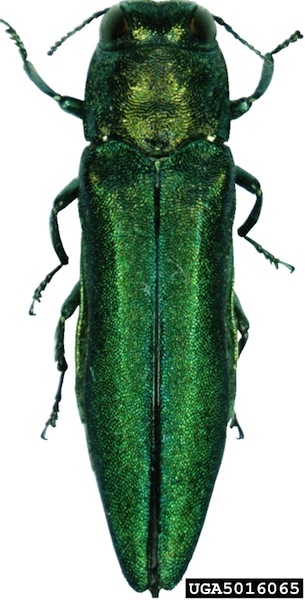
Like the winter moth the emerald ash borer also came to America from Eastern Europe and/or Asia. This alien invasive is west and north of us poised to invade our neck of the woods and devour all our ash trees.
They are not local yet, so let’s keep an eye out for them and if seen report them immediately to the Emerald Ash Borer Toll-Free Hotline – 866-322-4512.
The presence of emerald ash borers was recently confirmed in North Andover, Massachusetts, on November 15, 2013. The other Massachusetts location with a confirmed sighting of this borer is Dalton in Berkshire County.
Signs of emerald ash borer are tiny D-shaped holes in the bark of ash trees, tree-top dieback occurring in the upper third of the tree and sprouting of branches just below the dead area. Unusually persistent woodpecker activity on ash trees may indicate a possible emerald ash borer infestation. If such activity is noted, look for the D-shaped holes.
More information? Check out www.massnrc.org/pests
MERRY CHRISTMAS AND HAPPY HOLIDAYS! – 2014
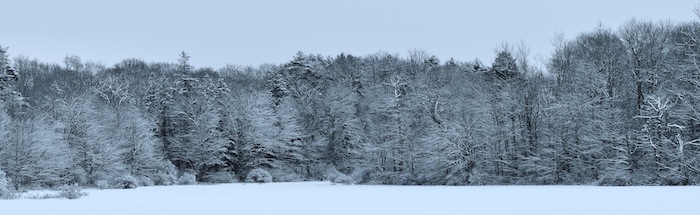
The 2013 Winter Solstice is December 21at 12:11 P.M. and everyone can celebrate. Those that enjoy snow and winter activities can welcome the arrival of winter on that date. Those preferring summer activities and sunny weather, here in the Northern Hemisphere, can look forward to increasing hours of daylight as we begin, once again, to slowly tilt toward the Sun culminating in the longest period of daylight at the Summer Solstice this June 21 at 6:51 A.M.
This winter get out in your natural environment and notice the seasonal changes. What can you see, smell, and hear out on a walk at this time of the year?
With deciduous trees and shrubs bare one can see way off into the forest. Who made those tracks in the snow? Local winter woods are deep and still and mostly silent, except for possibly a few “chick-a-dee-dee” calls, nuthatch “yank, yanks” and maybe, way off in the distance, the faint cawing of a crow or croak from an always hungry raven.
Click on our Calendar and see what’s to do in winter locally.
<Back
Social