Newsletters
February 2010 - Nuclear Power, Winter Moths
WELCOME TO GREEN FUTURES!
FEBRUARY, 2010
“In essence, a nuclear reactor is just a very sophisticated and dangerous way to boil water …analogous to cutting a pound of butter with a chain saw.”
-Dr. Helen Caldicott
“One of the things I draw from the Genesis story is the importance of us being good stewards of the land, of this incredible gift. And I think there have been times where we haven't been, and this is one of those times where we've got to take the warning seriously. And part of what my religious faith teaches me is to take an intergenerational view, to recognize that we are borrowing this planet from our children and our grandchildren. And this is where religious faith and the science of global warming converge: We have to find resources in ourselves to make sacrifices so we don't leave it to the next generation. We've got to be less wasteful, both as a society and in our own individual lives. I think religion can actually bolster our desire to make those sacrifices now. As president, I hope to rally the entire world around the importance of us being good stewards of the land.”
-Barack Obama
OBAMA – MELTS-DOWN, GOES NUCLEAR
“ And part of what my religious faith teaches me is to take an intergenerational view, to recognize that we are borrowing this planet from our children and our grandchildren.”
Guess Obama’s “take” has changed.
Obama, the guy that put the kibosh on further development of the nuclear waste burial site at Yucca Mountain, Nevada, now embraces nuclear power generation with a passion.
The announcement of $8.3 million in loan guarantees (yes, those “guarantees” are from you and me) were announced by Obama at a press conference on February 16, 2010.
We would have preferred a press event where Obama talked about energy conservation and funding and development of true clean energy alternatives. It would be nice to have a President that tells us what we most need to hear, but it's not about to happen.
Yes, we are energy pigs, and our energy appetite will never be sated.
For Obama to tout “clean” coal and “clean” nuclear as solutions to our energy needs leaves Obama’s “children and grandchildren” …and ours too …a terrible legacy.
The problem, of course, with what Obama calls “green and clean” nuclear energy is what to do with that pesky radioactive waste that lasts almost forever. It takes a tremendous leap of faith to believe government can store and safeguard, from wackos foreign and domestic, nuclear waste for the next 10,000+ years.
All of the nuclear generating countries have scientists working on ways to make nuclear waste benign. All say they will “probably” succeed sometime in the "future."
France has 59 nuclear power plants that produce almost 90% of its electricity. We presently have 104 nuclear power plants producing around 12 % of our electricity.
What do the French do with their nuclear waste? The same thing we do. While they attempt to find some rural area where they can pay-off the locals and bury the hazardous stuff, they store it on-site. According to one French nuclear proponent, “Today we store containers of waste because currently scientists don’t know how to reduce or eliminate the toxicity …but maybe in one hundred years …perhaps.”
How about we figure out how to neutralize the stuff before deciding to build more nuclear power plants?
Doesn’t matter how “state of the art” …or “robust” (favorite words of those seeking to site dangerous facilities) …nuclear plants are …there will always be human error and unforeseen events.
Regionally, Vermont Yankee is in the news. Tritium is leaking in the groundwater beneath the plant. Some feel it has already made its way to the Connecticut River. 27 of the 104 U. S. nuclear power plants are presently leaking tritium …and/or other radioactive isotopes into our shared environment. Cancer anyone?
Read a recent Keene, N.H., Sentinel Editorial - http://sentinelsource.com/articles/2010/02/19/opinion/sentinel_editorial/free/id_390904.txt
Here’s a Greenpeace link to some accidents and releases - http://74.125.113.132/search?q=cache:AH8s-3bZbrMJ:archive.greenpeace.org/comms/nukes/chernob/rep02.html+u.+s.+nuclear+power+accidents&cd=12&hl=en&ct=clnk&gl=us
Take your potassium iodide pill, children …everything is going to be alright!
INVASION OF THE WORMS – COMING INCH BY INCH
The winter moth, Operophtera brumata, caterpillar is a small green, horizontally striped yellow, leaf-eating insect native to Europe. The caterpillars are commonly called “inch worms.” The walking style of inch worm …or spanworm …caterpillars consists of bringing their back end forward to meet their front end.
We also have native inch worms. They are rarely a problem. All are geometrid moths.
Like many other alien species, the winter moth is invasive and is now very common in our neck of the woods. It arrived in Massachusetts around twelve years ago. Along with the long-established alien gypsy moth and native forest tent moth …these three species are responsible for the deaths of thousands of red oaks …and other deciduous species …in eastern Massachusetts and especially in the Southeastern Massachusetts Bioreserve.
Last December, throughout Eastern Massachusetts and neighboring Rhode Island, you probably witnessed …or saw on the television news …swarms of small brown moths flying around at night, and flocking to lights. During the day, in some local areas, houses would be covered with resting moths.
.jpg)
The moths you see flying about are the males. The female winter moths have only vestigial wings and spend their days on tree trunks, walls, large rocks, or other surfaces putting out male attracting pheromones in order to attract a male, mate, and lay their eggs.
Those over-wintering moth eggs will soon be hatching and winter moth inch worms may be a problem again this spring and summer. Watch for them.
Mother Nature has many lessons to teach. Unfortunately, it appears many of us are ineducable.
SPRING – AROUND THE CORNER?
Spring doesn’t come easy in coastal New England. Days of damp, cold and gray …a few sunny and mild. Watch for blooming pussy willows, (we’ve already seen them for sale in florist shops), and snowdrops, crocuses and other early spring flowers. The skunk cabbage will also be blooming in area wetlands. Slow down and smell the skunk cabbages. Check one out. A very interesting flower.
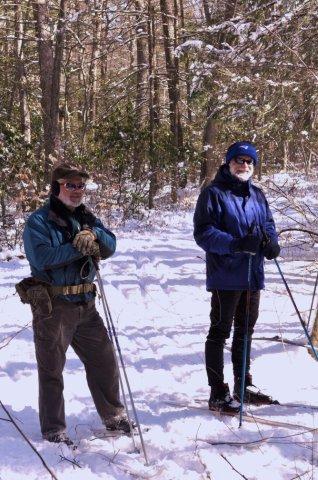
A March snowstorm is always a possibility, but it won’t last long. Might be your last opportunity to use those cross-country skis this season.
Click on our Calendar for spring things to do and learn. Welcome Spring!
<Back
Social