Newsletters
August 2014 - PAYT, Milk Snake, Nodding Ladies Tresses, ELA
WELCOME TO GREEN FUTURES !
AUGUST, 2014
“Nature is not a place to visit, it is home.”
- Gary Snyder
“Tell me what you pay attention to and I will tell you who you are.”
- Jose Ortega y Gasset
PAY-AS-YOU-THROW - FOR THE WRONG REASON
Fall River gets pay-as-you-throw (PAYT) …to make money? Huh?
Yep, the city says they’ll make 3.5 million dollars off PAYT. We’ll see.
Some years back we had a meeting with then newly elected Fall River Mayor Flanagan on environmental issues and suggested Fall River would be better served by implementing PAYT rather than continuing to host and rely on the largest dump in Massachusetts to dispose of the city’s solid waste.
We were told by the Mayor that PAYT would be too controversial and he would never, ever, consider that program for reducing the amount of solid waste headed to the dump, a dump perched within a quarter mile of the watershed of the municipal water supply. Bringing in PAYT to up Fall River’s abysmal recycling rate didn’t seem to interest him either.
Well, well, well!!! Due to multiple blunders, one being an inability of the present city administration to control and cover expenses, Mayor Flanagan has done a total flip-flop and has decided to implement PAYT. Not because PAYT is good for the environment and good for city residents, but because money is needed to fund the city budget.
The Mayor is using PAYT, which the city won’t be handling but has farmed out to private company WasteZero, because the city is drowning in a sea of red ink. This is a desperate move to keep the city afloat
This from Wikipedia, “Many variations of the PAYT concept exist, and all require that residents pay for trash collection based on how much trash they throw away (as opposed to all households paying the same flat fee or property tax for the service).
Whoa! Fall River residents are going to pay twice? Shouldn’t the city be reducing property taxes with PAYT coming to town? Nope, they are raising them!
Community sustainability and waste disposal equity are two good reasons for initiating PAYT, but those are only mentioned as afterthoughts. Quite simply, the present city administration dug themselves a hole and desperately needs money. That’s a sure way to poison residents’ thinking about a worthwhile, beneficial program.
Yes, we are pleased the city is taking our suggestion to go to PAYT to handle our municipal solid waste. We are not pleased the way it was done nor the reason for doing it.
Here’s what we had to say about the dump, PAYT and zero waste back in April: http://gf.gareworks.com/?content=jehpD03KTpePVxHQ
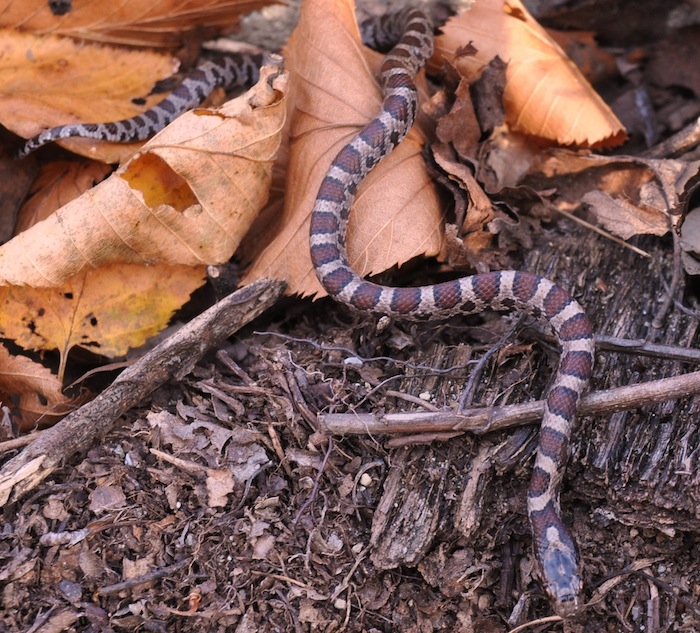
BIORESERVE FAUNA OF THE MONTH – Milk Snake (Lampropeltis triangulum)
Even those suffering from ophidiophobia might find our docile, beneficial and colorful milk snake an attractive and interesting fellow if they can bear to take a peek.
Our milk snake is in the kingsnake family. The “king” in the name refers to the fact that kingsnakes are at the top of the snake pecking order and readily eat other snake species and those other snake species include venomous rattlesnakes, copperheads and moccasins.
The milk snake received its common name from the old belief that these snakes suck milk from cows. In New England, milk snakes are primarily nocturnal and frequent cow barns in their search for a rodent dinner. A farmer, entering his cow barn early in the morning, would see a milk snake scurrying off to its daytime lair. If this coincided with a cow going dry, hasty conclusions could be made and the farmer could surmise that the snake he just saw was fleeing because it had sucked the cow dry during the night.
Although milk snakes are very docile and rarely bite even when grasped, they do have short, sharp teeth. No cow would allow a milk snake to latch onto her teat and suck milk.
Today, we know this is ridiculous, but back in early colonial days, before scientific animal husbandry practices and knowledge of wildlife habits, this was a commonly held belief in rural areas.
Milk snakes are very handsome reptiles. They are well proportioned, smooth and shiny with colorful reddish-tan ovals on a tan to white background. They blend in with the leaves and twigs on the forest floor. There is always a small, light colored “Y” shape design directly behind the head. Young milk snakes are more colorful than adults. Like most snakes, as they age, the colors become more muted and patterns subdued.
Superficially milk snakes resemble venomous copperheads. This often gets them killed. Copperheads have large triangular heads, oval cat-like pupils and stouter bodies. Copperheads also do not have the “Y” shaped design behind the head.
Copperheads are very rare in New England and absent, long extirpated, from the Southeastern Massachusetts Bioreserve as well as from neighboring towns and adjacent Rhode Island. What a shame! Both copperheads and milk snakes are unique forest life forms and both are beneficial species that keep rodent populations under control. Both deserve our protection.
Milk snakes range across the United States east of the Rockies. They are also found in extreme southern Quebec and Ontario and south of the United States in Mexico.
Milk snakes live in open woodlands and along forest edges that provide habitat for the milk snake’s rodent prey. Nearby stonewalls, rocks and ledges supply denning and hibernation sites. They may also den in old fieldstone cellars of farm buildings and rural homes. Although they may occasionally startle the humans therein, having a resident milk snake is beneficial, keeping the building mouse and rat free.
Adult milk snakes are generally 3 to 4 feet in length at maturity. Where prey is plentiful they may reach an additional half-foot in length.
Milk snakes mate in early spring. Males often wrestle for dominance and to attract the most desirable females.
Female milk snakes lay five to fifteen oval white eggs early in the summer in warm, damp rotting logs or in wood compost and sawdust/logging residue piles. They hatch after approximately 2 months and are 3 to 5 inches long at birth. The snakelings are on their own from the moment they leave their eggs and slither off into the forest to begin their solitary lives.
Milk snakes hunt mostly during the night for rodents and other small mammals, ground nesting birds and their eggs, other snakes and forest amphibians. They are constrictors, wrapping themselves around their prey until it expires and then swallowing it whole.
Preying on milk snakes are large forest hawks and owls, raccoons, fishers, foxes and coyotes.
BIORESERVE FLORA OF THE MONTH – Nodding Ladies’ Tresses (Spiranthes cernua)
Along with pink lady’s slipper and rattlesnake plantain, nodding ladies’ tresses is an orchid native to the Southeastern Massachusetts Bioreserve (SMB).
Nodding ladies’ tresses occur in all states east of the Mississippi and in North Dakota, South Dakota, Nebraska, Kansas, Oklahoma and Texas. In Canada it is found from Ontario east.
In the SMB this orchid grows best in acidic soil in sunny boggy areas and in very wet edges of open forests, meadows and wetlands.
Ladies’ tresses are perennial and grow from thick, tuberous roots. In July a terminal spike appears from near the center of the 3 to 6 narrowly oblong, 2 to 6 inch basal leaves. The flower spikes are between 12 to 24 inches in height.
The flowers are arranged along this spike and may number as few as 10 or as many as 50. Each flower has six petals. The flowers are typical orchid shape with a hood and labellum, modified lower petal, that is pouch shaped in many orchids, but not in this one. In the nodding ladies’ tresses the labellum hangs down like a small apron. The flowers have an intoxicating scent and are usually white although some may be greenish or a very pale yellow.
Pollination is accomplished by small forest bees that are attracted to the flowers by their fragrance. Following pollination, tiny, dust-like seeds form in linear capsules and when ripe split open and the seeds are dispersed by the wind.
If you see ladies’ tresses while hiking in the SMB, be sure to stop and smell the blossoms.
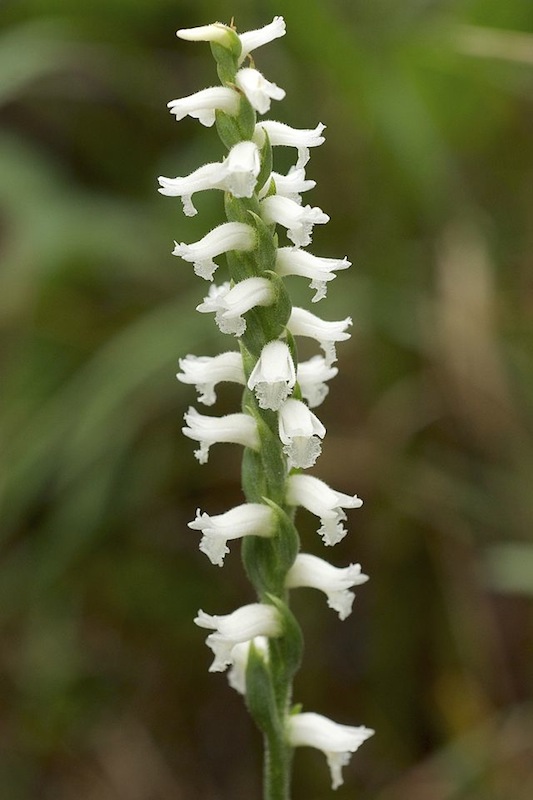
Photo – Eric Hunt – Spiranthes cernua (1) cc by sa 3.0 Wikimedia commons
ECOLOGICAL LANDSCAPING
Of the many emails from related environmental organizations and associations we receive each month one of the most interesting, due to the events offered, is the one that arrives from the Ecological Landscaping Association.
From their website we learn: The Ecological Landscaping Association is a nonprofit, member-based organization made up of professionals, businesses and pro-active community members who believe in using landscape practices that are environmentally safe and beneficial.
Their mission: The Ecological Landscaping Association (ELA) was founded in 1992. We advocate for environmentally responsible stewardship of land and natural resources in landscaping and horticultural practices of both professionals and the public. Through education, collaboration, and networking, ELA promotes the design, installation, and maintenance of landscapes that are guided by a knowledge of and respect for natural ecosystems.
A few of their August events: A Native Meadow: 40 Acres and Over 10 Years of Success; The Trouble with Earthworms; The edible landscape at Wellesley College.
If this is of interest, you might attend one of their events. If you do, we’d like to hear about it. Tell us at info@greenfutures.org.
WOW!!! AUGUST – Last full month of summer
We hope you are enjoying your summer. Don’t let it slip away without spending some time in your natural environment.
Click on our Calendar for a few things of natural interest.
<Back
Social