Newsletters
February 2014-Erosion, Am. Beech Tree, Red Back Salamander
WELCOME TO GREEN FUTURES !
FEBRUARY, 2014
“The preservation of wilderness is not simply a question of balancing competing special interest groups, arriving at a proper mix of uses on our public lands, and resolving conflicts between different outdoor recreation preferences. It is an ethical and moral matter. A religious mandate. Human beings have stepped beyond the bounds; we are destroying the very process of life.”
- Dave Foreman
“Facts do not cease to exist because they are ignored.”
- Aldous Huxley
YOUR HELP IS REQUESTED – Please help us and help our public forest land.
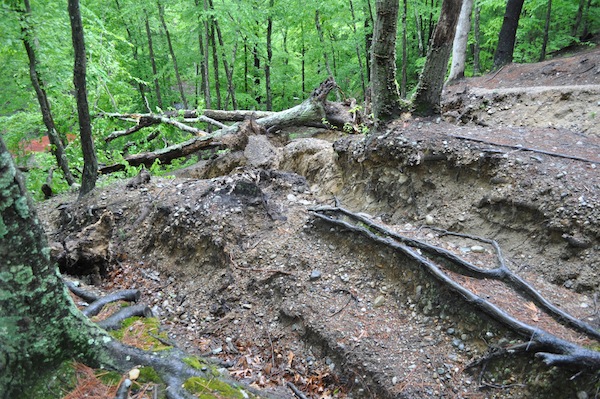
Can you help us?
We are trying to repair and save public forest land within the Freetown State Forest, especially the Rattlesnake Brook Corridor and also set up a forest management plan for the Southeastern Massachusetts Bioreserve of which Freetown State Forest is a part.
We are seeking the Boards of organizations (SEE LIST) who support this effort (SEE PROPOSED MOTION) to vote and notify GREEN FUTURES (info@greenfutures.org) by e-mail or (Green Futures, POB 144, Fall River, MA 02724-0144) by postal system of their support.
We plan to submit letters of support to the Massachusetts Department of Conservation and Recreation (DCR). If you know of any organizations and/or board members please contact them and let us know too.
If you know of any organization or association not on the list, below, please solicit their support and let us know at info@greenfutures.org. Doesn’t have to be only environmental/land trust organizations, but also neighborhood, religious, fraternal, civic, etc. that you might be familiar with or a member of.
If you or those you approach for support need more info and/or photos go to our website gf.gareworks.com and then, under Menu, click on “Current Projects.” In Current Projects, click on “Repairing Damaged Land and Restoring Rattlesnake Brook.”
Here’s a sample of what we need:
On (month, date, 2014), the (Board, Committee, Directors, Membership, etc.) of the (organization or group’s name) voted to (support, sign on to, etc.) Green Futures’ proposal to the Massachusetts Department of Conservation and Recreation regarding the Fall River-Freetown State Forest, Rattlesnake Brook and forest management planning within the Southeastern Massachusetts Bioreserve dated December 30, 2013.
Thank you!
Motion:
RE: FALL RIVER/FREETOWN STATE FOREST
We propose MA DCR
- Repair damage to hillside and Rattlesnake Brook caused by illegal OHV activity, now.
- Create a long-term forest, stewardship management plan with the Southeastern Massachusetts Bioreserve Partners and stakeholders.
- Massachusetts DCR fund all law enforcement, management, and damage repair if OHV are allowed anywhere on DCR managed property within the Southeastern Massachusetts Bioreserve. This part of the plan be incorporated in #2 above.
- Match OHV use to the available management and enforcement capacity (funding and staff). This will assure that resources exist to guarantee adequate legal enforcement.
Seeking Their Support:
*Westport River Watershed Alliance – 1151 Main Rd., Westport, MA 02790 – director@wrwa.org
*Taunton River Watershed Alliance – POB 1116, 1298 Cohannet St., Taunton, MA – advocacy@savethetaunton.org
*Massachusetts Audubon Society - 208 South Great Rd., Lincoln, MA 01773 – jclarke@massaudubon.org
*Dartmouth Natural Resources Trust - 404 Elm St., Dartmouth, MA 02748 – info@dnrt.org
*Greater Fall River Land Conservancy – Tel: 508.672.8217
*The Trustees of Reservations - 830 S Drift Rd, Westport, MA 02790 - Tel: 508.636.4693 - jdubois@ttor.org
*Conservation Law Foundation – 62 Summer St., Boston, MA 02110-1016 - Tel: 617.350.0990 - sreid@clf.org
*Sierra Club Massachusetts -10 Milk St., #632, Boston, MA 02108 – Tel: 617.423.5775 - office@sierraclubmass.org
*Environmental League of Massachusetts -14 Beacon St., Boston, MA 02108 – Tel: 617.742-2553 – info@environmentalleague.org
*The Nature Conservancy Massachusetts - 99 Bedford St., 5th Floor, Boston, MA, 02111 – Tel: 617.532.8300 - massachusetts@tnc.org
*Sea Run Brook Trout Coalition - PO Box 1024, Newburyport, MA. 01950 – Tel: 508.538.1857
*Environment Massachusetts - 44 Winter St., Ste. 401, Boston, MA 02108 – Tel: 617.747.4400
*Wildlands Trust – PO Box 2282, 165 West St., Duxbury, MA 02331 – Tel: 781.934.9018 – info@wildlandstrust.org
*The Trust for Public Land - 10 Milk St., #810, Boston, MA 02108 – Tel: 617.367.6200
*Ducks Unlimited - One Waterfowl Way, Memphis,TN 38120 Tel. 901.758.3825
*Save the Bay - 100 Save The Bay Dr., Providence, RI 02905 – Tel: 401-272-3540
*Westport Fishermen’s Association - PO Box 83, Westport Point, MA 02791 – wfa@westportriver.org
*Buzzards Bay Coalition - 114 Front St., New Bedford, MA 02740 – Tel: 508.996.6363 – info@savebuzzardsbay.org
*Natural Resources Defense Council - 40 West 20th St., New York, NY 10011 – Tel: 212.727.2700 – nrdcinfo@nrdc.org
Others
BIORESERVE FLORA OF THE MONTH – American Beech (Fagus grandifolia)
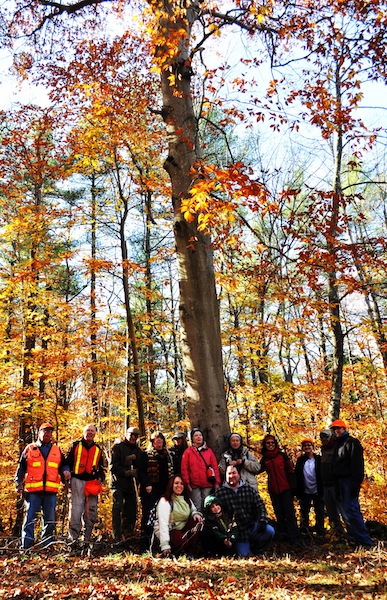
American beech in winter visited by some hiker friends.
They might not know it is a beech tree, but most woods walkers recognize the smooth, elephant-grey bark of the American beech. Their unique bark makes them instantly recognizable from other forest hardwoods. Other large New England forest tree species, for the most part, have roughly textured bark.
Unfortunately many view that unblemished bark as a blank slate and feel the need to carve their names, dates and trite sayings or remarks into the thin bark of beech trees. Not very thoughtful and not a smart thing to do since any breaks in the bark, like cuts in our skin, leave the body …human or tree ...vulnerable to infection and disease. In our southeastern New England area it is difficult to find a mature beech in close proximity to a hiking trail with its bark unsullied.
The American beech is found throughout the eastern United States and southeastern Canada. In the Southeastern Massachusetts Bioreserve its is often found growing alongside oaks, hickories, white pines, hemlocks and red maples. The beech is closely related to oaks and chestnut and like them has heavy, dense hard wood.
The European beech (Fagus sylvatica) is also commonly seen growing in New England, but not in the forest. Closely related, the European beech was widely planted in backyards and along city streets in the 1800s. The popular copper beech is a cultivated form of the European beech with reddish-brown and purple leaves.
The American beech is tolerant of a wide range of soil conditions; however it grows best in well-drained, rich, forest soils. It is a slow grower doing best in sunny forest openings, but is very tolerant of shade when young.
Beech trees can reach over a hundred feet in height and have a very broad, rounded crown composed of many slender twigs that in winter hold two inch long, pointy, light brown leaf buds.
Beeches are often found growing in groves and thickets that result from their shallow root system that freely sprouts. Old forest beech trees are often surrounded by their root sprouts and saplings.
Beech trees have simple, alternate leaves with serrations along the edge. The elliptical leaves average 4 inches in length. In spring, when newly emerged, the leaves are a beautiful silvery-green darkening to deep green as the season progresses.
In fall the leaves turn a rich golden-brown and most are retained by the tree through the winter. On sunny winter days beech leaves and bark reflect the sun and from a distance beech groves stand out as bright spots against a darker forest.
Beech trees flower in early spring and are monoecious, separate male and female flowers both on the same tree.
By fall those female flowers that were fertilized develop into brown, triangular, spiny burrs each containing two nuts about a half inch long. The nuts are oily and edible. In France and other European countries beech nuts are gathered and milled for flour and pressed for oil. Beech nut oil is used in salads and in cooking.
Almost every creature living in a forest where beech trees grow will bulk up on fatty beech nuts in preparation for winter. Forest birds and mammals eagerly search out beech nuts in October and November.
Today, it seems every North American tree species is under attack from a predatory insect or fungal species that we’ve foolishly imported intentionally or unintentionally. Unfortunately American Beech has not been spared. Wooly beech scale insects, native to the Caucasus Mountains and surrounding areas, punch holes in the bark to feed on beech sap and these tiny holes through the bark allow entry to a pathogenic fungus, Nectria coccinea. Nectria coccinea is the cause of beech bark disease. The fungus forms a necrotic canker that can restrict sap flow and kill the host tree.
Like native sycamores, beech trees often contain hollows which provide cozy dens for raccoons, fishers, opossums, grey squirrels, flying squirrels, barred owls, woodpeckers and other forest inhabitants.
It is easy to see that beech trees play a big and important role in our eastern forests. Hopefully they will develop resistance to beech bark disease and remain a valued member of the forest community.
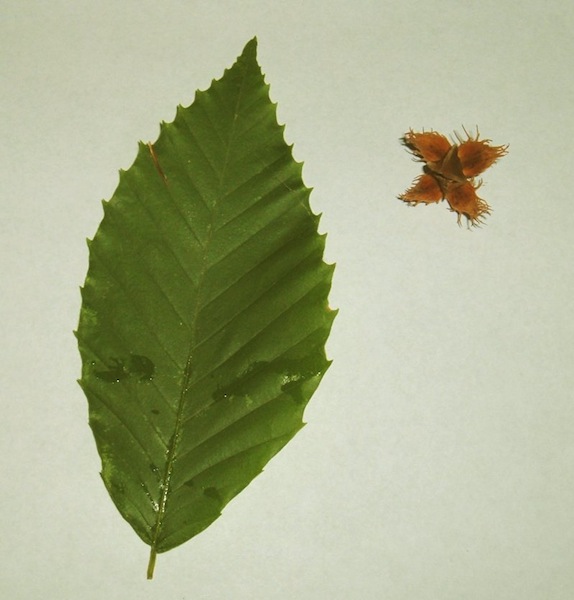
Beech leaf and nut husk
BIORESERVE FAUNA OF THE MONTH- Northern Red Back Salamander (Plethodon cinereus)
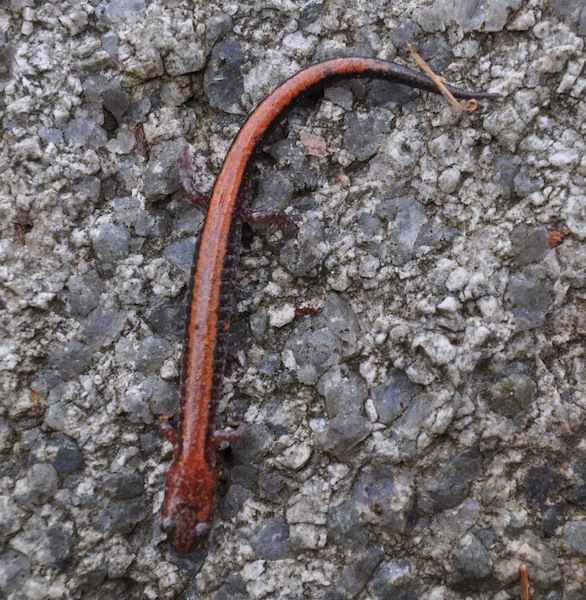
Right now the northern red back salamanders in the Southeastern Massachusetts Bioreserve (SMB) are hibernating in deep underground burrows. In a couple of months when the spring sun warms the earth and the temperature rises into the high forties to low fifties the red back salamanders will awaken and climb to the surface to begin another year of foraging under leaves and along the forest floor hunting for newly emerging insects, collembolas (snow fleas) and earthworms.
Forest ecologists and herpetologists believe that red back salamanders are the most abundant vertebrate in our New England woodlands. That is easy to believe in the SMB where just about every log or rock one looks under, during the warm months of the year, shelters one or more red backs.
Our red back salamanders are classified as lungless salamanders in the family Plethodontidae. Instead of having lungs for respiration, they absorb oxygen through their skin and the lining of their mouth.
Adult red backs are 3 to 4 inches in length. Most red back salamanders, as their name implies, have a red back but, not all. A few in every population will have orange, yellow, white or grey (known as lead-backs) backs. Whatever the color of this salamander’s back they all have white and black speckled legs and undersides. They have four toes on each forefoot and five on each hind foot.
Unlike most of our other salamander species the red back does not have an aquatic egg and tadpole stage. Metamorphosis occurs entirely within the egg. Male and female red backs maintain separate territories. During warm and humid summer nights males will wander visiting adjacent female territories seeking receptive females for mating.
Female red backs lay from four to fifteen eggs under rocks, logs and bark. The eggs are clustered together and hatch in about two months.
The range of the northern red back salamander extends down the Atlantic coast from the Canadian Maritime Provinces south to northern North Carolina and then west to eastern Missouri, north to eastern Minnesota and southern Ontario then east to Quebec.
Active and ferocious in seeking out their invertebrate prey these salamanders often find themselves on the menu of larger forest predators.
Almost all forest birds will gobble them up as will small mammals such as voles and shrews. If they fall into a brook or swim across a pond they will be quickly snapped-up by predatory fish and turtles.
In the SMB their major predator is the eastern ring neck snake. This snake feeds almost exclusively on salamanders and can follow them right into their burrows and under logs and rocks. You can read about the ring neck snake in our May 2011 newsletter here:http://gf.gareworks.com/?content=UbFrh35xxnDfqD2l
KING COAL IS DEAD – Somerset still in denial?
For those following the drama surrounding the phase-out of dirty coal as fuel for generating electrical power at Energy Capital Partner’s Brayton Point Power Plant here’s an interesting article that appeared in the The Herald News, dated January 18,http://www.heraldnews.com/article/20140118/NEWS/140119011/2011/OPINION
and this from the Boston Globe, dated January 21, http://www.bostonglobe.com/business/2014/01/21/coal-power-plant-somerset-may-delay-closing/hvjhdTRxvw2bIaSmr8PPEI/story.html
BIG DAY ALMOST HERE – Will spring come early …or 6 more weeks of winter?
As you know …and if you don’t know just watch an early morning television weather show on February 2 …Groundhog Phil from Punxsutawney, PA will wake from his long winter’s nap and predict whether spring will come early or if winter will linger for another six weeks.
Well, Punxsutawney being and south and west of where we are here in southeastern New England we’re not sure Phil’s prediction would be on target for our neck of the woods so this year we’ve decided to consult our local groundhog, Bioreserve Bob.
If Bioreserve Bob awakens and sees his shadow he will immediately return to his burrow for six more weeks of winter. If it is cloudy and Bob does not see his shadow, winter is at an end and spring is near.
Since it is close to Phil and Bob’s big day we took the liberty of sending a miniature camera down a cable into Bob’s burrow. Although it appears Bob’s eyes are open, he looks a little too comfortable in his hibernation bed. Will Bob hop out of his bed and leave his burrow on February 2? Will spring come early, will winter stay late?
We need Bob outside his burrow to find out because …only the shadow knows!
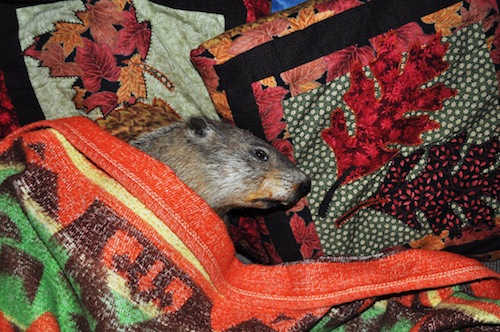
Happy Groundhog Day!!!
LAST FULL MONTH OF WINTER – Enjoy!
Have you noticed the sun’s angle is shifting and daylight increasing? February is a good month to get outside and welcome the sun’s return. Can you feel that vitamin D all around you?
By the end of the month redwing blackbirds and woodcocks will be back in area wetlands and in cities and towns the first snowdrops and early crocuses will be emerging from Mother Earth. Out in the wild, skunk cabbages will be blooming too. Click on our calendar for interesting activities.
<Back
Social