Newsletters
May 2014-SMB/DCR Update, Eastern Hemlock, Woolly Adelgid
WELCOME TO GREEN FUTURES !
MAY, 2014
“Do what you can, where you are, with what you have.”
-Teddy Roosevelt
“Self-control is the chief element in self-respect, and self-respect is the chief element in courage.”
- Thucydides
THANKFUL FOR SMALL THINGS – Now, let’s tackle the major problems.
We have been trying, since December of 2012, to work with the Massachusetts Department of Conservation and Recreation (DCR) in repairing and restoring what was once a beautiful wooded hillside above Rattlesnake Brook in the Freetown State Forest portion of the Southeastern Massachusetts Bioreserve (SMB). It’s been difficult to get beyond “trying” because DCR initially ignored our concerns and our suggestions, but they are paying attention now and some illegal access points and illegally cut trails have been closed off, forest gates secured and dumping of household and demolition waste cleaned up as soon as reported or noticed by DCR staff.
We …and the forest too …are thankful for this start at taking back the forest from the off road vehicle knuckle draggers, dolts and forest despoilers. We are also pleased that DCR has supplied additional staffing at the forest for this summer. They are already doing a great job and here are a few photos, below, of what they’ve been cleaning up. The next step should be to catch a few of the dumpers in the act, tow their vehicle and see them in court. A few examples made will go a long way toward bringing this nasty problem under control.
More ugly signs and meaningless educational efforts to reach the ineducable are a waste of time, energy and money. Enforce laws and regulations. Takes effort, but gets quick results.
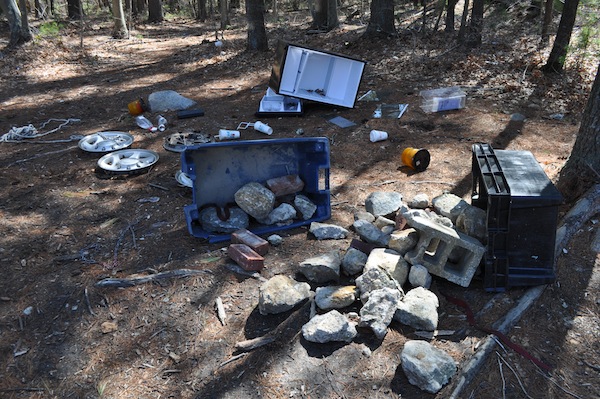
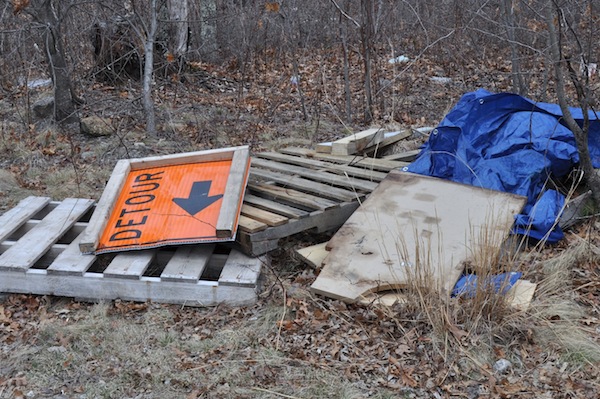
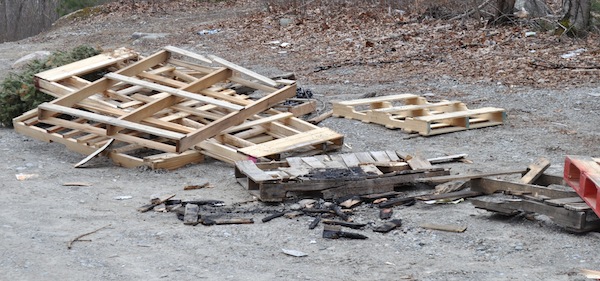
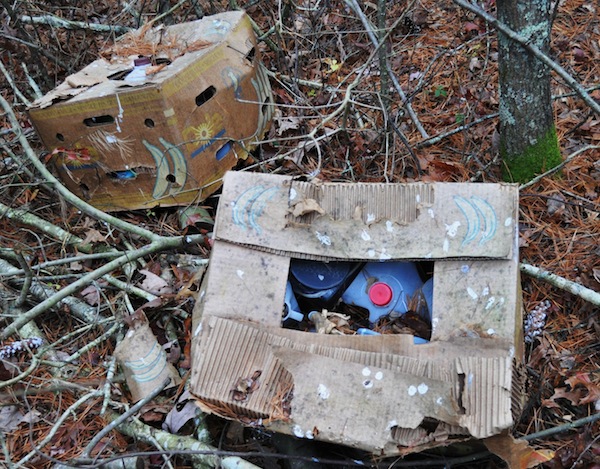
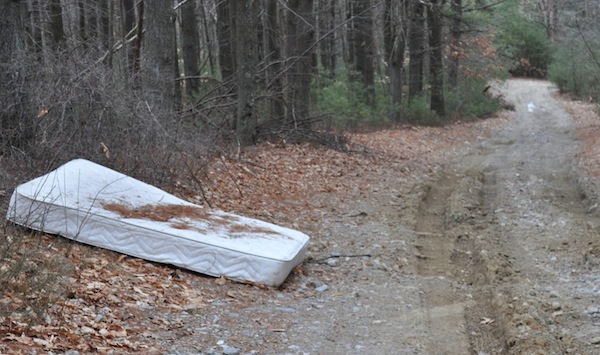
All of that trash has been removed and we say, “YAY!!!”
Hopefully, now that DCR is getting a handle on things, they will now begin to tackle the major problems. They must repair the damaged hillside and restore adjacent Rattlesnake Brook and work with the Bioreserve Partners and stakeholders in crafting a long-term Forest Biodiversity Management Plan.
DCR, stay the course and take back the forest. Woo-hoo!
SOUTHEASTERN MASSACHUSETTS BIORESERVE FLORA OF THE MONTH – Eastern Hemlock (Tsuga canadensis)
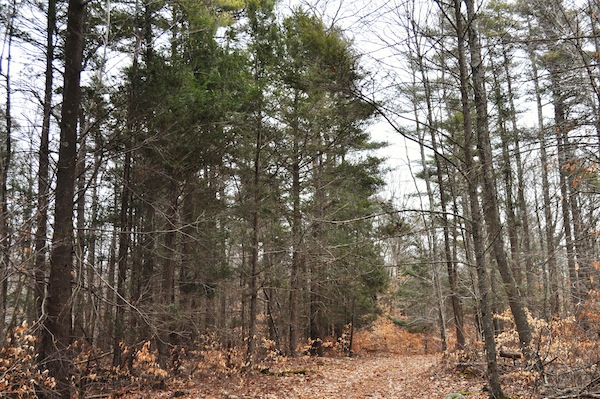
Young eastern hemlocks near King Philip Brook in the Bioreserve.
Eastern hemlock is one of our most beautiful evergreens. It is usually found growing in shady ravines, along brooks and on the north side of narrow valleys. Our most shade tolerant native conifer it thrives in areas the sun barely reaches.
Although you won’t see any of this size in the Southeastern Massachusetts Bioreserve, hemlocks can grow to a height of over 150 feet with trunks over 6 feet in diameter. They grow very slowly and do not produce seed cones until at least 20 years old. Some do not reach maturity and bear cones until over 100 years old. Large specimens can be over 1,000 years old.
Unfortunately our hemlocks are under extreme stress, many dying, from attacks by the Asian hemlock woolly adelgid. The invasive woolly adelgid is a very serious threat to the continued survival of the hemlock and those species that depend on the hemlock. You’ll find more on the woolly adelgid, below, in this month’s Bioreserve Fauna of the Month.
Eastern hemlock have short, flat needles, a half inch to an inch long, dark green above with two narrow white lines running the length of the needle’s underside. The needles are attached to their twig by a slender stalk.
Tiny flowers are produced in spring with inch long cones ripening in the fall and releasing seed during the winter. Many winter birds and small forest rodents depend on hemlock seeds as a winter food source.
The eastern hemlock grows best in damp, acidic soil from extreme southern Ontario and Quebec east to Nova Scotia. From Nova Scotia south along the Atlantic coast to New Jersey and then inland following the Appalachian Mountains to extreme northern Georgia and Alabama. To the west, the hemlock range extends south from southern Ontario to eastern Minnesota, Wisconsin, Michigan and then down the western side of the Appalachians.
On the northern edge of their range whitetail deer depend on eastern hemlock for food and/or shelter. Dense stands of hemlock slow the accumulation of winter snow beneath them. When heavy snows, frigid temperatures and strong winds buffet our northern forests small family groups of deer gather at these hemlock stands, called “deer yards,” for shelter, feeding and bedding. Young, dense hemlocks also provide food and shelter for snowshoe hare and various species of forest voles and mice.
A fortifying tea can be made from hemlock needles. And, no, this is not the “hemlock” Socrates drank. Socrates’ death-sentence drink was concocted from poison hemlock, Conium maculatum, an herbaceous plant, not a tree.
Not that long ago hemlock bark was rendered for tannin, which was widely used for tanning leather prior to the development of various chemical methods which require less labor and are more economically advantageous.
There are numerous insect species that feed on hemlock. Only two of these are capable of killing their host. One of these is the previously mentioned alien hemlock woolly adelgid and the other is the native hemlock borer which preys on weakened hemlocks often killing woolly adelgid compromised trees.
Old eastern hemlocks and hemlock stumps and logs occasionally nurture an interesting and much sought after medicinal fungus. The hemlock varnish shelf polypore, Ganoderma tsugae, is very closely related to the highly valued Asian “miracle” mushroom reishi or ling chi/lingzhi, Ganoderma lucidum.
Both mushroom species contain triterpenes, polysaccharides and sterols and both can be made into a “tea” reportedly containing immunotherapeutic properties, anti-tumor inhibitors and enhancers for anti-viral and anti-bacterial activity.
One can easily see the eastern hemlock is a species we do not want to lose. Unfortunately, like the American elm, American chestnut and various other native species, that have been extirpated from vast areas of their natural range by introduced insects and diseases, the future is not bright for this grand American tree.
SOUTHEASTERN MASSACHUSETTS BIORESERVE FAUNA OF THE MONTH – Hemlock Woolly Adelgid (Adelges tsugae)
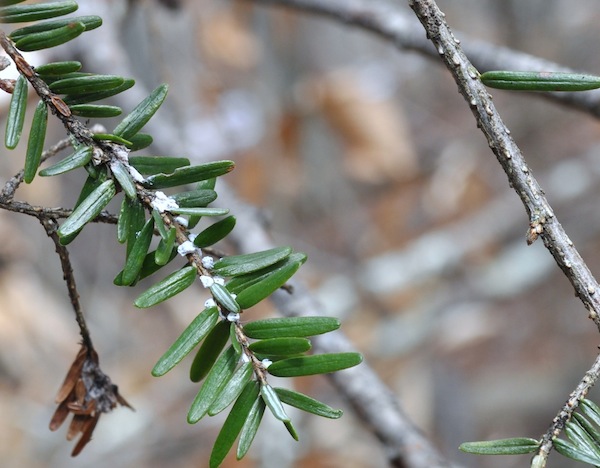
The hemlock eating woolly adelgid is a fairly recent arrival to our Bioreserve first making an appearance around 1990. They are a Japanese species first arriving on the west coast in 1924 and have been expanding their range east and north ever since.
The present range of this adelgid is from Virginia, North Carolina and east Tennessee north up the Appalachian Mountains and the coast to southern Maine.
As with almost all alien invasive species they found a bountiful food supply and few predators. In the woolly adelgid’s native Japan there are species of native insects that have evolved to prey on wooly adelgids keeping their numbers in check and doing only minor damage to Japan’s native hemlocks.
Wooly adelgids are supposed to have difficulty surviving temperatures below 20 degrees Fahrenheit, but a check of Bioreserve hemlocks in February, when the temperature was in the teens, showed many adelgid infested trees.
Wooly adelgid abundance also comes from the fact that they not only reproduce sexually, but also reproduce by parthenogenesis. Adelgids produce two generations a year. One generation overwinters on the hemlock. In this overwintering generation the adelgids are called “sistens.” Sistens are wingless and reproduce parthenogenetically. In the second, spring, generation the adults are “progrediens.” There are two forms of progrediens, another wingless form that remains on the hemlock and a form that has wings that flies off in search of a different host tree, a species of spruce not found in North American forests. The winged progrediens are all viviparous (producing living young instead of eggs) females which give birth to both males and females which mate and the females then lay fertilized eggs. However, these guys do not survive to reproduce and add to the adelgid population in our area because, as mentioned, we don’t have the required host spruce necessary for their survival.
The eggs of the hemlock staying progrediens hatch into nymphs which are so tiny and light that the wind easily disperses many of them throughout the forest. Those fortunate enough to land on a hemlock crawl to the underside of a hemlock needle and insert a pointed mouthpart, stylet, into the base of the needle. There they remain feeding on phloem, the food conducting tissue that supplies the hemlock with the nutrients it needs for survival. The nymphs pass through four growth stages on their way to becoming adult.
A hemlock heavily infested with wooly adelgids slowly turns grey and dies. Biologists have been studying a number of beetles and fungal diseases that keep the wooly adelgid population under control in Japan. Whether they will be effective predators of this invasive insect species on this continent has not yet been definitively determined.
MAY – A most marvelous month
There are a million reasons to love May in New England. Sunny, mild days mean friendly flowers are blooming in gardens and the wild members of their families are doing the same thing in local woodlands. Our summer nesting birds have returned to nest and raise their young in the rapidly greening forest. Fish are biting, bikes are being pedaled, boats are going into the water. Mother Nature is awake and on the move. Time to get yourself outdoors and enjoy the spectacle.
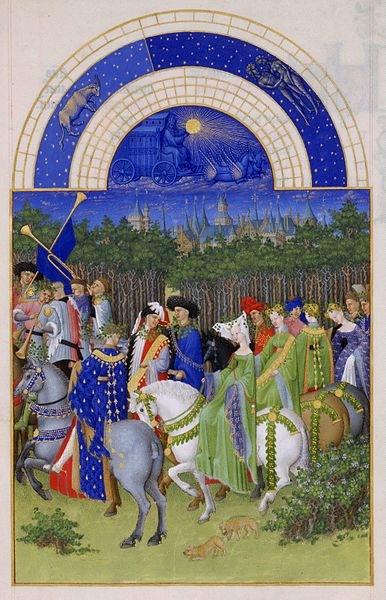
In the Middle Ages the Limbourg Brothers (1385-1426) were commissioned to create a calendar, part of an illuminated manuscript, known as the “Tres riches heures du Duc de Berry.” Each month illustrates a scene from the estates of John, Duke of Berry.
In the May scene, above, we see the Duke and his entourage, with blowing horns and prancing horses, celebrating May’s return.
Although most of us …we surely don’t …celebrate the return of May by riding around our estate on horseback, dressed in Medieval fashion and accompanied by blowing horns and frisky dogs we do feel the same urge to get ourselves outdoors and celebrate. May, the most marvelous of months.
Click on our Calendar for May and June activities.
<Back
Social