Newsletters
October 2014 -Red Fox, Joe Pye Weed, Wilderness Act
WELCOME TO GREEN FUTURES !
OCTOBER, 2014
“Often it does seem such a pity that Noah and his party did not miss the boat.”
-Mark Twain
“Be not simply good …be good for something.”
-Henry David Thoreau
THE WILDERNESS ACT – Happy 50th
In September of 1964 President Lyndon Johnson signed into law the Wilderness Act. This important legislation set aside still wild areas of the United States where the earth and its natural communities are left unchanged by people, where the primary forces of nature are in control and where people are visitors who do not remain.
There are some great National Wilderness Areas in New England. Visiting one should be on your list of things to do. Go feral next summer!
Maine:
Caribou-Speckled Mountain Wilderness
Moosehorn Wilderness
Allagash Waterway Wilderness
New Hampshire:
Great Gulf Wilderness
Pemigewasset Wilderness
Presidential Range – Dry River Wilderness
Sandwich Range Wilderness
Wild River Wilderness
Vermont:
Aiken Wilderness
Lye Brook Wilderness
Bristol Cliffs Wilderness
Big Branch Wilderness
Peru Peak Wilderness
Broadloaf Wilderness
Joseph Battell Wilderness
Glastenbury Wilderness
Massachusetts:
Monomoy Island Wilderness
Here’s an interesting article from the Des Moines Register on some Iowans who were early advocates for saving our natural environment and protecting wilderness areas. http://www.desmoinesregister.com/story/opinion/columnists/iowa-view/2014/09/21/wilderness-act-anniversary-love-nature/15994607/
Want more wilderness? Try here: http://www.wilderness.net/
“To those devoid of imagination a blank place on a map is a useless waste; to others, the most valuable part.”
- Also Leopold
CLIMATE CHANGE – Heating up the planet
Back in the summer of 2013 there was a large protest over the burning of dirty coal at the Brayton Point Power Plant in Somerset, MA. Dozens of “stop climate change” activists offered themselves up for arrest and were politely hauled away by the police for ”trespassing” on power plant property. Read about it here: http://gf.gareworks.com/?content=1djuMK7Q7gaw8W84
Part of that same protest was a blockade of a large coal carrier by two activists in a lobsterboat that dropped anchor and stopped, for a time, the off-loading of the coal.
They were arrested and their trial was slated for September 8 and 9, 2014. We issued two “Action Alerts” to notify those interested. The trial opened and hundreds of activists arrived to support the defendants.
Climate change believer, Bristol County District Attorney Sam Sutter, dropped the charges and with the paying of fines everyone went home to continue the fight. Read it here in The Fall River Herald:http://www.heraldnews.com/article/20140908/NEWS/140907227/0/SEARCH
For an interesting and controversial article on averting ecological disaster go here: http://m.democracynow.org/stories/14653.
BIORESERVE FAUNA OF THE MONTH – Red Fox (Vulpes vulpes)
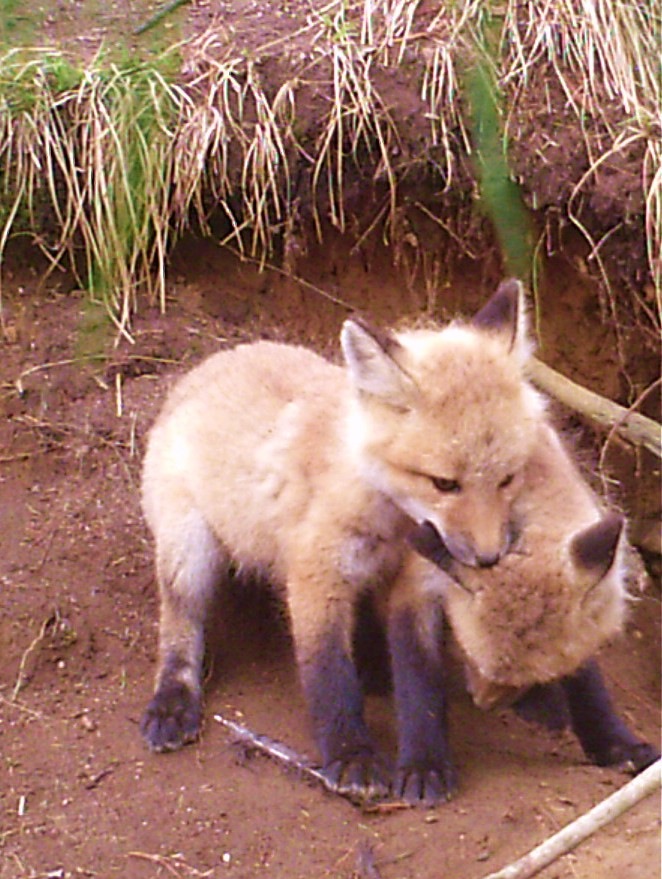
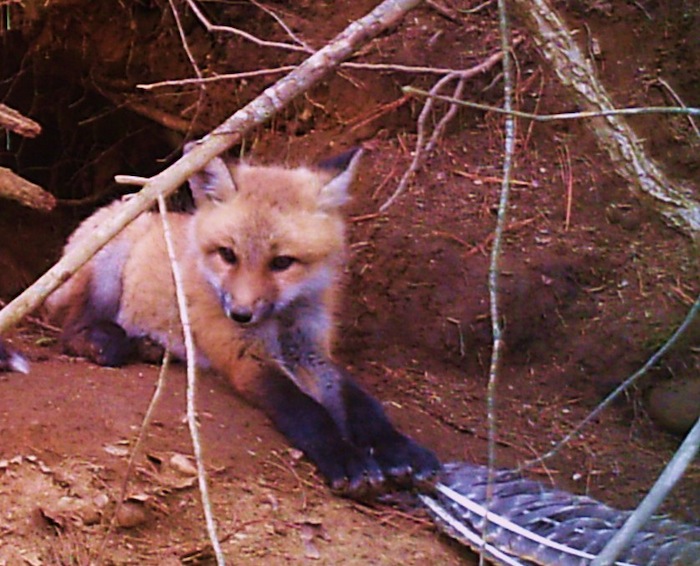
Red fox pups playing outside their den in the Southeastern Massachusetts Bioreserve.
There are two species of fox in the Southeastern Massachusetts Bioreserve (SMB), the red fox and the gray fox. Many people have difficulty identifying one from the other.
Gray foxes can be quite red, especially along their flanks, neck and chest leading many to misidentify them as red foxes. Although there are many other ways to tell the two species apart, the easiest way is to view the tail. Red foxes, which can sometimes have a black, silver or gray coat …even if its coat is a different color …always have a white tail tip. The gray fox never does.
Adult red foxes weigh between 8 and 15 pounds. Length is around 3 feet long with an additional foot long tail. Males are larger than females. Foxes often appear larger than they are, especially in winter, because of their long and dense furry coat. Their tail is long and bushy and carried straight out keeping them on balance when moving fast.
Red foxes have longer legs than gray foxes and are much faster runners capable of running at 40 miles per hour for short distances and trotting at 10 miles per hour for hours at a time.
Red foxes are canines related to our doggie friends. They have all the intelligence of dogs and more. Most cultures have the clever and cunning foxes as central figures in ancient myths and fables.
Red fox have a worldwide distribution in the Northern Hemisphere. They were introduced into Australia, from England, for hunting and to control introduced European rabbits. Of course, this has proven to be a costly mistake. The introduced foxes have found it easier to prey on Australia’s indigenous marsupial species that didn’t evolve having to avoid foxes. Rabbits did.
Red foxes normally den out in the open. They go to underground den only when pups are about to be born or to seek refuge from coyotes. In the SMB foxes usually enlarge an abandoned woodchuck burrow, although occasionally they take over an active burrow after they have eaten the owner. The den entrance is usually on a bank or on a hillside above a gully where it will remain dry even during heavy rain.
Fox dens usually have an “escape” exit and the main den chamber is usually lined with soft grass and leaves prior to the arrival of pups. The fox breeding season is January and February and fox pairs remain together throughout the year.
Female foxes, vixens, generally give birth to 3 to 5 pups in March or April. Once the pup’s eyes open, ten days after birth, the pups spend most of their time playing with bones, feathers and other bits of their dinner brought home by their parents. At 12 weeks of age their parents begin to teach them how to hunt. The family may stay together through the winter or the pups may disperse in early winter to find territories of their own.
Fox enemies include humans, dogs, coyotes and eagles. Sarcoptic mange and canine distemper often devastate local red fox populations.
Red foxes dine primarily on mice, voles and other small rodents. They will also eat rabbits, hares, snakes and other reptiles and even large insects such as grasshoppers. They will also eat carrion and ripe corn, apples, grapes and other fruits.
Watch for these colorful wild canines, most usually seen at dawn and dusk, when walking woodland and meadow trails.
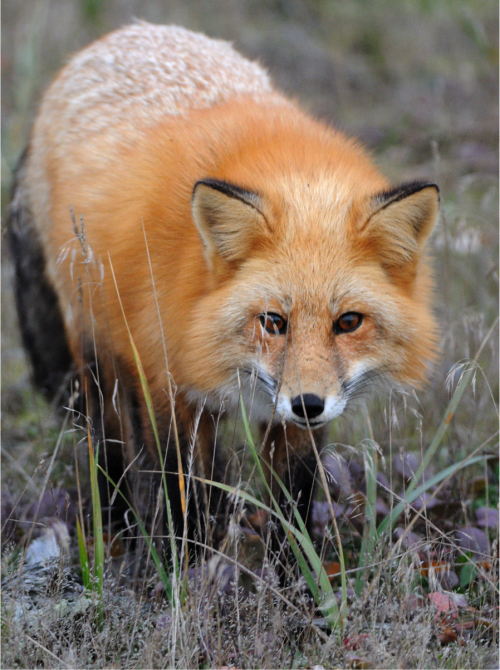
Photo – Matt Knoth CC by-sa 3.0
BIORESERVE FLORA OF THE MONTH – Joe Pye Weed (Eutrochium fistulosum)
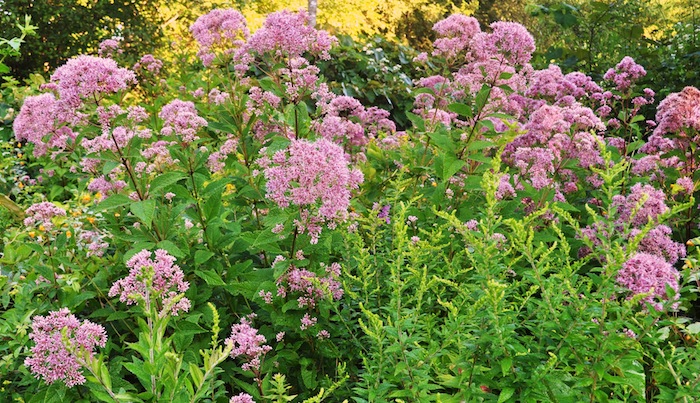
There are four species of Joe Pye weed in our area and finding out which one you’re looking at can get pretty tricky because some of them like to fool around and hybridize making exact identification very difficult. The one think they do all have in common? The all have very tall stems topped by attractive composite flowers ranging in color from pink to old rose and red-purple.
Hollow stem Joe Pye weed is the species in the photo, above. The other species are: Spotted Joe Pye weed, Eutrochium maculatum; sweet Joe Pye weed, Eutrochium purpureum; coastal plain Joe Pye weed, Eutrochium dubuim.
Hollow stem Joe Pye weed is found from Texas and Oklahoma east across North America to the Atlantic and from Quebec south to Florida.
Growing best in moist to wet soil hollow stem Joe Pye weed thrives in full sun backing salt marshes and freshwater swamps, wetlands and low areas in fields, meadows and along roadsides that have mucky soils that stay damp throughout the year.
All the Joe Pye weeds are perennial plants and produce copious nectar attractive to various bees, hornets, flies, butterflies and moths.
Hollow stem Joe Pye weed grows to a height of 6 to 8 feet. The lower stems are green, the upper are red-purple. The dark green leaves are large, serrated and grow in whorls around the flower stem. Lack of moisture late in the summer will cause the leaves to droop and turn yellow.
The Joe Pye weeds are hardy and tough with few diseases and insect enemies. Joe Pye weed is low on the list of desirable food items for deer, rabbits, woodchucks and other forest-edge herbivores.
By now, you’re probably wondering how this plant acquired its name. Who is this Joe Pye guy?
Reputedly Joe Pye was an eighteenth century itinerant Indian herbalist skilled in using wild plants to cure health problems in colonial America. Supposedly one of his favorite medicinal plants was the tall, pink, wild flower known, at that time, as “gravel root” because of its use as a diuretic in alleviating problems from kidney stones.
Using a concoction of gravel root and other herbs legend has it that Joe Pye could cure fevers. His fame at curing fevers, especially during deadly typhus outbreaks, soon led to grateful New Englanders calling the principle wild plant used in his “medicine” after the medicine man himself. Quite the honor, we think.
DISGUSTED WITH THE MASSACHUSETTS DEAPARTMENT OF CONSERVATION AND RECREATION – DCR
In our September newsletter we mentioned that we would be listing in our October newsletter some of the good, bad and ugly actions that occurred in the forest this summer in the effort to take back the forest from dumpers, vandals, illegal off-road vehicle operators, obtuse bureaucrats and commercial exploiters.
When we began to compile our list, the “good” was so outweighed by the bad and ugly that we decided to postpone that idea.
Yes, gates have been have been closed and locked to prevent illegal trespass and dump sites have been cleaned up when reported to staff, but those are things that should have been happening all along.
The major problems that make Freetown State Forest the problem child of the Southeastern Massachusetts Bioreserve are still not being effectively addressed. And, it’s not because of a lack of funding and staff. Not when DCR can throw millions at filling in wetlands for golf course construction and millions for other highly dubious projects
We are planning a new initiative to require DCR be a more responsible manager of the land and environment within our Freetown State Forest.
Stay tuned.
AUTUMN IS HERE – Enjoy colorful October and …hopefully …an Indian Summer
We are into another great month if you live in New England autumn and New England complement each other nicely. Take a walk on a sunny afternoon and kick those fallen leaves around. Heck, if the leaves are dry and crispy roll around in them for awhile like you used to do when you were a kid. Who says an adult can’t bury themselves in leaves?
Click here for activities other than leaf rolling.
<Back
Social