Newsletters
July 2014-Logging, Old Man's Beard, Red Bat, FR Waterfront
WELCOME TO GREEN FUTURES !
JULY, 2014
“An appeaser is one who feeds a crocodile, hoping it will eat him last.”
- Winston Churchill
“The most difficult thing is the decision to act, the rest is merely tenacity.”
- Amelia Earhart
NOPE, NONE - There isn’t any good reason for any commercial logging of our DCR managed state public lands
Green Futures IS NOT opposed to timber cutting on our public lands if the intent of the logging is to increase species specific biodiversity. For timber extraction to occur, studies and surveys must first be done to determine which species will logging an intended area encourage and which species will logging impact negatively, discourage or harm.
Specifically, within the Southeastern Massachusetts Bioreserve (SMB), where there are endangered, threatened and species of special concern, what can responsible logging due to maintain them and/or what can logging do to return native, but presently extirpated species?
Massachusetts contains 4,992,000 acres of land. Our public forests, parks and watersheds consist of only about 400,000 acres. Those few acres are all we have to protect and preserve native species and their habitat, clean water and air, sequester carbon, provide scenic beauty and passive outdoor recreation, grow old-growth trees and provide a little wilderness in this third most densely populated state.
We, Massachusetts taxpayers, presently subsidize the felling of our forests for private gain. Halting mindless logging of our public lands would increase the value of timber on privately owned forest land and the increase in value to the landowner could be incentive enough to keep the property in income producing trees rather than selling it off to a developer for one-time gain. Help private forests remain economically viable. Save our public forests.
DCR’s Quabbin Watershed contains the largest public forest in southern New England. It has many devoted followers. DCR’s outdated and crude forestry practices in the Quabbin forest, as in our SMB, have not gone unnoticed.
For further info on present and past DCR hanky-panky on our lands you might want to start here:
https://www.youtube.com/watch?v=7pi5RpT7hKw
http://www.networkingfriends.net/articles/Dr_Eric_Chivian_Water_Supply.pdf
http://www.networkingfriends.net/articles/Dr_Eric_Chivian_Water_Supply.pdf
TAKE ME TO THE RIVER – Local effort to access an urban section of the Wild and Scenic Taunton River.
An important public benefit that could result from the recently completed Route 79/Davol Street Corridor Study.
SEND YOUR COMMENTS TO: jbarrett@fhiplan.com & Ethan.Britland@dot.state.ma.us by June 30, 2014!
Email Jill Barrett and Ethan Britland and tell them to please https://www.youtube.com/watch?v=anjT71N4PGM by foot or bike.
Don’t need much, just a comment or two. Something like this:
I (we) support the recommendations of Jamie Fosburgh of the U.S. National Park Service to create access to the waterfront via a bike/pedestrian path connecting the "Route 79 Flyover" with the old Brightman Street Bridge area and the adjacent Veterans' Memorial Bridge Bike Path. Opening-up the riverfront to bicyclists and pedestrians and the accompanying expanded green space created by these actions will be of immeasurable benefit to the city, the environment, the Wild and Scenic Taunton River and its residents and visitors.
Please make my (our) comments part of the official record. Thank you.
Sincerely,
Fred Fish
If you have unlimited reading time and want further info on the Route 79/Davol Street Corridor Study, it is here:https://www.massdot.state.ma.us/route79/Documents.aspx
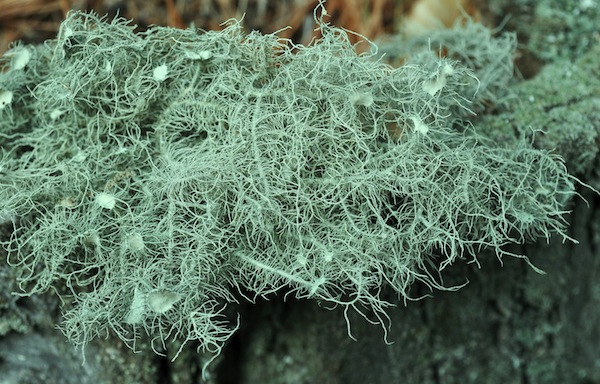
BIORSERVE FLORA OF THE MONTH – Old Man’s Beard (Usnea strigosa)
Old Man’s Beard is a form of lichen. Lichens are a combination of fungi and algae in a symbiotic relationship. Symbiosis is a mutual relationship that benefits both. The fungal partner in the old man’s beard retains water required for both to function and also breaks down organic matter into mineral nutrients. The green alga uses the energy from the sun, photosynthesis, to manufacture food from carbon dioxide and water.
The actual vegetative body of a lichen is called a thallus. The thallus of the old man’s beard is bushy consisting of multiple grey to green branches commonly about four inches long. Under ideal growing conditions these branches can reach seven to eight inches in length. Old man’s beard is usually found growing on the branches of oak, but is often found on other deciduous trees and occasionally on some evergreen tree species.
The world range of old man’s beard is still being mapped. In North America they are found wherever conditions are conducive to their existence.
Old man’s beard reproduces asexually through vegetative fragmentation when filaments of the thallus are broken off by weather, birds or by other means and land on a receptive surface. Lichens also produce soredia. Soredia are tiny reproductive vehicles composed of both the lichen’s fungal hyphae and its algae. They are dispersed into the air. Sexually, the fungal part of the lichen can reproduce by spores.
Old man’s beard can be used as an air quality indicator. It is one of many lichen species very sensitive to dirty air. Sulphur dioxide, nitrous oxide, heavy metals, acid rain all stunt the growth of lichens and if persistent enough eliminate them entirely.
Usnea family lichens have many ancient and modern uses. One of the oldest is as a source of dye for fabrics and textiles.
Old man’s beard also has a long history of use as an antibiotic and antifungal agent and was commonly used to treat wounds.
Old man’s beard is common in local woodlands, but it can be especially luxuriant along the coast nourished by frequent fog and high humidity. Watch for it.
BIORESERVE FAUNA OF THE MONTH – Red Bat (Lasiurus borealis)
With a wingspan averaging 1 foot and foxy-red to blond in color, the red bat is easy to distinguish from the other seven bat species that one might encounter in Massachusetts. These bats are also easy to spot because they often fly during daylight early in the evening and occasionally may be found flying about even earlier on cloudy, overcast days.
Despite their bright color red bats usually roost in hardwood trees blending in amazingly well. In the Southeastern Massachusetts Bioreserve (SMB) they particularly favor oak, hiding themselves among the older, drier oak leaves.
In the Southeastern Massachusetts Bioreserve (SMB) the red bat is most frequently seen in late fall when large numbers of migrating red bats join local relatives in feasting on emerging fall and winter moths. These bats also prey on beetles, flying ants and other flying insects. Their insect prey can detect their echolocation hunting calls and will take evasive action by darting to the side, climbing steeply or dropping toward the ground. Although the flying insect attempting to evade capture often cannot be seen, the chase can easily be followed by watching the darting, sharp turns, dropping and swooping flight of the feeding bat.
You might have heard of a bat disease, white-nose syndrome, Pseudogymnoascus destructans, that appeared in New York in 2006 and now has spread throughout the eastern United States and adjacent Canada. It has killed millions of bats that hibernate in colonies. Red bats are fortunate. As a relatively solitary species that does not hibernate in caves, but instead migrates, red bats do not appear to be effected by this deadly disease.
Along with our red bats, silver haired bats and hoary bats also migrate south for the winter. All our other local bat species are hibernators
Wide ranging, red bats are found from extreme southern Canada, across the United States east of the Great Plains and then south into eastern Mexico and on down through Central America.
Red bats mate while on the wing in September, but ovulation and fertilization does not occur until April. After mating males go off to a solitary life in the forest. Females give birth in late May to usually two, sometimes four young while roosting in densely foliaged trees. The bat babies, called pups, cling to their mother. When night falls she places the young among camouflaging leaves and goes off to feed. If predators appear, the female will carry each baby to a new, safer tree top location. Females stay close to the young until they are weaned.
Young red bat bats start learning to fly when three weeks old and spend a few more weeks with their mother perfecting their flying and learning insect hunting skills.
Red bat predators include most forest hawks and owls as well as tree climbing carnivorous mammals. Tree climbing black racer snakes are not averse to eating red bats and their young if they come upon them while searching trees for bird eggs and hatchlings.
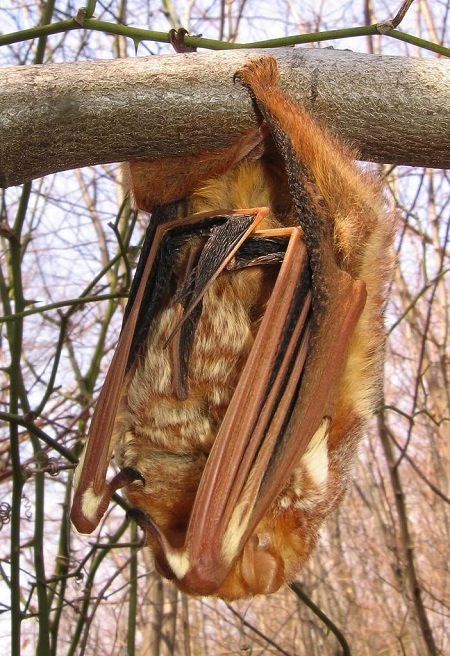
- Eastern red bat. Photo by Anita Gould, courtesy of Creative Commons.
FALL FUNGI – Intrigued? Interested? Hungry?
Every fall we get requests from folks who want to learn about their mushroom neighbors. Although The Trustees of Reservations, Audubon, us and others occasionally offer a fall “mushroom walk,” the average couple-of-hours walk does little more than skim the surface of an immensely fascinating and complex subject.
Is there a mycologist or maybe just a foraging mycophagist lurking inside of you and wanting to get out and learn more? Perhaps you simply want to know the names of all those colorful mushrooms you meet when on a fall hike in area woodlands?
If any of the above, here’s your chance for a few days of total ‘shroom immersion with some of the most knowledgeable folks in the field. Intended for beginners, you might want to check this out: http://www.worldfellowship.org/ai1ec_event/2907/?instance_id=362
TAUNTON RIVER WATERSHED ALLIANCE, ETC. – Fishing Contest and Teen Photo Activity and other things to do outdoors
TRWA has a Family Fishing Event coming up in July at Dighton Rock State Park. The river is rather shallow at that location and fish might not be too cooperative, but we’re sure kids will have a great time whether the fish bite or not. For info go here:https://mail.google.com/mail/u/0/?tab=wm#inbox/146b3e76bafbe40a
For Teen Nature Photography click on this: https://mail.google.com/mail/u/0/?tab=wm#inbox/146b3e74de6fc92b
The days are slowly getting shorter as our sun heads back toward the equator. Don’t let summer slip away. For other summer environmental activities and events click on our Calendar.
Happy Summer!!!!
<Back
Social